
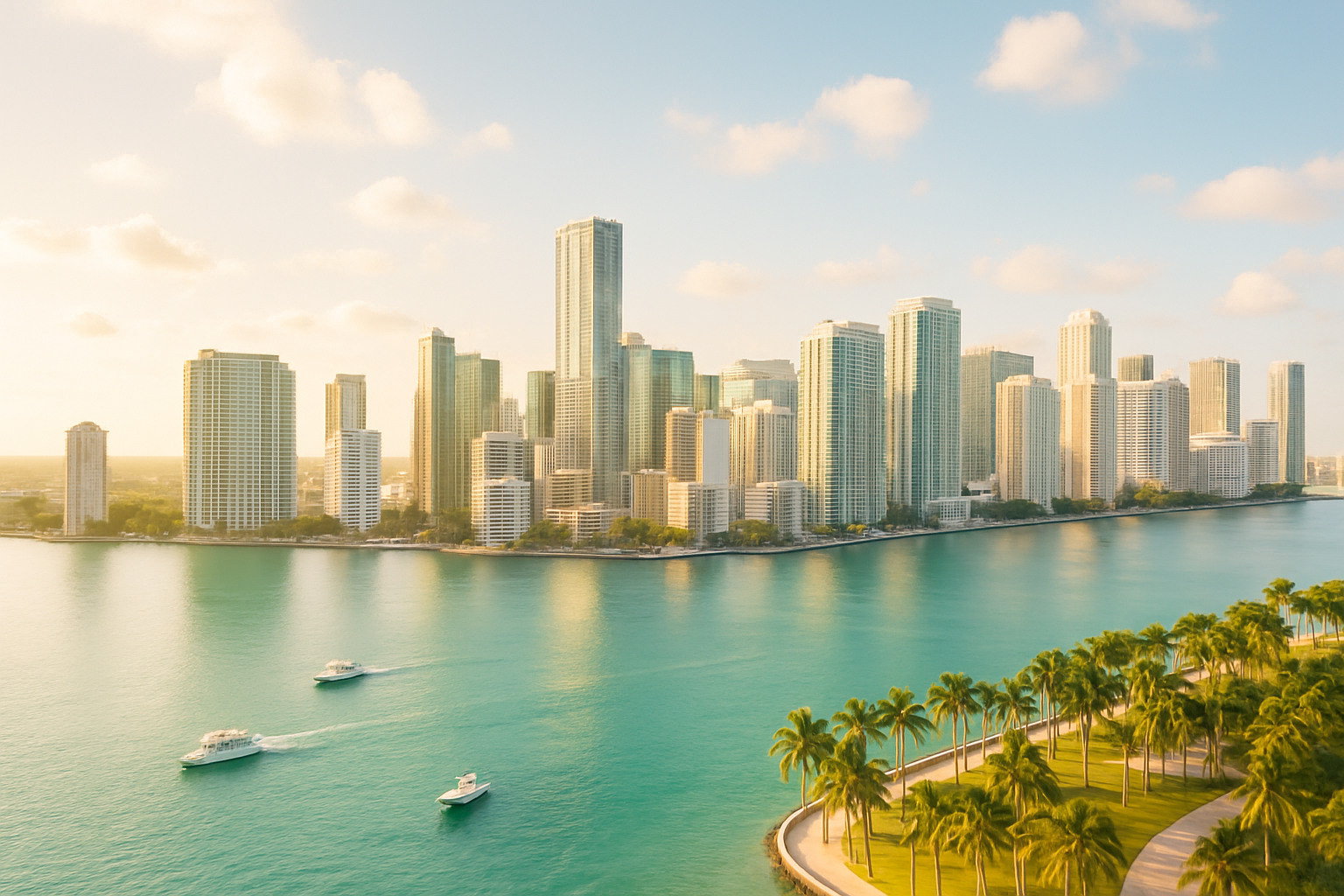
Billionaires Flood Miami: Wealth Migration and the New American Geography
The Million Dollar Question: When Ken Griffin moved Citadel’s headquarters out of Chicago, which city did he pick — and how much of Palm Beach has he quietly bought?
A) Dallas / ~5 acres B) Miami / ~27 acres C) Nashville / ~12 acres D) Austin / ~40 acresRead on for the answer.
Over the past few years, a certain kind of moving truck has been rolling south. It carries hedge fund servers, art collections, and the residency paperwork of people worth more than some countries. The headlines make it look like a celebrity story — Griffin here, Bezos there — but the real story is a measurable shift in where American money lives, and what happens to the cities on both ends of the move. This piece explains who is actually moving, why, how big the flow really is, and who pays for it.
What it is
“Wealth migration” is the unglamorous term for a very glamorous-looking trend: high-income households and the companies they run relocating from high-tax states — mostly New York, California, Illinois, and New Jersey — to low-tax ones, above all Florida and Texas, with Tennessee and the Carolinas catching the overflow.
It comes in two flavors. The first is corporate: a company moves its headquarters or opens a major second office. When Ken Griffin’s Citadel announced in 2022 that it was moving its headquarters from Chicago to Miami, that was the corporate flavor. The second is personal: an individual changes their legal domicile, buys a house, and starts paying taxes (or not paying them) somewhere new. When Jeff Bezos announced in late 2023 that he was leaving Seattle for Miami, that was the personal flavor.
The two feed each other. A firm relocates, its senior people follow, their households arrive, and the local market for everything from private schools to waterfront lots tightens. Miami has become the poster city for the whole phenomenon, but the pattern is national. It’s less a single migration than a slow redrawing of the map of where wealth is headquartered.
Who’s actually moving
Start with the marquee names, because they set the tone. Ken Griffin — worth roughly $44.5 billion by Forbes’ 2025 count, and higher on some indices — didn’t just move a headquarters. He assembled a Palm Beach compound of roughly 27 acres that Robb Report and others have valued near $1 billion, anchored by a record-breaking $99.1 million land purchase in 2019. Citadel is building a waterfront headquarters tower in Miami’s Brickell financial district that reporting has pegged as a $1 billion-plus project.
Jeff Bezos went further, faster, in a smaller footprint. Between August 2023 and 2024 he bought three estates on Indian Creek — the guarded island locals call the “Billionaire Bunker” — for $68 million, then $79 million, then $87 million, a roughly $234 million cluster of neighboring lots. At the time he made the move, Forbes put his net worth above $155 billion.
Bezos’s move had a work rationale layered under the tax one: his rocket company, Blue Origin, does much of its manufacturing and launching out of Cape Canaveral, a couple of hours up the coast. That’s a useful reminder that these decisions rarely have a single motive — proximity, family, and business logistics ride along with the spreadsheet.
Behind the two billionaires is a thicker layer of finance and tech. Hedge funds and trading firms including Point72, Millennium, and Schonfeld have built out Florida operations alongside Citadel. Venture capital followed: Andreessen Horowitz opened a Miami Beach office, and firms like Founders Fund and SoftBank planted flags in the area. But the layer that actually moves the numbers isn’t famous at all. It’s the anonymous $200,000-and-up household — the partner, the portfolio manager, the founder who just had a liquidity event — repeated tens of thousands of times. The billionaires are the billboard; these households are the traffic.
Why they’re going
The first reason is the simplest: Florida has no state income tax, a policy written into its constitution. For a household earning ordinary income in New York City or California, the combined state-and-local top rate can approach or exceed the low double digits; in Florida it’s zero. The higher the income, the larger the check that difference represents. This is the core of the #06 Taxes logic — wealth doesn’t just seek returns, it seeks structures that preserve them.
But taxes alone don’t explain it, or everyone would have left decades ago. Three other things changed. Remote and hybrid work loosened the tether to a specific office, so a portfolio manager could live in Miami and still touch New York. The pandemic made warm, outdoor, lower-density living newly attractive. And a cluster effect kicked in: once enough peers, deals, and dinners moved south, staying put started to feel like being off the map. Griffin himself has pointed to quality-of-life and safety concerns in Chicago as part of his calculus, citing crime near employees and the city’s fiscal trajectory.
Politics runs underneath all of it, and it cuts both ways. Florida marketed itself aggressively as business-friendly and light on regulation. Meanwhile the receiving end of the anger became vivid in New York, where mayor Zohran Mamdani won in 2025 on a platform of taxing the wealthiest residents and corporations — and Griffin responded by signaling that Citadel’s future growth would tilt toward Miami rather than New York. For a certain investor, the move is as much a statement as a spreadsheet.
One underappreciated wrinkle: changing your tax domicile is not as simple as buying a house and forwarding your mail. High-tax states audit departing high earners aggressively, and the burden of proof falls on the person leaving to show they’ve genuinely cut ties — days spent in-state, where the family lives, where the doctors and the dog are. That’s part of why the serious movers don’t dabble; they relocate their whole center of gravity. A pied-à-terre in Miami and a life still lived in Manhattan is the fastest way to end up paying both.
How the money shows up
The migration is easy to dismiss as vibes and press releases until you look at the tax data, which is where it stops being anecdotal. The IRS tracks income that physically moves across state lines when people file from new addresses. In the most recent full year of that data, Florida gained a net $20.6 billion in adjusted gross income, the largest gain in the country. The losers were exactly who you’d guess: California shed $11.9 billion, New York $9.9 billion, Illinois $6 billion, Massachusetts $4 billion, and New Jersey $2.6 billion.
Crucially, this isn’t retirees on fixed incomes. Florida gained a net of more than 50,000 residents earning above $200,000, and the average income of people moving to Florida from another state was around $122,530 — the highest of any state. This is high-earning income relocating, not just people.
The wealth-counting firms tell the same story from the top. Henley & Partners, which tracks millionaire populations city by city, found that Miami’s millionaire count grew 94% between 2014 and 2024, to just under 39,000 — one of the fastest jumps of any major city on earth, with roughly 180 centi-millionaires (people worth $100 million-plus). Nearby West Palm Beach more than doubled its millionaire population over the same decade, and Scottsdale, Arizona, another no-drama, low-tax sunbelt magnet, grew even faster.
But scale matters, and here’s the part the “everyone’s fleeing” headlines skip: New York still tops the global list in absolute terms with around 384,500 high-net-worth residents, and the San Francisco Bay Area holds roughly 342,400, including the country’s densest cluster of billionaires. The old capitals are still enormous. They’re leaking at the margin, not collapsing — but the margin is exactly where the newest, most mobile money sits, which is why a relatively small percentage shift produces such dramatic dollar figures and such loud headlines.
What it costs (and what it saves)
For the mover, the appeal is a piece of tax arithmetic. Take a household with $5 million in ordinary annual income in a state with a ~10% top rate. Escaping that rate is worth on the order of $500,000 a year, every year, before you factor in capital gains and estate-planning advantages. Against numbers like that, even an eight-figure trophy house can pencil out over a long enough horizon — which is part of why Griffin and Bezos treat South Florida real estate as a place to park hundreds of millions rather than a splurge.
The trouble is that the same math has repriced the destination. As of early-to-mid 2025 the typical Miami home was around $510,000, roughly 30% higher than six years earlier, and rents had climbed more than 40% in four years, leaving Miami ranked the least affordable rental market of 182 U.S. cities studied. In Miami-Dade, homes priced below $400,000 fell to about 2% of active single-family listings, while some 42% were listed above $1 million.
So the cost depends entirely on which side of the move you’re on. For the arriving nine-figure buyer, Miami is a bargain wrapped in sunshine and zero income tax. For the schoolteacher or line cook who already lived there, the same inflows show up as a rent check that no longer fits the paycheck. Both experiences are produced by the same event.
Hidden costs and tradeoffs
Even for the wealthy, Florida isn’t a free lunch. The most immediate catch is insurance. Property insurance in hurricane-exposed South Florida has become expensive and, in places, hard to get at all — a recurring, rising line item that partially offsets the income-tax savings, especially for waterfront trophy homes that sit directly in harm’s way. Climate risk isn’t an abstraction here; it’s an actuarial one, priced into every premium and, increasingly, every mortgage.
Then there’s the civic bill, which lands on the receiving city as a whole. Between 2024 and 2025 more than 10,000 people left Miami, many of them aged 20 to 29, priced out by a cost of living that had climbed roughly 20% above the national average. Retail and service workers — the people who staff the restaurants, hospitals, and classrooms the new arrivals rely on — have been leaving in the thousands. A city can gain 39,000 millionaires and still hollow out if it loses the workforce that makes daily life run.
For the mover personally, the softer tradeoffs are real too: distance from established networks, the awkwardness of being a newcomer in a place with its own deep-rooted culture, and the quiet discovery that a beautiful climate doesn’t relocate your family, your doctors, or your friendships along with your tax domicile.
What people get wrong
The biggest misconception is that a rising tide lifts everyone. Boosters describe the influx as pure economic good news, and for landlords, developers, luxury retailers, and the tax base it largely is. But the same forces dissolving the middle class are a direct consequence of the boom, not a separate problem. A city can get richer and less livable at the same time, and Miami is the case study.
The second mistake is assuming middle earners can copy the playbook. The tax savings that make the move obviously worth it scale with income; on a $150,000 salary, Florida’s zero income tax is real but modest, and it can be swallowed whole by higher housing and insurance costs. The move that’s a slam dunk at $5 million a year can be a wash or a loss at $150,000. It is not a universally winning strategy dressed up as one.
The third mistake is treating the move as total and permanent. Griffin didn’t abandon New York — Citadel still advanced plans for a multibillion-dollar Park Avenue tower, even as he threatened to freeze expansion there. The tech version of this story is instructive: firms decamped from California to Austin, and then some, like Oracle, moved on again to Nashville. Capital that moves for tax and mood can move again for the same reasons.
Bottom line
So, the Million Dollar Question: Ken Griffin moved Citadel to Miami (answer B), and quietly assembled a Palm Beach compound of roughly 27 acres valued near $1 billion. That’s the headline. The deeper answer is that the headline is the smallest part of the story. Underneath the two or three famous names is a broad, documented flow — $20.6 billion of net income into Florida in a single year, Miami’s millionaire ranks up 94% in a decade — that is genuinely reshaping American economic geography.
Is it permanent or cyclical? The honest answer is both. The tax advantage is structural and durable, so the wealth already anchored in South Florida is unlikely to reverse en masse. But the marginal, most-mobile money that drove the recent surge chases climate, politics, and peer clusters as much as tax rates, and those can shift — as the Austin-to-Nashville hop already shows. Miami has changed permanently; whether it keeps winning the next round of migration is an open question. What’s not in doubt is who’s carrying the cost of the round it already won.
Related reading: ZIP Codes: Where the Wealthy Live · Taxes: How Wealth Is Structured and Preserved · Hedge Funds and Private Equity: The Other Engine of Modern Finance Wealth · Houses: First Homes, Second Homes, and Estates · Residency and Citizenship: Why the Wealthy Buy Options Across Borders