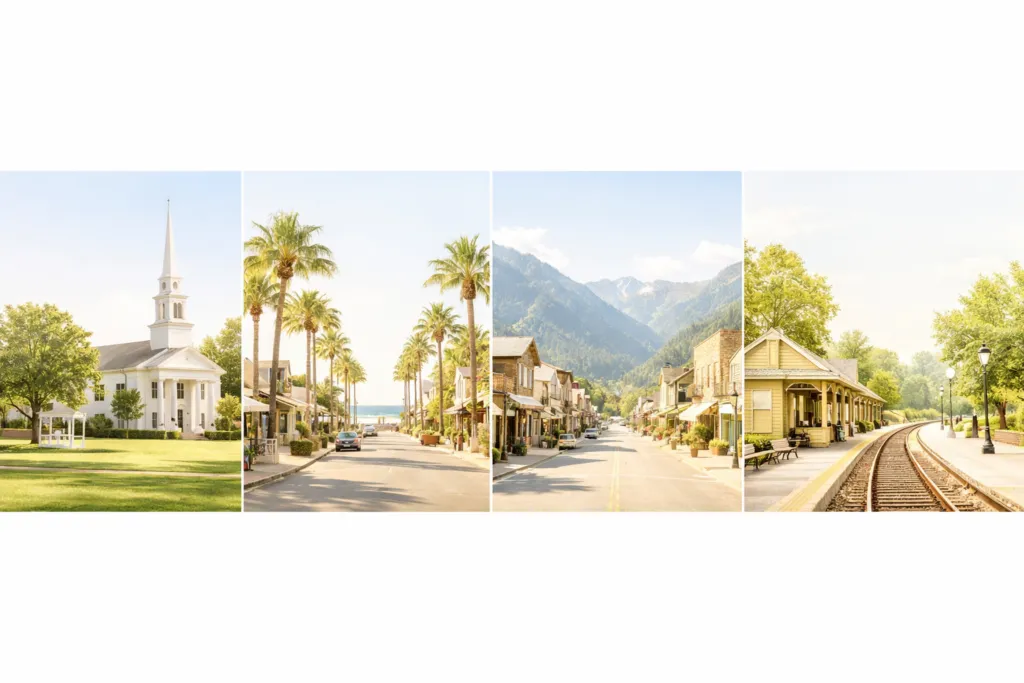
The Million Dollar Question: Of Atherton, CA; Scarsdale, NY; Palm Beach, FL; and Jackson, WY — the four towns that keep showing up at the top of “richest town in America” lists — which one has the fewest year-round residents?
Read on for the answer.
Ask “what’s the richest town in America” and you’ll get at least four different answers, and all four are defensible. One list crowns a Silicon Valley enclave of under 7,000 people. Another crowns a New York suburb an hour from Manhattan. A third crowns a Wyoming ski town. A fourth crowns a barrier island off the coast of Florida. None of the rankings is wrong — they’re measuring different things, counting different towns, and drawing the line between “town” and “not big enough to count” in different places. Laying them side by side is the fastest way to understand what “rich” actually means when it’s attached to a place rather than a person.
What it is — four different questions wearing one headline
“Richest town” sounds like a single fact, but it’s really shorthand for at least four separate questions: Which town has the highest average household income? Which has the highest median household income? Which has the most expensive homes? And which has the most millionaires or billionaires per resident? Those four questions produce four different leaderboards, because average income gets dragged upward by a handful of very large earners in a way median income doesn’t, home values track something closer to land scarcity than income, and millionaire density is a headcount question that has almost nothing to do with any of the other three. A town can lead one list and not even qualify for another, simply because the people compiling that list set a minimum population or household count that excludes it.
Every ranking below also comes from a different organization, using a different Census vintage, a different definition of “town,” and a different population floor — which is exactly why the same handful of places keep reappearing without ever agreeing on who’s actually number one.
Even the word “town” is doing more work than it looks like. Atherton and Cherry Hills Village are legally towns; Scarsdale is a village; Palm Beach is a town that functions more like an island resort community; Jackson is a town inside a county, Teton, that is vastly wealthier and vastly larger in area than the town itself. The Census Bureau classifies all of them differently again — as “Census-designated places,” incorporated municipalities, or pieces of a “micropolitan statistical area” — and which classification a ranking uses quietly decides which towns are even eligible to compete.
The income rankings — and they don’t agree with each other
The most-cited “richest town” ranking is built on Bloomberg’s income index, as last widely reported by The Independent, via Yahoo News, in February 2020: Atherton, California, with an average household income of roughly $525,324, topped the list “for the fourth year running,” with Scarsdale, New York in second place and Hillsborough and Los Altos Hills — both, like Atherton, in the San Francisco Bay Area — rounding out the top five alongside Cherry Hills Village, Colorado. The methodology only considered Census-designated places with at least 2,000 households, about 6,280 of them nationwide, and ranked them by mean (average) household income rather than the median. That index hasn’t been re-published at the same scale since, so treat “fourth consecutive year” as a 2020 snapshot, not a live 2026 ranking — though as the Census data below shows, Atherton hasn’t exactly gotten any poorer since.
A newer, differently built ranking tells a different story at the top. GOBankingRates’ “America’s Wealthiest Suburbs” list, relayed by the Palm Beach Daily News, used 2022 American Community Survey data and Zillow home values, but restricted its universe to suburbs of the country’s largest metro areas with at least 5,000 households — a higher floor than Bloomberg’s, which pushes some small enclaves out entirely. On that list, Scarsdale takes first place outright, with an average household income of $568,942 and a typical home value of $1.41 million, followed by Rye, New York and West University Place, Texas. Palm Beach, Florida lands at 11th, with an average household income of $365,991 and a typical home value of $11.57 million — a home-price figure more than eight times higher than Scarsdale’s despite a lower income ranking, itself a preview of the next disagreement.
Two “richest town by income” rankings, two different winners, and the gap isn’t a mistake — it’s the population floor and the Census vintage doing the work. Change who’s allowed on the list and the answer changes with it.
The home-price ranking puts a different town on top
Income and home value often move together, but not always, and nowhere is that clearer than in Jackson, Wyoming. LendingTree’s analysis of 2024 Census American Community Survey data, covering “micropolitan” areas with 10,000 to 49,999 residents, ranks Jackson at third nationally for median home value, at $1,075,500 — behind only Nantucket, Massachusetts ($1,593,800) and Vineyard Haven, Massachusetts ($1,165,800), both island communities with extreme land scarcity. Notice what’s missing from that list entirely: Atherton, Scarsdale, and Palm Beach. All three fall under LendingTree’s 10,000-resident floor, which simply excludes them from this particular ranking regardless of how expensive their homes actually are — Atherton’s own Census QuickFacts page reports median home value as “$2,000,000+,” a figure so high the Census Bureau’s own public tool won’t publish an exact number, only a top-coded floor.
Jackson’s home prices track land scarcity (most of Teton County is federally protected wilderness, national park, or national forest, leaving a sliver of private land to build on) combined with no Wyoming state income tax, a combination that has made it one of the most expensive small housing markets in the country even though, as a town, its year-round population is modest.
The millionaire-density ranking crowns yet another set of towns
A fourth way to ask the question — not “how much do residents earn” or “how expensive are the homes” but “what share of households are millionaires” — produces yet another leaderboard. Using data from Phoenix Marketing International, Kiplinger’s ranking of small towns by millionaire-household concentration put Los Alamos, New Mexico at number one, with 13.2% of households qualifying as millionaires (at least $1 million in investable assets, not counting primary residence), followed by Summit Park, Utah (home to Park City) at 13.0%. Jackson, Wyoming (combined with a small slice of Idaho in the same micropolitan area) landed roughly 10th, at 8.7% — 1,236 millionaire households out of 12,894 total. For comparison, the same dataset put the national millionaire-household rate at 6.7%.
Neither Atherton, Scarsdale, nor Palm Beach appears on that list at all — again, a population-floor issue, since Phoenix Marketing International’s “small town” category is built from the same 10,000-to-50,000-resident micropolitan definition LendingTree uses. The towns that top income rankings and the towns that top millionaire-density rankings are, for the most part, simply too differently sized to ever compete on the same list.
The billionaire-count ranking — and Palm Beach’s two very different numbers
Move up from millionaires to billionaires, and Palm Beach takes the lead — but even here, the exact count depends on how you ask the question. 24/7 Wall St’s analysis of the Forbes Real Time Billionaires List, counted by city of residence as of December 31, 2024, found 24 billionaires living in Palm Beach with a combined net worth of $126.7 billion, tying it for fifth place among U.S. cities and towns of any size — behind only New York (109 billionaires), San Francisco (50), Los Angeles (35), and Dallas (tied with Palm Beach at 24). The same count put Atherton at 11 billionaires worth a combined $73.4 billion, and Jackson, Wyoming at 4 billionaires worth $55.4 billion — a striking figure, since it means Jackson’s tiny population of billionaires is worth, on average, far more per person than almost anywhere else on the list.
A separate, more recent count produces a much bigger Palm Beach number. A Palm Beach Daily News analysis of the 2026 Forbes World’s Billionaires List, released March 10, 2026, counted at least 65 billionaires with residential ties to Palm Beach, worth a combined $649 billion — including hedge fund manager Ken Griffin ($49.8 billion, up from $42.3 billion the year before), Interactive Brokers founder Thomas Peterffy ($82.9 billion, Palm Beach’s richest resident and 23rd-richest person in the world), Koch Industries heir Julia Koch and family ($81.2 billion), Blackstone’s Stephen Schwarzman ($38.3 billion), Fidelity’s Abigail Johnson ($33.2 billion), and Donald Trump ($6.5 billion). The gap between 24 and 65 isn’t a contradiction — “by city of residence” counts a billionaire’s single primary address, while “ties to Palm Beach” counts anyone with a home there, however many other homes they also own. Both numbers are real; they’re just answering different questions, the same way the income and home-value rankings above are.
Who actually lives in these towns
The four towns don’t just disagree on rankings — they’re populated by different kinds of wealth entirely. Scarsdale is overwhelmingly a commuter town: its Metro-North line puts Grand Central roughly 35 minutes away, and its households are typically anchored by one or two high earners in finance, law, or medicine who draw a salary and bonus rather than living off investment income. Atherton and its Bay Area neighbors skew toward founders, early employees, and venture investors whose wealth is concentrated in equity — often illiquid, often tied to a single company’s stock price, which is part of why a town like Atherton can look staggeringly rich on an income survey one year and noticeably less so the next if a local company’s valuation drops. Palm Beach’s wealth is older and more portable: hedge fund managers, heirs to industrial fortunes, and retirees who relocated at least in part for Florida’s lack of a state income tax, with a seasonal population that swells well beyond the roughly 9,200 year-round residents during the winter social season. Jackson’s wealthy residents are the most varied of the four — ranchers and old land-wealth families alongside a newer wave of remote financiers and tech executives who can live anywhere and chose a place with no state income tax, excellent skiing, and a strict cap on development that keeps supply scarce.
The weekly email
How wealth actually works, once a week
The new explainers, the Million Dollar Question and the numbers behind them, in one short email. Free, and no ads.
We send a confirmation link first. One-click unsubscribe in every email; your address is never shared.
Why the same handful of towns keep reappearing
Despite four disagreeing rankings, the same few names surface again and again, and the pattern underneath is consistent: very small, very low-tax, very land-constrained places where a comparatively small number of very high earners make up an outsized share of the population. Florida and Wyoming have no state income tax, which pulls high earners toward Palm Beach and Jackson regardless of which ranking you check. Atherton, Scarsdale, and the Bay Area towns around Atherton benefit from proximity to concentrated technology and finance wealth combined with tightly restricted housing supply — Atherton has long capped new construction and has no commercial zoning at all, which keeps the number of households small and the average income per household high almost by construction. Jackson’s land scarcity is a product of geography rather than zoning: roughly 97% of Teton County is federal land, leaving a thin ribbon of private, buildable land to absorb an enormous amount of demand.
What people get wrong
The most common mistake is treating “richest town in America” as a settled, singular fact rather than a methodology question. The honest answer is always “richest by which measure, among which towns, using whose data” — and a ranking’s silence about its own population floor is usually the reason a town you’d expect to see (Atherton, on a home-value list; Scarsdale, on a millionaire-density list) is nowhere to be found.
The second mistake is confusing a county’s wealth with its namesake town’s. Teton County, Wyoming’s eye-popping per capita income figure — $532,903 in 2024, about 7.3 times the national average, according to an analysis by Jackson town councilman Jonathan Schechter — describes the entire county, not the town of Jackson specifically, and 77% of that figure is investment income rather than wages, which is a very different kind of wealth than a paycheck-based town like Scarsdale. It’s worth noting that figure comes from a local newsletter analysis rather than a named federal statistical release, which is itself a reminder to check who produced a number before repeating it.
The third mistake is treating mean (average) and median income as interchangeable, the same confusion covered at the national level in our median-vs-average net worth piece — a handful of very large incomes in a town of only a few thousand households can pull the average far above where most residents actually sit, which is exactly the dynamic that let Atherton’s small size become an advantage on income rankings rather than a disqualifier.
The fourth mistake is assuming everyone in a “richest town” is actually rich. Median figures already smooth over wide internal variation, but even they hide it: a town’s school staff, municipal employees, and service workers often live and work in the same ZIP code as its billionaires without coming anywhere close to the town’s own reported average. A “richest town” ranking describes a place’s statistical center of gravity, not every resident in it.
Bottom line
The Final Answer is A — Atherton, California, with roughly 7,000 year-round residents, is the smallest of the four towns, and that’s not incidental to its ranking: a small, high-earning population is precisely what makes a place vulnerable to topping an average-income list while simultaneously getting excluded from rankings that set a higher population floor, like LendingTree’s home-value list or Kiplinger’s millionaire-density list. Palm Beach (pop. ~9,200) and Jackson (pop. ~11,000 in town proper) are also small by national standards, while Scarsdale, at roughly 18,000 residents, is the largest of the four and the one most likely to show up consistently across different kinds of rankings. The real lesson isn’t which town wins — it’s that “richest town in America” is never one number. It’s at least four: average income, median income, home value, and wealth concentration, each counting a different set of towns, and each one correct on its own terms.
Related reading: ZIP Codes: Where the Wealthy Live · Billionaire Places: Teterboro, St. Barths, and Sun Valley · The States With the Most Millionaires — and the Richest States, Measured Properly · The Most Expensive Houses in the World — and Who Actually Lives in Them · Median vs. Average Net Worth in America — and Where the Top 10% and 5% Begin
Methods and sources. The income rankings are Bloomberg’s “Richest Places in America” index as reported by The Independent/Yahoo News (Feb. 21, 2020) and GOBankingRates’ “America’s Wealthiest Suburbs,” relayed by the Palm Beach Daily News via AOL, using 2022 American Community Survey data and Zillow home values. The home-value ranking is LendingTree’s analysis of 2024 Census ACS 5-year estimates, updated Aug. 10, 2026. Atherton’s top-coded Census figures are from the Census Bureau’s QuickFacts page. The millionaire-density ranking is Kiplinger’s report using Phoenix Marketing International data. The billionaire counts are from 24/7 Wall St’s analysis of the Forbes Real Time Billionaires List (as of Dec. 31, 2024) and a Palm Beach Daily News analysis of the 2026 Forbes World’s Billionaires List (released March 10, 2026); every named individual’s net worth is a Forbes-published estimate, not an assertion of our own. Teton County’s per capita income figure is from an analysis by Jackson town councilman Jonathan Schechter, reported by Cowboy State Daily (Feb. 28, 2026). This is not financial or investment advice; home values and income figures are estimates that vary by source, methodology, and year. See Editorial Standards.