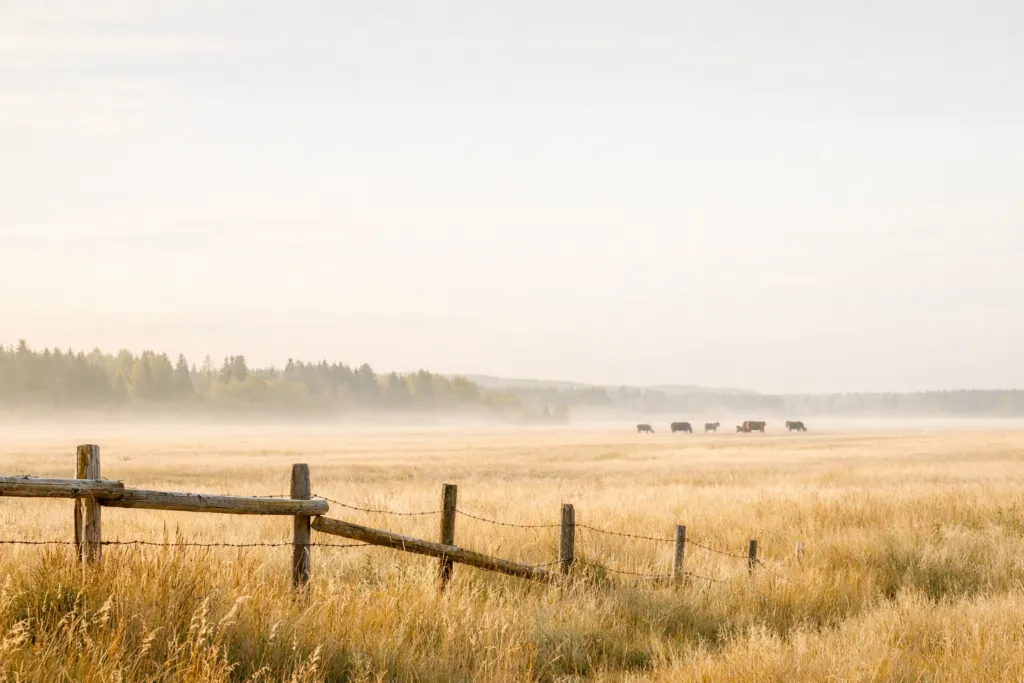
The Million Dollar Question: Of these four, who actually owns the most private land in America?
Read on for the answer.
For years, the internet’s go-to answer to “who owns the most land in America” has been Bill Gates — a meme sturdy enough to survive multiple fact-checks. It was never close to true, and in early 2026 the real answer changed anyway: a sports-team owner most people couldn’t pick out of a lineup quietly bought nearly a million acres of New Mexico ranchland in total secrecy and became the largest private landowner in the country, dethroning a California timber family that hadn’t lost that title in years.
What it is — a scoreboard almost nobody watches
“Largest landowners” is shorthand for a specific, closely tracked ranking: The Land Report’s annual Land Report 100, which has catalogued America’s biggest private holdings since 2007 by combining county tax records, financial filings, corporate press releases, and direct confirmation from landowners or their representatives where possible. It counts deeded acres — land the owner (or their company) actually holds title to — which is a meaningfully different number from leased or permitted acres, the grazing rights many Western ranchers hold on public land without owning it outright. Some entries on the list blend both and say so explicitly; a few, like the Robinson and Freed families’ Idaho operation, report more leased federal grazing allotments than deeded land.
It’s also worth being clear about what the list doesn’t include: the federal government itself, which owns roughly 640 million acres — more than a quarter of all land in the United States, concentrated heavily in the West. No private landowner, however large, is within two orders of magnitude of that number. The Land Report 100’s combined holdings, by contrast, run into the tens of millions of acres — genuinely enormous by any individual standard, but a rounding error against the federal estate.
Who’s on top now
As of early 2026, the largest private landowner in America is Stan Kroenke — owner of the Los Angeles Rams, Denver Nuggets, Colorado Avalanche, and a controlling stake in Arsenal FC — at an estimated 2.7 million acres, according to The Land Report. The move to #1 came from a single transaction: in December 2025, Kroenke’s ranching arm quietly bought the Singleton family’s New Mexico ranches — seven properties including Agua Verde, Bojax, Conchas, Lobo, Pecos, San Cristobal, and Trigg, assembled over decades by Teledyne founder Henry Singleton — totaling 937,950 acres. The Land Report calls it “by far the largest” ranch sale in American history, well ahead of the next-largest deals: Pennzoil’s 1996 sale of the Vermejo Ranch to Ted Turner (588,000 acres) and Kroenke’s own 2016 purchase of Texas’s Waggoner Ranch (roughly 535,000 acres). The sale price was never disclosed — both brokers declined to comment — though broker Sam Middleton told The Land Report that Singleton himself originally assembled most of the land decades ago for as little as $55 to $70 an acre.
The purchase pushed Kroenke from fourth place in 2025 to first in 2026, passing the family that had effectively owned the title for years.
Kroenke is better known to most Americans as a sports-team owner than a rancher — he controls the Los Angeles Rams, Denver Nuggets, Colorado Avalanche, Colorado Rapids, Colorado Mammoth, and a majority stake in Arsenal FC — but the land empire is older than the sports portfolio and, in his own telling, the more durable business. He built his first fortune developing shopping centers anchored by Walmart stores, a company his wife’s family founded; he married Ann Walton Kroenke, daughter of Walmart co-founder James “Bud” Walton, in 1974, and Forbes separately estimates her own net worth at roughly $14.6 billion. Beyond the new New Mexico acreage and the Waggoner Ranch, Kroenke’s holdings include British Columbia’s Douglas Lake Ranch, Canada’s largest working cattle ranch at more than 500,000 acres — land that doesn’t count toward his US ranking at all.
The rest of the top five
Second place now belongs to the Emmerson family, which built its roughly 2.44 million acres — mostly in California, Oregon, and Washington — through Sierra Pacific Industries, the company patriarch “Red” Emmerson built into the nation’s largest private timberland owner. It’s working land in the most literal sense: sawmills, window factories, and biomass power plants sit on or near much of it.
Third is cable pioneer John Malone, with roughly 2.2 million acres of forest and ranchland spread across Florida, Wyoming, New Mexico, and Colorado — according to Forbes, worth an estimated $11.5 billion, making him the 134th-richest American on the 2026 Forbes 400, with cable television as the original source of that fortune. Malone has held a top-five spot on the Land Report 100 for well over a decade.
Fourth is Ted Turner, at roughly 2 million acres — though that figure now describes an estate rather than a living owner. Turner, the CNN founder and the country’s largest private bison owner with a herd of roughly 45,000 head, died on May 6, 2026, at age 87, of complications from Lewy body dementia. His holdings span thirteen ranches across five states — New Mexico, Montana, Nebraska, Kansas, and South Dakota — anchored by the 560,000-acre Vermejo Park Ranch straddling New Mexico and Colorado, and the 113,600-acre Flying D Ranch in Montana, which already sits under a Nature Conservancy conservation easement. Turner Enterprises has stated that the lands will “continue to be protected, limiting future development and parcellation,” and at least one parcel — the 79,292-acre McGinley Ranch — has already been donated to the Turner Institute of Ecoagriculture. Beyond that, no public succession plan to his five children has been disclosed; his ranchland’s future is, for now, a continuation of his own conservation commitments rather than a confirmed inheritance story.
Fifth is the Reed family, owners of Green Diamond Resource Company, with roughly 1.615 million acres of sustainably managed timberland spread across eight states in the Pacific Northwest and the South.
Why Bill Gates isn’t actually #1
Bill Gates, through his investment vehicle Cascade Investment, owns roughly 275,000 acres of American farmland spread across 17 or more states — mostly used to grow row crops like onions, carrots, and the potatoes that supply McDonald’s fries. That’s a real and sizable holding — roughly a tenth the size of Kroenke’s — but it puts Gates at 44th on the Land Report 100, not first.
The “Bill Gates owns all the farmland” narrative took hold around 2021, when reporting first surfaced that he’d become America’s largest owner of farmland specifically — a genuinely narrower claim than “largest landowner” overall, since it excludes the ranchland, timberland, and rangeland that dominate the true top of the list. The distinction between “largest farmland owner” and “largest landowner” collapsed almost immediately in public conversation, and the simplified version — just “Gates owns the most land” — proved far stickier than the correction. Four years and a changed #1 later, it’s still the answer most people would guess first.
What it costs
Land this size doesn’t trade at a single price; it trades at wildly different per-acre prices depending on what the land is and where it sits. Henry Singleton assembled most of his New Mexico ranches decades ago for roughly $55 to $70 an acre — remote, semi-arid rangeland with limited agricultural use beyond grazing. Compare that to Kroenke’s 2016 purchase of the Waggoner Ranch in Texas — a 535,000-acre property that had belonged to one family since 1849, listed at $725 million (a final price was never disclosed, though people close to the deal said it came in somewhat below the asking figure) and including oil wells and 30,000 acres of farmland alongside the cattle operation. That works out to well over $1,000 an acre once the mineral rights and farmland are factored in — more than ten times what Singleton paid per acre in New Mexico, for land in a very different category.
Timberland and farmland price differently again: productive farmland in corn-belt states routinely trades well above $10,000 an acre, while remote Western grazing land can still be bought for a few hundred dollars an acre or less. The Land Report 100’s combined acreage, in other words, represents wildly different dollar values per acre — the ranking is a count of acres, not a count of dollars, and the two don’t track each other closely at this scale.
Hidden costs and tradeoffs
Owning millions of acres comes with costs that scale with the acreage itself: property taxes, fencing, water rights litigation, wildfire risk (acute for Western ranchland and timber holdings alike), and the sheer logistics of managing working land across several states. Several of the largest owners have offset some of that burden by trading future development rights for tax relief through conservation easements — Turner’s Flying D Ranch is one example, permanently restricted from subdivision in exchange for a reduced valuation.
The weekly email
How wealth actually works, once a week
The new explainers, the Million Dollar Question and the numbers behind them, in one short email. Free, and no ads.
We send a confirmation link first. One-click unsubscribe in every email; your address is never shared.
Land at this scale is also deeply illiquid. A publicly traded stock position worth billions can be sold in minutes; a 2.7-million-acre ranching empire cannot, which is part of why the Singleton-to-Kroenke sale took place in near-total secrecy and why final prices on deals this size routinely go undisclosed — there’s no efficient public market setting a continuously updated price, so negotiations happen one buyer and one broker at a time.
Water is its own hidden cost. Much of the ranchland on this list sits in the arid West, where water rights are often litigated separately from the land itself and can be worth more, acre for acre, than the surface ground they’re attached to; a ranch’s grazing capacity, and therefore its real value, can swing sharply with a single dry year or a single court ruling on a shared aquifer. Wildfire risk compounds the same geography problem for both ranching and timber operations — a single bad fire season can wipe out years of standing timber value for a family like the Emmersons, or force a ranching operation to destock herds it spent decades building. And land ownership at this scale doesn’t end cleanly at death: Turner’s passing leaves roughly 2 million acres with a stated conservation intent but no confirmed, public succession plan, which is itself a quiet reminder that even extraordinarily well-organized land empires can leave open questions behind.
What people get wrong
The biggest misconception, by far, is treating “largest landowner” and “largest farmland owner” as the same thing — which is how a man who owns less than 300,000 farming acres became shorthand for an entirely different, larger ranking he doesn’t come close to leading.
The second is assuming individual billionaires are the main force buying up American land at all. They aren’t, by a wide margin. Per the USDA’s most recent AFIDA data, compiled by farmdoc daily, foreign entities hold reportable interests in 46.3 million acres of US agricultural land as of the end of 2024 — forestland makes up 88.5% of that — with Canada alone accounting for 2.28 million acres, or 38% of confirmed foreign-owned acreage. That single country’s confirmed holding is already larger than Kroenke’s entire 2.7-million-acre ranching empire would need to be to rank; the total reportable foreign interest is roughly 170 times the size of Gates’s entire farmland portfolio. Whatever anxiety drives the “someone is buying up all our land” conversation, the actual numbers point far more toward foreign and institutional capital than toward any single American billionaire.
The third is assuming the largest landowner must also be the richest person — it doesn’t work that way. Malone’s $11.5 billion net worth and Gates’s roughly $122 billion both sit well above most of the names ahead of them on the Land Report 100, yet both own a fraction of Kroenke’s acreage; land ownership at this scale correlates more with a specific appetite for illiquid, management-intensive assets than with total net worth.
The fourth is conflating deeded and leased acreage. Several Land Report entries, including some in the top 50, blend owned land with long-term federal grazing permits or state leases; treating every acre on the list as equally “owned” overstates how much some entries have actually purchased outright.
Bottom line
The Final Answer is D — Stan Kroenke. At roughly 2.7 million acres, he passed the Emmerson family for the #1 spot in early 2026 on the strength of a single secret purchase of New Mexico ranchland, becoming the largest private landowner in the country. Bill Gates, despite years of internet shorthand to the contrary, ranks 44th, with about a tenth of Kroenke’s acreage and a portfolio limited to farmland rather than the ranching and timber empires that dominate the true top of the list. The pattern underneath the ranking is consistent even as the #1 name changes: the biggest private landholdings in America are built by families and companies with a specific tolerance for illiquid, debt-tolerant, generational assets — ranching, timber, and farmland operators — not simply by whoever happens to be richest, and not, despite the memes, by Bill Gates.
Related reading: Hunting and Sporting Estates: Land, Tradition, and the Sport of the Wealthy · Buying an Island: Privacy, Power, and the Ultimate Trophy · The Most Expensive Houses in the World — and Who Actually Lives in Them · Real Estate as an Investment: How the Wealthy Actually Use Property · The States With the Most Millionaires — and the Richest States, Measured Properly
Methods and sources. Rankings and acreage figures are from The Land Report’s Land Report 100, the trade publication that has tracked America’s largest private landowners since 2007, cross-checked against a September 2026 secondary aggregation of the same data. Details on the Singleton-to-Kroenke sale, including per-acre historical pricing, are from The Land Report’s “2025 Deal of the Year” report. Waggoner Ranch history and pricing are from the Dallas Morning News (Feb. 21, 2016). Ted Turner’s landholdings, death, and stated conservation plans are from DTN Progressive Farmer (May 6–7, 2026); his death and age are corroborated by the Associated Press, via WTOP (May 6, 2026). Bill Gates’s and John Malone’s wealth and landholding figures are from Fortune (Sept. 2, 2026) and each man’s real-time Forbes profile (Gates; Malone), accessed November 2026. Stan Kroenke’s and Ann Walton Kroenke’s net worth figures and the Douglas Lake Ranch detail are from Business Insider, via AOL, citing Forbes. Foreign ownership figures are from the USDA’s AFIDA program, as compiled and reported by farmdoc daily, University of Illinois (Sept. 23, 2026), covering holdings through December 31, 2024. Every named individual’s net worth or property valuation is a publisher’s estimate, not an assertion of our own, and acreage figures — especially ones involving leased or permitted land — can vary by source and survey method. This is not financial or investment advice. See Editorial Standards.