Billionaire Places: Teterboro, St. Barths, and Sun Valley
The Million Dollar Question: Jeff Bezos’s superyacht Koru — a fixture anchored off St. Barths every New Year’s — reportedly cost how much to build?
A) $75 million B) $200 million C) $350 million D) $500 millionRead on for the answer.
Most stories about where billionaires live are really about ZIP codes — permanent addresses, primary homes, the neighborhoods that show up on wealth-migration maps. But a lot of extreme wealth doesn’t live anywhere in particular. It passes through a small number of specific places, on a predictable schedule, in concentrations far higher than those places’ populations would suggest. A private airport across the river from Manhattan. A ten-square-mile French Caribbean island that fills up with more net worth over eight weeks than most countries hold. A ski town in central Idaho that empties out for ten months and, for two windows a year, becomes one of the most expensive square miles in America. None of the three is a home in the ordinary sense. That’s exactly what makes them worth understanding on their own terms.
What it is
Teterboro Airport, St. Barths, and Sun Valley, Idaho share a structural pattern even though they have almost nothing else in common: each concentrates an outsized share of billionaire activity for a short, predictable window rather than housing billionaires as permanent residents. Teterboro’s window is every business day — it’s the private-jet gateway that lets Manhattan-bound money skip the commercial terminals entirely. St. Barths’ window is the eight weeks around New Year’s, when the island’s harbor fills with more superyacht tonnage than almost anywhere else on earth. Sun Valley’s window runs longer — ski season plus a summer that includes, but isn’t defined by, the week in July when the Allen & Company conference takes over (a distinct phenomenon covered in our Conference Circuit piece). In all three cases, the place is a node the money moves through, not a ZIP code the money settles into.
Who uses it
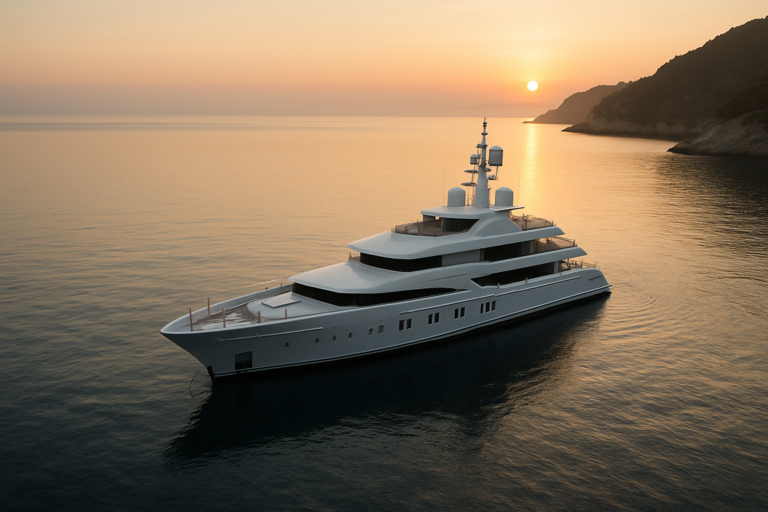
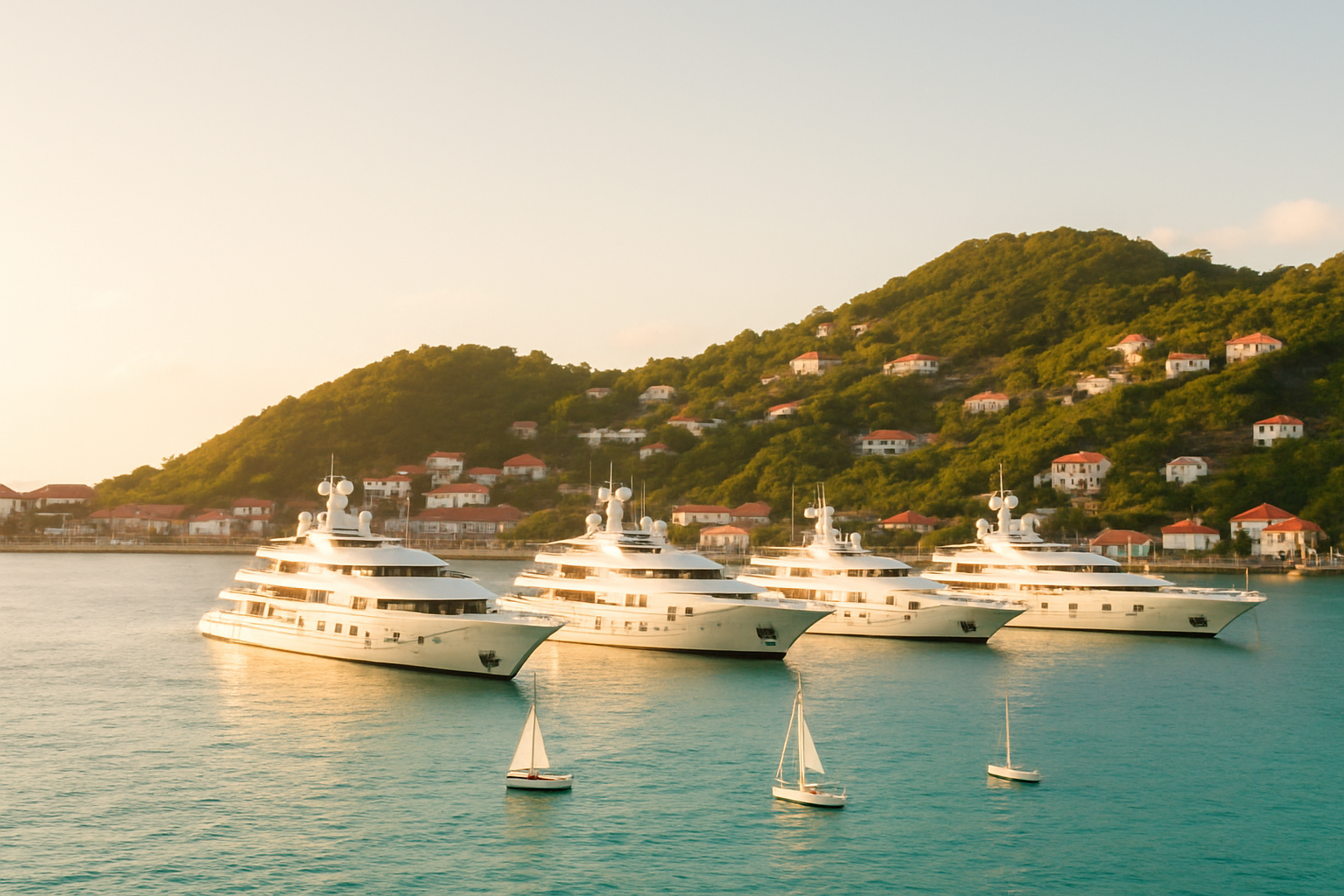
Teterboro’s traffic skews toward New York-based finance, media, and real-estate money making same-day round trips to Midtown, plus fractional-ownership clients — NetJets in particular has built out dedicated infrastructure there for its owner base. St. Barths draws the superyacht-owning tier specifically: this past New Year’s, Forbes tracked Jeff Bezos’s 417-foot Koru, WhatsApp co-founder Jan Koum’s 330-foot Moonrise, former Google CEO Eric Schmidt’s Whisper, and packaging magnate Graeme Hart’s Ulysses — currently the world’s largest expedition yacht — all anchored in the vicinity at once, part of a record 13 superyachts over 100 meters gathered for the holiday, more than Monaco saw on the same night. Sun Valley’s owners are a quieter, more residential crowd: second-home tech and entertainment wealth who hold property there year-round, a pattern that predates and outlasts the conference — Steve Jobs’s widow, Laurene Powell Jobs, bought a home in the area back in 2012 and has remained part of that landscape since. Unlike Teterboro’s daily commuters or St. Barths’ holiday flotilla, this group’s presence is mostly invisible outside ski season and the handful of midsummer weeks locals actually notice the traffic pick up.
Why they use it
Each place solves a different problem. Teterboro is pure time arbitrage: a 20-minute drive from Midtown beats hours of commercial-terminal friction, and it’s the only general-aviation airport near a major metro with the ramp capacity and fixed-base-operator infrastructure to absorb heavy-jet volume at scale — private-aviation trend reporting describes it as the anchor node in a recurring circuit that also runs to South Florida, Aspen, and Bozeman. That circuit framing matters: nobody picks Teterboro because they love New Jersey specifically, they pick it because it’s the fastest legal way to convert money into time on the one trip that actually matters, the last twenty minutes into Manhattan. St. Barths sells discretion and a specific kind of scarcity: French-territory privacy rules, no runway capable of handling a jet (more on that below), and a harbor culture where “who’s anchored off Gustavia” has become an actual, photographed status ranking every New Year’s Eve. Sun Valley sells something closer to genuine escape — a real ski-and-summer outdoors town, without the density Aspen or Jackson Hole have accumulated, built on four decades of quiet tech-money infrastructure that the Allen & Co. conference (running since 1983) helped seed but does not itself explain. In all three cases the appeal has very little to do with the place’s own natural charms and almost everything to do with what it lets money do more efficiently: land closer, dock more visibly, or disappear more completely.
How it works
Teterboro runs on hard infrastructure: 827 acres, 23 hangars, and more than 570,000 square feet of hangar space, according to airport-facility reporting. Starting in 2025, NetJets built a dedicated owner-only ramp, hangar space, and lounge there in partnership with Signature Aviation — infrastructure built specifically to keep its fractional-ownership clientele separate from general charter traffic. St. Barths works almost the opposite way: Gustaf III Airport’s short, cliff-side runway is famous for being unable to handle anything larger than a small turboprop, which means the actual superyacht fleet never touches the island’s own airstrip at all — owners fly into St. Martin or arrive by helicopter, then transfer to yachts anchored offshore, in Gustavia’s harbor or the coves around it. Sun Valley is the odd one out in that it’s a real town with a real housing stock, not a hotel circuit or a harbor — Ketchum’s luxury inventory includes homes like the newly built “River Lodge,” an 8,665-square-foot riverfront estate near the resort’s River Run lodge, designed by Ro Rockett Design, a California firm that builds similar high-end mountain homes in Aspen and Lake Tahoe, sitting in the same market as the modest houses year-round locals actually occupy. Access has historically been the limiting factor: the valley’s own small airport has run mostly seasonal, connection-dependent service through Boise or Salt Lake City, though 2026 brought new direct routes to eight major cities for the winter season — a sign the isolation that has long defined the place is loosening, slowly.
What it costs
Teterboro’s baseline cost is unglamorous compared to what follows: hangar space alone for a large-cabin jet in the Gulfstream 550 or Global 6000 class runs $20,000 to $30,000 a month, before fuel, crew, insurance, or the aircraft itself. St. Barths operates at a different order of magnitude. A suite at the Eden Rock hotel runs $30,000 to $40,000 a week in season, and a full top-tier week on the island — villa, staff, tenders — can run past $1 million all-in. The yachts themselves dwarf even that: Bezos’s Koru reportedly cost roughly $500 million to build, Koum’s Moonrise about $220 million, and Schmidt’s Whisper about $200 million, per Forbes’s holiday-season tracking. Graeme Hart’s Ulysses, also anchored in the harbor that week, holds a different distinction entirely — it’s the largest expedition yacht in the world, a category of ice-capable, go-anywhere vessel that barely existed as a purchasable option for private owners a decade ago and doesn’t have a widely reported price tag to match the others. St. Barths’ priciest sale wasn’t a yacht at all: businessman David Rockefeller built a villa in the hillside enclave of Colombier back in 1960, and Luxury Tribune reported it recently changed hands for $136 million — a figure that says as much about six decades of the island’s price appreciation as it does about any single buyer. Sun Valley sits at a lower, more conventional real-estate scale by comparison — median home prices above $1.5 million as of 2025, luxury estates routinely clearing $4 million, and the current most expensive listing in the state, the River Lodge, asking $36 million (owned, per BoiseDev’s reporting, by a Nevada-registered LLC rather than a publicly named individual). Laurene Powell Jobs, for comparison, paid a comparatively modest $4 million for her Sun Valley home back in 2012 — a price the market has since left far behind.
Hidden costs and tradeoffs
None of these places is free of friction for the money that uses them. Teterboro’s proximity has a real downside: Bergen County residents have pushed back for years on noise from the airport, and ramp and slot congestion during peak windows — holidays, the Super Bowl — can strand even NetJets-tier owners behind a queue. The airport also sits on just 827 acres with a fixed 23 hangars, which means demand for space has a hard ceiling that money alone can’t expand — a rare case in this world where more capital doesn’t automatically buy more room. St. Barths’ entire luxury economy is a bet on an eight-to-ten-week window; Gustaf III’s short runway physically caps how much of the crowd can land on the island itself rather than anchor offshore, and the hurricane season that dominates the rest of the calendar year keeps it a seasonal address, never a year-round one. Sun Valley’s isolation cuts both ways — the same remoteness that keeps it uncrowded means most visitors still fly private or connect through Boise or Salt Lake City, even as new direct routes have started chipping at that in 2026 — and a home bought for $4 million in 2012 now sits inside a market that has more than tripled, meaning today’s buyers are pricing in at 2025–2026 numbers a decade-plus removed from the deals that built the area’s tech-money reputation.
The people who actually live in these places year-round carry a cost the visiting money never sees. In Ketchum, the town next to the Sun Valley resort, the median home price hit $998,000 in 2024 against a local workforce earning a median of roughly $45,000 a year — a gap wide enough that hospital, school-district, and sheriff’s-office job candidates have turned down offers after doing the housing math, and some workers have ended up living out of trucks and trailers. The Bluebird Village affordable-housing project, built specifically for local workers, is the town’s attempt to patch that gap. St. Barths runs an even starker version of the same math on a 24-square-kilometer island of about 12,000 people: real estate prices have risen roughly 70% over the past decade, a 56-square-meter studio can list for €3 million, and locals interviewed by Luxury Tribune describe adult children sleeping on boats because they can’t afford housing on land despite both working full-time. Teterboro’s version is milder but real: it is Bergen County residents, not billionaires, who live with the noise.
What people get wrong
The most common mistake is treating these three the way you’d treat a wealthy ZIP code — as evidence of where billionaires “live.” None of them is that. Teterboro has essentially no residential population of its own; it’s a piece of transit infrastructure. St. Barths’ billionaire reputation is a harbor phenomenon, not a real-estate one — the money is mostly floating, not built on land, because there’s very little large-scale land left on a small French island to build on. And Sun Valley gets conflated constantly with the one week in July when Allen & Co. runs its conference there; the second-home ownership pattern this piece is actually about runs all winter and all summer, independent of — and older than — that single week of panels and photographed walks. Confusing “a place that hosts a famous event” with “a place people actually own homes in” flattens two genuinely different geographic patterns into one.
People also underrate how small these places physically are relative to their reputation. Teterboro is 827 acres — smaller than many single golf courses. St. Barths is 24 square kilometers, smaller than most American suburbs, with a year-round population of about 12,000. Ketchum’s entire downtown core could sit inside a few blocks of a mid-sized American city. None of the outsized wealth signal these places carry comes from scale; it comes from concentration, in a footprint that is, in every case, surprisingly modest.
Bottom line
The answer is D: Jeff Bezos’s Koru reportedly cost around $500 million to build — more than most billionaires’ primary residences, floating a few hundred yards off an island most of its passengers visit for one week a year. That’s the throughline across all three places. Teterboro exists to move people through as fast as possible, not to house them. St. Barths’ harbor fills to a global record for eight weeks and then empties. Sun Valley’s ownership pattern runs quietly all year, mostly invisible except for the one week everyone associates with it. Understanding the difference between wealth that lives somewhere and wealth that merely passes through explains a real, underappreciated slice of how the geography of money actually works.
Related reading: ZIP Codes: Where the Wealthy Live covers the permanent-residence geography this piece is the transit-and-seasonal counterpart to. The Conference Circuit is the direct disambiguation for Sun Valley — the Allen & Co. conference week versus the year-round second-home pattern covered here. Flying Private explains the mechanics and cost of the aviation this piece treats as a place rather than a system. Yachts is the companion piece on what it actually costs to own and run vessels like Koru, Moonrise, and Whisper.