
Real Estate as an Investment: How the Wealthy Actually Use Property
The Million Dollar Question: The IRS lets a landlord deduct a residential rental building’s cost over a fixed “useful life” — even while the building is going up in value. How long is that useful life?
A) 15 years B) 27.5 years C) 40 years D) 50 yearsRead on for the answer.
This piece is about real estate as an asset class — not the house you live in, but property bought to produce income, appreciation, and tax advantages. It explains the four main ways wealthy households hold it, why the tax code is half the return, and where the famous strategies (1031 exchanges, depreciation, opportunity zones) actually fit.
What it is
Investment real estate is property held to make money rather than to live in: apartment buildings, single-family rentals, warehouses, office and retail space, farmland, self-storage, raw land waiting for entitlement. It pays its owner in up to four ways at once — rent, appreciation, loan paydown by tenants, and tax treatment — and that stacking is what separates it from most other things a household can own. A stock can appreciate and pay a dividend; it cannot also shelter unrelated income from tax while a bank finances 70% of the position.
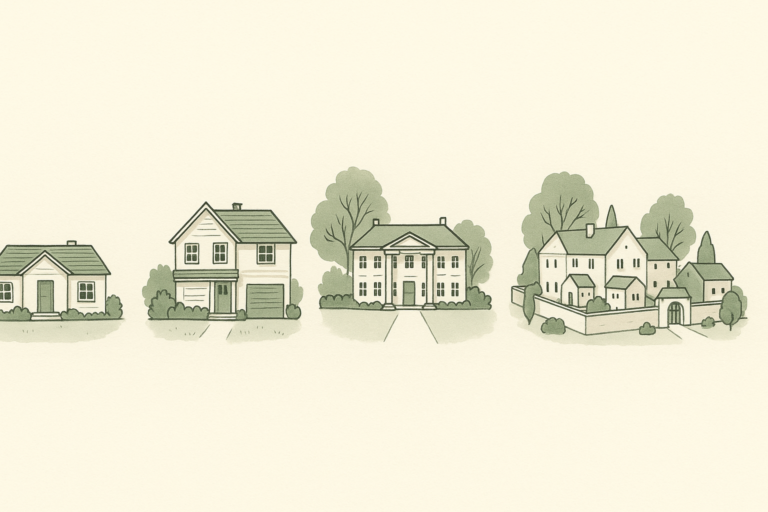
The asset class comes in four basic wrappers, and most of this piece is about which wrapper shows up at which wealth level. Direct ownership means holding title, usually through an LLC: maximum control, maximum tax benefit, maximum hassle. Syndications and private funds pool investor money under a sponsor who finds and runs the deals; investors are passive limited partners. REITs — real estate investment trusts — are companies that own portfolios of property and trade like stocks; Nareit counts roughly 170 million Americans holding REIT shares through retirement and brokerage accounts, against more than $4.5 trillion in gross real estate assets. And at the top, holding companies and family real estate offices run property as a multigenerational operating business.
One boundary to draw immediately: your primary residence is not an investment in this sense. It produces no income, and its “return” is mostly shelter you would otherwise rent. The lifestyle side of property — first homes, second homes, estates — is covered in Houses. This piece is about the asset class.
Who uses it
The wrapper changes almost completely as wealth rises — and, counterintuitively, the share of wealth in housing falls.
$1M–$5M. This is the small-landlord heartland: a duplex, a few single-family rentals, often self-managed, financed with conventional mortgages. For many households in this band, rentals are the second act of home equity — a HELOC or a cash-out refinance became the down payment on the first rental. Real estate here is concentrated, leveraged, and hands-on. Plenty of households in this band skip the hassle entirely and hold REITs inside retirement accounts, which is statistically the most common form of real estate investing in America.
$5M–$30M. The accredited-investor gate swings open — the SEC’s threshold is $1 million of net worth excluding the primary residence, or roughly $200,000–$300,000 of household income — and with it comes the private market: syndications, real estate private-equity funds, Delaware Statutory Trusts used as passive 1031 landing spots. Checks typically run $25,000 to $250,000 per deal. Households here often mix a few directly owned properties with a spread of LP positions.
$30M–$100M. Direct commercial ownership becomes practical: a medical office building, a small apartment portfolio, a stake in a development deal — professionally managed, held in layered LLCs, often with a dedicated property manager or a fractional asset manager on payroll.
$100M+ and $1B+. Real estate becomes an operating business or a dynasty. The clearest American example is Donald Bren, who built a fortune Forbes puts around $18–19 billion — the largest US real estate fortune — by spending five decades compounding one asset: the Irvine Company’s hundreds of office buildings and apartment complexes in Southern California, largely held rather than sold.
Here is the twist in the data: the Richmond Fed’s analysis of household portfolios shows housing dominates the balance sheet of the middle class, while the top of the distribution holds most of its wealth in business equity and financial assets. The Federal Reserve’s Survey of Consumer Finances puts the primary residence at roughly 30% of the average household’s net worth; for wealthy families the figure is far smaller. Even families rich from real estate hold it as income-producing portfolio, not as an oversized home. UBS’s Global Family Office Report 2025 pegs real estate at 11% of the average family office portfolio globally — 18% for US family offices — a meaningful slice, nowhere near a majority.
Why they use it
Leverage no other asset offers a household. Banks will routinely lend 65–80% of a property’s value at terms no stock portfolio can match, because the collateral is insurable, inspectable, and slow-moving. Leverage converts a 4–6% unlevered property return into a low-double-digit equity return when things go well — and it is the quiet engine behind most self-made real estate fortunes.
The tax stack. Covered in depth below, because it is the heart of the piece. No mainstream asset class in America carries comparable advantages, and at higher wealth levels the tax treatment — not the rent — is often the deciding argument.
Collateral for living. Property supports the borrow-instead-of-sell playbook described in Borrowing Against Wealth: commercial credit lines and cash-out refinances produce spendable, untaxed cash while the asset keeps compounding.
Inflation behavior. Rents and replacement costs tend to rise with prices while fixed-rate debt erodes in real terms — a package wealthy investors prize, though it is protection on a lag, not a hedge that fires on schedule.
Tangibility and control. A building can be improved, refinanced, re-tenanted, or redeveloped. For operators who made money running businesses, that lever-pulling is precisely the appeal. And unlike a hedge-fund LP statement, a building can be driven past — an underrated psychological dividend.
How it works
The tax mechanics are where real estate stops resembling other investments, so it is worth walking through the stack a piece at a time.
Depreciation. The IRS treats a building (not the land) as wearing out over a fixed schedule — 27.5 years for residential rentals, 39 for commercial — and lets the owner deduct that “loss” every year, even while the building appreciates. Buy a $2.75 million apartment building (excluding land) and you deduct roughly $100,000 a year against its rental income. A property producing $80,000 of actual cash flow can report a taxable loss — cash in the pocket, a loss on the return.
Cost segregation and bonus depreciation. Engineers can carve a building into components — carpets, fixtures, land improvements — that depreciate over 5, 7, or 15 years instead of 27.5. The 2025 tax law (the One Big Beautiful Bill Act, enacted July 4, 2025) made 100% bonus depreciation permanent for assets acquired after January 19, 2025, meaning those carved-out components can often be deducted in full, in year one. On large acquisitions this front-loads enormous paper losses — one reason acquisition activity and cost-segregation studies move together.
The 1031 exchange. Section 1031 lets an investor sell a property and roll the entire gain into a replacement property without paying capital gains tax now — identify the replacement within 45 days, close within 180, and use a qualified intermediary so the cash never touches your hands. There is no limit on repetitions: a duplex can become a fourplex, then a strip mall, then an apartment complex, gain rolling forward untaxed for decades.
The endgame: stepped-up basis. Hold until death and heirs receive the property at its current market value — decades of deferred gains and depreciation recapture simply vanish for income-tax purposes. Practitioners call the strategy “swap till you drop,” and it is the real-estate version of the buy-borrow-die logic in the broader tax playbook.
Opportunity Zones 2.0. The 2017 program letting investors defer capital gains by funding projects in designated census tracts was overhauled in 2025: the OBBBA made it permanent, with new zone designations taking effect January 1, 2027, a rolling five-year deferral for new investments, a 10% basis step-up after five years (30% for rural funds), and — unchanged and most valuable — completely tax-free appreciation on investments held ten years or more.
Who gets to use the losses. One catch keeps the stack from being a free lunch for high earners: passive-loss rules generally trap rental losses so they offset only passive income, not a salary. The two well-worn exits are qualifying as a real estate professional — materially working more than 750 hours a year in real estate, common for the non-earning spouse in high-income households — and the short-term-rental treatment that lets actively managed vacation rentals escape the passive box entirely. Both are audit-sensitive, both are heavily marketed by tax advisors, and both explain why so many surgeons and executives suddenly own ski condos with cost-segregation studies attached.
Around this stack sits the ordinary machinery: LLCs for liability isolation, professional property management (typically 8–10% of collected rents for residential), and, in syndications, a sponsor who earns fees plus a 20–30% share of profits above a preferred return.
What it costs
Entry tickets by wrapper, in rough ranges:
REITs: the price of a share. Full liquidity, zero control, and ordinary dividend taxation with none of the depreciation-and-1031 stack. This is how most households of every wealth band below $5M actually hold real estate.
Direct residential rentals: $50,000–$500,000 of equity per property, at typical 20–30% investment-property down payments, plus reserves — a working rule is several months of expenses per unit, because roofs and vacancies do not schedule themselves.
Syndications and private funds: $25,000–$250,000 minimums, accredited investors only, capital locked for five to ten years. Sponsor economics — often 1–2% in fees plus 20–30% of the upside — are the price of doing nothing.
Direct commercial: $1 million+ of equity per deal for anything institutional-adjacent, plus legal, engineering, and lender costs that can run 2–4% of the purchase price before the keys change hands.
The family real estate operation: staff. At $100M+, families that lean into property build a real estate arm inside the family office — an asset manager, a controller, outside counsel — at a cost measured in the high six figures a year, justified only when the portfolio runs well into nine.
As for what the money earns: unlevered returns on stabilized US property have typically run in the mid single digits — income yields (cap rates) roughly in the 4–7% range depending on property type, market, and the rate environment, plus whatever appreciation the location delivers. Leverage, tax treatment, and operational improvement are what turn that modest base into wealth-building returns, and each of the three adds risk in proportion. Anyone promising mid-teens returns from a stabilized building without heavy leverage is describing a fee structure, not a market.
Two costs apply everywhere. Transaction friction is heavy: 2–6% round-trip between brokerage, transfer taxes, title, and financing, which is why real estate rewards decade-scale holding. And the trophy end of the market is consumption wearing an investment costume: when Ken Griffin paid about $238 million for a penthouse at 220 Central Park South — the most expensive home ever sold in the United States — no rent check was ever part of the math.
Hidden costs and tradeoffs
Illiquidity is the defining risk. A property sells in months on a good day; in a frozen market, it doesn’t sell at all, and a building that must be sold quickly is a building sold badly.
Leverage cuts both ways. The same 75% financing that multiplies gains erases equity fast when values fall 20–30% — the arithmetic that turned 2008–2010 into a landlord extinction event and, more recently, handed lenders the keys to older office towers bought with cheap pre-2022 debt.
Depreciation is a loan, not a gift. Sell without a 1031 and the IRS recaptures those deductions at rates up to 25%, on top of capital gains tax. The stack rewards those who can afford never to need the money — which is exactly why it works best at higher wealth levels.
Passivity is purchased, not automatic. Self-managed rentals are a part-time job with tenants, contractors, and municipal inspectors as colleagues. True passivity means paying a manager or a sponsor, and syndication investors carry a risk stock investors rarely price: the sponsor. Fraudulent or merely overconfident syndicators wiped out real LP money in the 2022–2024 rate shock, with floating-rate deals underwritten at 2021 prices leading the casualty list.
Concentration sneaks up. A household with three rentals in one metro has made an enormous, undiversified bet on one local economy — a bet that feels diversified because it comes in separate buildings.
What people get wrong
“Ninety percent of millionaires come from real estate.” The internet’s favorite property statistic, usually pinned to Andrew Carnegie. There is no reliable source for the quote, and the figure is a century out of date at best: modern wealth research consistently finds most US millionaires built their fortunes through business ownership, equity compensation, and retirement-account compounding — the paths mapped in Paths to Millions. Real estate is a major path. It is nowhere near ninety percent of anything.
Confusing your house with an investment. The home you live in is shelter plus forced savings. Counting it as your real estate allocation leads households to skip the asset class entirely while believing they’re overweight.
“Passive income.” The phrase sells courses. Direct ownership is an operating activity; the passive versions hand a meaningful slice of returns to whoever does the operating. Choose which — just don’t expect both.
Assuming REITs deliver the tax stack. They deliver real estate exposure with stock-market convenience — and stock-market tax treatment. No depreciation against your salary, no 1031, no stepped-up building basis. The famous strategies belong to direct owners.
Believing deferral means forgiveness. A 1031 defers tax; opportunity-zone deferrals now come due on a five-year clock. Only two things actually erase the bill: the ten-year OZ hold and dying. Both require patience.
Bottom line
The answer to the Million Dollar Question is B — 27.5 years. That oddly specific number, sitting in the IRS’s rental property rules, is the key to how the wealthy actually use property: it lets a profitable, appreciating building report a taxable loss year after year. Stack the rest on top — permanent 100% bonus depreciation, endlessly repeatable 1031 exchanges, a permanent opportunity-zone program, stepped-up basis at the end — and real estate emerges as the most tax-favored mainstream asset class in American life. The returns are real but rarely spectacular; the financing and the tax treatment are what make fortunes. Which is the honest summary of the whole game: at $1M the investor buys a building and gets rent. At $30M and beyond, the investor buys a building and gets a tax position with rent attached.
Related reading: Houses: First Homes, Second Homes, and Estates · Borrowing Against Wealth: Why the Rich Often Use Debt · Taxes: How Wealth Is Structured and Preserved · Alternative Assets: Investing Beyond Stocks and Bonds · Billionaires Flood Miami





One Comment