
One Fortune, Explained: Warren Buffett
The Million Dollar Question: Warren Buffett started giving away his Berkshire Hathaway stock in June 2006. What was the stock he owned worth on the day he started?
A) About $12 billion B) About $43 billion C) About $76 billion D) About $110 billionRead on for the answer.
Most fortunes of this size are hard to see. They sit inside private companies, family holding structures, offshore trusts and valuations nobody outside the family has ever tested.
This one is different, and that is the reason to write about it. Warren Buffett’s wealth is a line item in a public company’s proxy statement, updated every time it moves, in filings anyone can download. There is no estimating. You can count the shares.
So this piece does not ask how much he is worth. It asks what he owns, what it paid him, what it costs to run, how he is disposing of it, and what happens on the day he dies — from documents, and only from documents. One correction before starting, because much of the writing about him has not caught up: Buffett has not run Berkshire Hathaway since 1 January 2026. Greg Abel is the chief executive. Buffett is chairman, in the office five days a week, and no longer writing the annual report.
What he actually owns
On 14 July 2026, Berkshire published a press release with a sentence most companies would never print: “Mr. Buffett’s ownership of Berkshire now consists of 188,290 Class A shares and 1,162 Class B shares.”
That is the whole portfolio, as far as Berkshire is concerned. In the June 2025 release he put a number on the rest: “I have no debts and my remaining A shares are worth about $145 billion, well over 99% of my net worth.” At the Class A close on 5 August 2026 — $777,696 a share — the same holding is worth $146.4 billion. Whatever else he owns is under 1% of him, and no document has ever itemised it.
The 2026 proxy statement sets out the structure. As of 4 March 2026 there were 510,766 Class A shares and 1,390,722,404 Class B shares outstanding. Each A share carries one vote; each B share carries one ten-thousandth of a vote. Buffett held 196,317 A shares on that date — 38.4% of the entire A class — which worked out to 30.2% of the votes and 13.7% of the economics.
That gap is the single most important structural fact about this fortune. He controls more than twice as much of the company as he owns of it, without a special class of super-voting founder stock, without a pyramid of holding companies, and without a shareholders’ agreement. He simply held the older, undiluted share class while Berkshire issued the newer one to everybody else.
Two details make the arrangement less aggressive than it sounds. Each A share converts into 1,500 B shares at the holder’s option, but B shares do not convert back — a one-way valve, so every conversion permanently shrinks the voting bloc. And Buffett has signed a voting agreement with Berkshire: if the combined voting power of shares he votes or controls ever exceeds 49.9%, he votes the excess proportionally with everyone else. He has capped himself below outright control.
A fortune with no cash in it
Here is the part that does not behave like other large fortunes.
Berkshire does not pay a dividend. The 2025 Form 10-K states it flatly: “Berkshire has not declared a cash dividend since 1967.” That year’s payout was ten cents a share, and Buffett has spent decades calling it a mistake.
So the 188,290 A shares generate no income at all. Not a small yield — none.
Nor has he been selling. In the June 2025 statement he wrote: “During the following 19 years, I have neither bought nor sold any A or B shares nor do I intend to do so.” Not sold much. Not sold tax-efficiently. Not sold, at all, since 2006. Every share that has left his hands since then has gone to a charity, not a buyer.
Which leaves the salary. Berkshire has no compensation committee; the Governance, Compensation and Nominating Committee handles the job, and the proxy records that it “has not proposed an increase in Mr. Buffett’s compensation since the Committee was created in 2004.” His annual compensation was $100,000 for more than 40 years.
His total 2025 compensation was $389,488, of which $289,488 was the cost of the personal and home security Berkshire provides and is required by SEC rules to report as pay. The CEO pay ratio that Dodd-Frank forced on public companies puts him at 4.16 to 1 against a median employee at $93,709 — a figure identified from 2023 W-2 wages, under the rule letting companies refresh the median only every three years. Berkshire’s own summary is the defensible one: “Mr. Buffett’s total compensation is far less than almost all public company CEOs.” In the same year, Berkshire paid Abel and insurance vice-chairman Ajit Jain $22 million each.
How a person lives on this, the filings do not say, because they only cover Berkshire. What they show is the mechanism: a fortune held this way throws off almost no taxable income, so its owner has almost no income to tax.
What it costs to be Warren Buffett
The running costs of this fortune are, unusually, disclosed — and short enough to list.
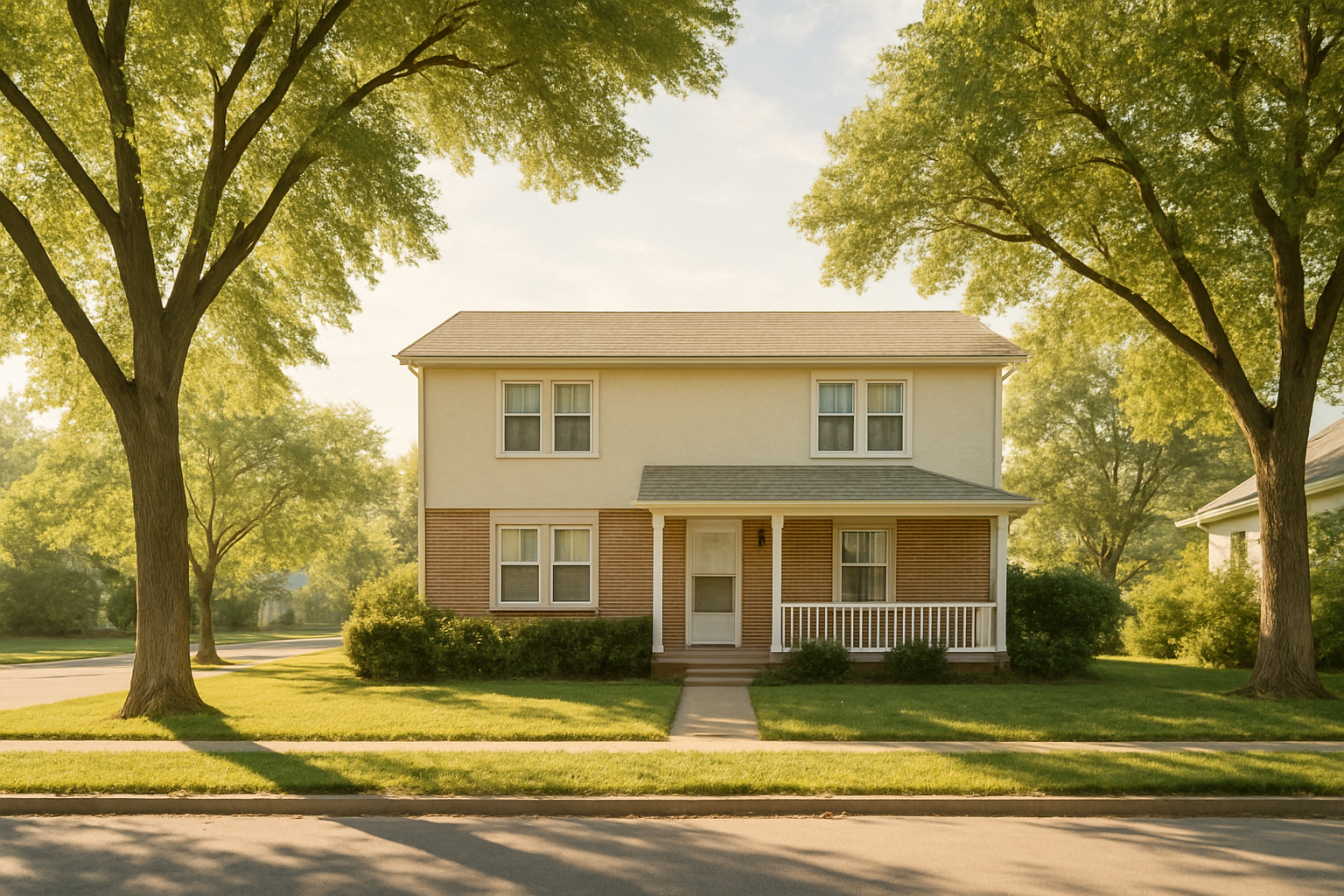
The house is the famous item, and the primary source is better than the legend. In his 2010 letter to shareholders Buffett wrote: “All things considered, the third best investment I ever made was the purchase of my home, though I would have made far more money had I instead rented and used the purchase money to buy stocks. (The two best investments were wedding rings.) For the $31,500 I paid for our house, my family and I gained 52 years of terrific memories with more to come.”
He bought it in 1958 and still lives there. In his November 2025 letter he places it: about two miles from where he grew up, six blocks from the family grocery store, and a six-to-seven-minute drive from the office building where he has worked for 64 years. Charlie Munger grew up a block away; Don Keough, later president of Coca-Cola, lived directly across the street.
It has not been his only house. He bought a place at Emerald Bay in Laguna Beach in 1971 for $150,000 and sold it in 2018 for $7.5 million, a third below his asking price. The Omaha house is the one he kept.
The proxy handles the rest of the lifestyle line by line, in language that reads like a deliberate rebuke to the genre. Buffett occasionally used Berkshire staff or had Berkshire pay for “minor items such as postage/delivery fees that are personal”; he reimbursed the company $50,000 in 2025 to cover it. None of Berkshire’s named executives use company cars or belong to clubs the company pays dues for. And the sentence that does the most work: “Mr. Buffett does not utilize corporate-owned aircraft for personal use. Mr. Buffett is personally a fractional NetJets owner, paying standard rates.”
Berkshire owns NetJets. He buys hours from his own subsidiary at the list price.
One more line, in the director compensation section: outside directors receive $900 per meeting attended in person, and “the Company does not provide directors and officers liability insurance to its directors.” Berkshire’s board members are personally exposed to the consequences of their decisions, which is rare among large public companies.
The one genuine exception is the $289,488 of security. The board’s stated rationale has two limbs — “Mr. Buffett’s critical role as Berkshire’s Chairman and CEO,” and the significant time he spent on Berkshire business while at home — and concluded the cost was a bona fide business expense. It is the only line in the proxy where the argument needs help.
The conversion machine
The giving is not improvisation. It is a mechanism, and it has run on a published schedule for two decades.
It starts with a letter dated 26 June 2006, addressed to Bill and Melinda Gates, still posted on Berkshire’s own website. Buffett earmarked ten million B shares for the Gates Foundation and irrevocably committed to giving away 5% of the remaining earmarked balance every July, for life — 500,000 shares in 2006, 475,000 in 2007, 5% fewer each year thereafter — subject to three conditions: at least one of the Gateses must stay active in running the foundation; the gifts must qualify as charitable and untaxed; and the money had to be additive to what the foundation was already legally required to distribute.
One adjustment is needed to read that schedule against today’s numbers, and skipping it makes the arithmetic look impossible. Berkshire’s Class B stock split 50-for-1 in January 2010, so the ten-million-share pool is 500 million in today’s terms, and the conversion ratio moved with it: an A share became 30 B shares until 2010, and 1,500 after.
Do it properly and the schedule is still running exactly as written. Five per cent of the balance remaining in year nineteen is 500,000,000 × 0.95¹⁹ × 0.05 = 9,433,835 shares. The June 2025 release records a gift to the Gates Foundation Trust of 9,433,839 — nineteen years on, to within four shares.
The engineering is in one parenthesis of the 2006 letter: “I currently own only A shares but will soon convert a number of these to B.” The pattern has been identical every year since. Convert A into B, then give the B shares away. B is the small denomination, so it divides across recipients; the conversion is not a sale, so nothing is realised.
In June 2025 he converted 8,239 A shares into 12,358,500 B and gave 12,358,321 of them to five foundations. In November 2025 came the Thanksgiving supplement: 1,800 A shares into 2,700,000 B, about $1.34 billion, split among the four family foundations. Those foundations, he wrote in the same letter, began with “very small sums” and have been “irregularly increased to more than $500 million annually” — and the two 2025 gifts did put roughly $520 million of stock into each of his children’s three.
Then July 2026, and the break in the pattern.
Why the Gates Foundation is no longer on the list. On 14 July 2026, Buffett converted 8,000 A shares into 12,000,000 B — about $5.9 billion — and gave every share to the four family foundations. For the first time in twenty years, the Gates Foundation was not a recipient.
The press release does not mention it. But unlike most such changes, this one has a documented explanation, and leaving it out would be its own kind of distortion. Two weeks earlier, CNBC reported, following the Wall Street Journal, that Buffett was holding off pending the outcome of a review into the foundation’s ties to Jeffrey Epstein. He had told CNBC’s Becky Quick in March that he had not spoken to Gates since the matter surfaced and did not think it made sense “to do a lot of talking” until it was cleared up.
What he said afterwards gets quoted less and matters as much. In a July interview Buffett called what he had read about Gates’s dealings with Epstein “distasteful,” then added that he “found nothing in there that was beyond what I could picture myself doing.” He said he does not regret twenty years of donations to the foundation.
A second pressure predates all of this: the November 2025 letter, with its case for stepping up gifts to his children while they are still in their prime. Both things are true at once, and nothing published weights them. One loose thread the documents leave hanging — the 2006 letter is a lifetime commitment made “irrevocably,” and in June 2025 Buffett wrote that its conditions “continue to be met.” A skipped year sits in obvious tension with both sentences.
(On the share counts: the proxy records 196,317 A shares on 4 March 2026, and the July release reports 188,290 after converting 8,000 — a 27-share gap. It reconciles exactly on EDGAR, where Buffett’s Form 4 filings show a gift of 2 A shares in March and a conversion of 25 more in May.)
Why giving away $60 billion left him richer
Now the answer to the Million Dollar Question, in Buffett’s own words from June 2025: “When originally made, I owned 474,998 Berkshire A shares worth about $43 billion and those shares represented more than 98% of my net worth.” The answer is B.
Then the part that is hard to hold in your head. “The five foundations have received Berkshire B shares that had a value when received of about $60 billion, substantially more than my entire net worth in 2006 … my remaining A shares are worth about $145 billion, well over 99% of my net worth.”
Add the two later gifts and the running total is roughly $67 billion — measured at the price on each day the shares changed hands, which is the only defensible way to add gifts made across twenty years. He has given away more than half again his entire 2006 fortune, and is worth about three and a third times what he was worth when he started.
Buffett declines to make the reason sound complicated: “Nothing extraordinary has occurred at Berkshire; a very long runway, simple and generally sound decisions, the American tailwind and compounding effects produced my current wealth.”
The mechanics are two numbers moving in opposite directions. His share count has fallen 60%, from 474,998 to 188,290. The price has gone from about $91,500 at the close on the day of the pledge letter to $777,696 on 5 August 2026 — 8.5 times, or about 11.3% a year. Compounding at that rate beat a 5%-a-year giveaway, and beat it for two decades.
There is a tax dimension that most coverage misses, and it cuts against the assumption. Donating appreciated stock rather than selling it means no capital gains tax is ever paid on the appreciation — not by him, not by the charity. That part is genuinely valuable. But the deduction is capped as a share of income, and his income is minuscule next to the gifts.
In October 2016, after a challenge from Donald Trump during that year’s presidential campaign, Buffett released a summary of his 2015 federal return. It showed adjusted gross income of $11,563,931, charitable contributions during the year of $2,858,057,970, and an allowable charitable deduction of $3,469,179. He paid $1,845,557 in federal income tax — 15.96% of AGI.
Look closely at that deduction. $3,469,179 is exactly 30.000% of $11,563,931 — the ceiling the tax code sets on gifts of appreciated capital-gain property. He gave away $2.86 billion and deducted the statutory maximum, about one eight-hundredth of the gift. The code allows a five-year carryforward for the excess; Buffett’s stated position is that he has never used one and never will, because there will never be an income large enough to absorb it.
The company is a different story. Berkshire paid $11.75 billion in cash U.S. federal income taxes in 2025 and $26.48 billion in 2024, on shareholders’ equity that reached $717.4 billion at year-end — a payment Buffett noted in his 2024 letter came to roughly 5% of all corporate income tax collected in the United States. The corporation pays enormous tax. The man who controls 30% of its votes reported an eight-figure income and a seven-figure bill.
The 2034 deadline, and the will
Buffett has now put a hard date on the disposal of his own fortune, which the very rich do not normally do.
From the July 2026 release: “My goal is to dispose of all of my Berkshire shares within about eight years … my remaining shares will be donated to the four foundations one way or the other by December 31, 2034.”
The reason he gives is demographic. In the November 2025 letter: “My children are all above normal retirement age, having reached 72, 70 and 67. It would be a mistake to wager that all three — now at their peak in many respects — will enjoy my exceptional luck in delayed aging.” He wants the money handed over while the people receiving it can still spend it well. One countervailing consideration: he would like to hold a meaningful block of A shares “until Berkshire shareholders develop the comfort with Greg that Charlie and I long enjoyed.”
The structure that catches whatever is left is described in a November 2023 release, and it is unusual in three ways.
It requires unanimity. His three children are the executors of the will and the named trustees of the charitable trust that receives 99%-plus of his wealth. “In administering the testamentary trust, the three must act unanimously.” Susan, Howard and Peter fund substantially different things, so any grant of consequence needs all three to agree. A side effect worth noting — an observation, not something Buffett has written — is that unanimity also gives each of them a standing, blameless answer for anyone who asks them for money.
It is designed to disappear. “The testamentary trust will be self-liquidating after a decade or so and operate with a lean staff.” That is the opposite of the perpetual foundation, the default structure for American fortunes at this level, built to exist forever and employ people forever. The November 2025 letter adds that three alternate trustees stand ready in case of premature death or disability, deliberately unranked and not tied to any particular child.
It will be public. “After my death, the disposition of my assets will be an open book — no ‘imaginative’ trusts or foreign entities to avoid public scrutiny but rather a simple will available for inspection at the Douglas County Courthouse.” The June 2025 release supplies the proportion: “My will provides that about 99½% of my estate is destined for philanthropic usage.”
The reasoning behind giving his children discretion rather than instructions is the most quotable line in twenty years of these letters: “Ruling from the grave does not have a great record, and I have never had an urge to do so.”
What people get wrong
That he lives on nothing. He drew very little from Berkshire — $100,000 a year, a reimbursed postage account, no company car. But “well over 99%” of net worth in Berkshire stock is a floor, not a total, and the remainder is undisclosed. It could be a hundred million or a billion; nothing published says. “Modest” is documented. “Nothing” is not.
That the giving is a tax strategy. His 2015 return shows $2.86 billion given and $3.47 million deducted — the statutory 30%-of-AGI maximum, and about 0.12% of the gift. Permanently escaping capital gains tax on the appreciation is real and worth understanding. The deduction is not the story.
That $100,000 means he was not paid. Control is the compensation. Every dollar Berkshire retains rather than distributing compounds inside a share he already owns. Salary is taxed at ordinary rates. Retained earnings are not taxed to him at all until — and unless — he sells, which he does not.
That he still runs the company. He has been chairman, not chief executive, since 1 January 2026. Greg Abel wrote the 2025 annual letter. Buffett’s own November 2025 note announced he would stop writing the annual report and stop taking questions at the meeting: “As the British would say, I’m ‘going quiet.’ Sort of.”
That the concentration is prudent. More than 99% of his net worth is in one stock, and the 2025 10-K carries the standard disclosure that Berkshire’s own equity portfolio is concentrated in a small number of issuers. His November letter notes the shares have fallen roughly 50% three times in sixty years. This is the least diversified large fortune in America, held that way on purpose, and it worked. Those are two separate observations, and only the first generalises.
That the frugality explains the fortune. The arithmetic is not close. Living in a $31,500 house for 68 years instead of a $30 million one saves a rounding error against $146 billion. The fortune came from owning a compounding asset for sixty years and never interrupting it. The house is evidence of the temperament that made the not-interrupting possible — a real thing, and a different claim.
That any of this was ordinary luck. Buffett is the one who insists otherwise, in the bluntest terms available: “I was born in 1930 healthy, reasonably intelligent, white, male and in America. Wow! Thank you, Lady Luck.” He adds that his sisters “had equal intelligence and better personalities” and faced a materially different outlook. When the subject himself puts starting conditions at the centre of the explanation, it is odd how much of the writing about him does not.
Bottom line
Strip out the folklore and the fortune has a simple shape: one asset, one company, one job, one house, one city, and sixty years of not selling.
Everything that looks eccentric follows from that. No dividend, because a dividend forces a distribution he does not want. No meaningful salary, because retained earnings compound better than compensation. No diversification, because diversifying means selling, and selling means paying tax on sixty years of gain that has never once been realised. The $100,000 and the 1958 house are downstream of the strategy, not decoration on top of it.
What is genuinely rare is not the thrift. Plenty of rich people are cheap. It is the disposal: a schedule published in 2006 and followed to within four shares nineteen years later, a deadline of 31 December 2034, a trust engineered to spend itself out of existence in a decade, three trustees who must agree unanimously, and a will that will sit in a county courthouse for anyone to read.
It would be neat to say the transparency is voluntary, and mostly it is not. The share counts, the gifts, the salary, the security cost and the pay ratio are all compelled — by Section 16, by the proxy rules, by Dodd-Frank. The law is what puts the numbers there.
The voluntary part is narrower and more interesting: the pledge letter posted on the company’s own website, the reasoning about his children’s ages, the percentage of the will, the sentence about the Douglas County Courthouse. Nothing obliged him to narrate any of it. Disclosure gives you the figures; he supplied the explanation, including the parts — the luck, the mistakes, the grand plans that “did not prove feasible” — that make him look smaller than the legend does.
Most fortunes of this size are built to persist. This one has an end date, and the end date is in a press release.
Methods and sources. Share counts, salary, security costs, reimbursements, voting and economic percentages, the voting agreement, the pay ratio and its median-employee vintage, director fees and the absence of D&O insurance come from Berkshire’s 2026 proxy statement, filed 13 March 2026 and reporting positions as of the 4 March 2026 record date. Gift mechanics, share counts after each donation, the $43 billion and $60 billion figures, the 99½% estate provision and the 2034 deadline come from Berkshire press releases dated 27 June 2025, 10 November 2025 and 14 July 2026; the trust’s unanimity requirement and self-liquidating design from the 21 November 2023 release; the alternate trustees from the November 2025 letter. Original pledge terms come from Buffett’s 26 June 2006 letter. Corporate figures — shareholders’ equity, cash federal income taxes paid, dividend history, the concentration risk disclosure — come from the 2025 Form 10-K, filed 2 March 2026. The house price is from the 2010 shareholder letter. The 2015 tax figures come from a summary Buffett released on 10 October 2016; the return was filed with the IRS but never published, so these are his own disclosure, not a government document. Prices are as of the close on 5 August 2026 and will be wrong by the time you read this; the share counts will not be. Pledge share figures are given as the 2006 letter states them and split-adjusted where compared to later gifts, since Berkshire’s Class B stock split 50-for-1 in January 2010 and the A-to-B conversion ratio moved from 30:1 to 1,500:1 at the same time. Reporting on the Gates Foundation pause is from CNBC, following the Wall Street Journal, with Buffett’s own subsequent comments; no Berkshire filing gives a reason and this piece supplies none beyond what he said on the record. Forbes and Bloomberg net worth figures differ by billions at any moment because they mark the same share count at different times; this piece uses the share count and a dated price instead. This draft was fact-checked line by line before publication and the check changed the piece in two substantive ways. An earlier version called a 27-share discrepancy between the proxy and the July 2026 press release unexplained; Buffett’s Form 4 filings reconcile it exactly, and the corrected passage is a better illustration of the point. And an earlier version said no reason for the Gates Foundation’s exclusion had been given, which was wrong — he has addressed it publicly, and this version reports what he said, including the parts favourable to Gates. The same pass corrected the compounding rate from 11.4% to 11.3%, cumulative giving from $68 billion to $67 billion, the multiple of his 2006 net worth from 3.5x to 3.3x; added the 2010 Class B split, without which the pledge schedule does not reconcile; corrected “compensation committee” to the Governance Committee; corrected the framing throughout to reflect that Greg Abel, not Buffett, has been chief executive since 1 January 2026; removed an unsupported claim that his non-Berkshire assets exceed a billion dollars and a claim that he owns no other reported home; and rewrote the closing argument, which had wrongly asserted that this disclosure was voluntary when most of it is legally compelled.
Related reading: Philanthropy: Giving, Status, and Influence · Taxes: How Wealth Is Structured and Preserved · Trusts: How Wealth Is Held, Protected, and Passed On · Generational Wealth: How Long Fortunes Actually Last · Billionaire Rankings: How the Lists Are Built and Why They Disagree






2 Comments