The Ozempic Effect: Luxury Hotels Rewrite the Menu for a Thinner Clientele
The Million Dollar Question: A guest at The Broadmoor asks to split one entrée between two people. What does the resort charge for it?
A) A $15–25 plating fee B) Half the entrée price C) Nothing D) It won’t do itRead on for the answer.
For about a century, the expensive hotel sold you abundance. Now a meaningful slice of its guests physically cannot eat it — and the properties are rebuilding the menu, the minibar and the spa around that fact.
What it is
A GLP-1 is a class of drug — semaglutide, sold as Ozempic and Wegovy; tirzepatide, sold as Mounjaro and Zepbound — that mimics a gut hormone, slows digestion and suppresses appetite. The relevant part for a hotel is not the weight loss. It is the appetite. A guest on a therapeutic dose does not decide to eat less. They open the menu, order the way they always did, and then find they are finished after four bites of a course designed to be eaten in twelve.
That is a different problem from a diet. A dieting guest is exercising restraint and can be tempted out of it — that is what the dessert trolley is for. A guest on tirzepatide cannot be tempted, and the trolley reads to them as a small social embarrassment about to happen. The whole grammar of high-end hospitality, in which generosity is expressed as volume, stops working.
So properties started editing. According to Forbes Travel Guide’s July 2026 report on GLP-1s in luxury hospitality, The St. Regis Washington, D.C. reworked the menu at its flagship restaurant, Alhambra, toward lighter, smaller, protein- and plant-forward, nutrient-dense plates. The Miami Beach EDITION revised menus across every dining outlet toward what it calls protein-maxed dishes — nut-crusted salmon, charred octopus. The Broadmoor, in Colorado Springs, now lets guests split a meal into smaller portions at no additional charge. And the Four Seasons Hotel Los Angeles at Beverly Hills went further than food: it introduced a GLP Body Preservation Infusion, an IV therapy built with its onsite wellness partner Immortelle Integrative Health, aimed at the muscle mass, energy, nutrient levels and skin quality that rapid pharmacological weight loss tends to erode.
None of this is being marketed loudly. Most of it is a policy change and a menu revision rather than a press release. That is the shape of a real operational shift rather than a campaign.
Who uses it
The scale is no longer niche. Gallup’s July 2026 survey found that 11% of U.S. adults currently take a GLP-1 medication for weight loss, up from 3% in 2024, with 15% having used one at some point. Ninety-one percent of Americans now know what these drugs are. Forbes Travel Guide, citing household-level survey data, put the share of U.S. households containing at least one current user at roughly one in five — more than double the figure a year earlier.
Now overlay income. Morning Consult’s consumer research on GLP-1 users found the population skews sharply upmarket: the share of users in households earning over $100,000 runs at roughly double their share of the general adult population, and nearly all users are insured. That is not a coincidence of taste. Access to these drugs still runs through insurance coverage, a willing prescriber, and the ability to absorb a few hundred dollars a month if coverage falls through — three filters that all sort by income.
Which means the guest profile most likely to be on a GLP-1 is, roughly, the guest profile most likely to be standing in a Four Seasons lobby.
Within that, the experience differs sharply by wealth level:
- $1M–$5M. Usually a covered prescription through a regular physician, or a cash-pay arrangement through the manufacturers’ direct channels — Lilly’s self-pay Zepbound vials and Novo’s NovoCare pricing sit in the low hundreds per month depending on dose, against list prices near $1,000. The travel adaptation is entirely self-managed: order the appetizer as the main, skip the wine.
- $5M–$30M. Typically managed inside an existing concierge medicine relationship, with bloodwork, dose titration and a protein plan handled by a physician on retainer. Hotel spa services and gym programming start to matter, because the muscle-loss problem has been explained to them.
- $30M+. The drug becomes one input in a broader body-composition program — DEXA scanning, resistance training with a traveling trainer, IV protocols, and a longevity clinic coordinating it. At this level the hotel is not being asked to accommodate; it is being asked to integrate, which is a much taller order and is why properties are building the services in-house.
Why they use it
The obvious answer — appearance — is real but incomplete, and it is also the least interesting part.
The more useful frame is the one that runs through most of what wealth actually buys: control over a variable that used to be uncontrollable. Weight, for most of human history and for most people’s adult lives, has been a source of effortful, unreliable, repeatedly failed self-management. A drug that makes the problem tractable is, in that sense, in the same family as the personal assistant or the private terminal — it converts a recurring drain on attention into a solved logistical item.
There is also a plainly medical driver that gets lost in the cultural conversation. Gallup’s data shows U.S. adult obesity dropping from a 2022 peak of 39.9% to 36.4% in 2026, tracking inversely with GLP-1 uptake, while diabetes diagnoses have leveled off after fifteen years of increases. Many users are managing metabolic disease, not chasing a silhouette, and the two groups overlap heavily.
And then there is the reason hotels care most: the muscle problem. Rapid weight loss on a GLP-1 tends to take lean mass along with fat, which is why the services being built around these guests are not weight-loss services at all. They are preservation services — protein, resistance training, amino acid infusions, monitoring. The property that understands this is selling into a genuine anxiety rather than a vanity.
How it works
Operationally, the adaptation has landed in five places.
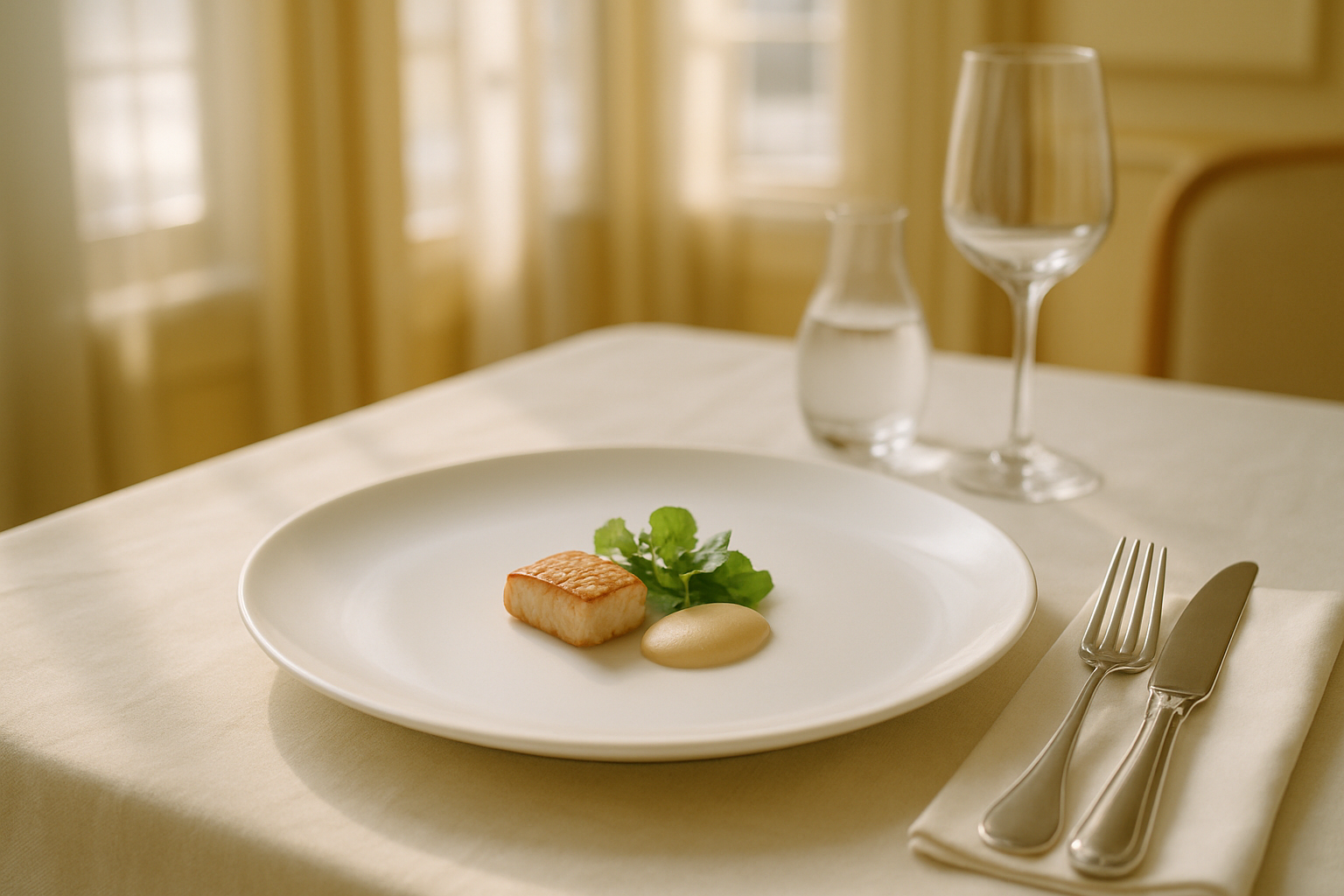
The menu. The dominant move is not new dishes; it is new sizes. Protein-forward, vegetable-heavy, nutrient-dense plates, offered small. In many kitchens this means a shadow menu — the same dish, plated at roughly half, at a lower price — which is harder than it sounds because a half-portion of a composed dish is not a composed dish cut in half. The luxury sector did not invent this. Chains moved first: Fortune reported in March 2026 on the spread of smaller-portion “GLP-1” menu sections across the restaurant industry, from national chains to independent dining rooms, and Fine Dining Lovers has tracked the same shift into higher-end kitchens.
Policy. The Broadmoor’s no-charge split is the clean example. Splitting a plate used to be quietly discouraged, sometimes with a fee, because it halves the check. Removing the friction is a deliberate signal that the property would rather keep the guest comfortable than defend the average.
The room. Minibars and in-room dining are being reweighted toward protein, water and electrolytes rather than confectionery, and turndown service in some properties has moved away from the reflexive chocolate.
Spa and clinic. This is where the revenue is being recovered. The Four Seasons infusion is one version; more broadly, that property’s expanded wellness programming is built around resident specialists rather than a treatment menu. Elsewhere, the destination-wellness properties have built whole programs: Hilton Head Health launched a week-long GLP-1 support experience combining strength training, chef-prepared meals, biomarker testing and behavioral health work.
Fleet and itinerary. The effect extends past hotels. Writing for Seatrade Cruise, industry analysts estimated that on a global base approaching 40 million cruise passengers, something on the order of 5–6% will have GLP-1 experience — concentrated, notably, in the higher-fare cabins and among repeat high-income guests. On a ship where the buffet is a load-bearing part of the product, that is a real planning problem.
What it costs
For the guest. The drug itself now spans a wide range depending on channel. List prices for the branded injectables sit near or above $1,000 a month; manufacturer self-pay programs bring that down substantially — roughly $200 to $450 a month depending on drug and dose, with the lowest tiers requiring prompt refills. Gallup found that 19% of current users are on compounded or custom-mixed versions rather than brand-name, and that among people who switched from brand to compounded, about two-thirds cited cost or coverage as the reason. So even in a high-income user base, price is steering behavior.
Layered on top, at higher wealth levels:
- Concierge medicine retainers, typically a few thousand to well into five figures a year depending on the practice.
- Destination wellness weeks. Published rates for the established properties generally run $4,000–$12,000 per person per week — Hilton Head Health in the lower part of that band, Canyon Ranch and SHA in the middle, Lanserhof Tegernsee at the top — before travel, treatments and add-on diagnostics.
- IV and infusion protocols, generally a few hundred dollars per session at hotel spas, more inside a clinic relationship.
For the property. Counterintuitively, serving less is not cheaper. A split-entrée policy at no charge is straight margin given away. A smaller-portion menu run alongside the standard one duplicates prep, complicates the pass and raises waste risk on two inventory lines instead of one. And the protein-forward direction pushes food cost up — fish, shellfish and quality cuts are the expensive part of the plate; starch and sauce are the cheap part.
The bigger hole is beverage. Morgan Stanley’s research on obesity drugs and the food industry found GLP-1 users consuming 20–30% fewer calories a day, with a large majority cutting sugary drinks and alcohol; separate survey work put the share drinking less alcohol at around 62%. In a hotel restaurant, wine and cocktails are where the margin lives. A guest who orders a smaller entrée and no second glass can cut the check by a third without changing anything else about the visit.
Hidden costs and tradeoffs
The revenue arithmetic is the visible cost. The subtler ones are worse.
The category has to unlearn its own instincts. Everyone in a luxury dining room, from the chef to the server, has been trained that generosity equals more — the extra course, the topped-up glass, the amuse nobody ordered. Retraining a floor to read restraint as service rather than as a failure to upsell is slow, and it cuts against how tipping and check averages have historically rewarded staff.
Medical adjacency creates liability. A hotel that sells an infusion to a guest on a prescription drug has stepped, at least partway, into clinical territory. The properties doing this well are partnering with actual medical groups — the Four Seasons arrangement runs through a physician-led practice rather than a spa menu — precisely because the alternative is a hospitality company making implicit medical claims.
Under-eating is a real risk, not a marketing angle. Appetite suppression plus a low-protein plate is how people lose muscle and run into nutrient deficiencies. A property that leans into “lighter” without leaning into protein is making the problem worse, which is why the credible versions of this are protein-forward rather than calorie-forward.
And the household spending data suggests the effect follows guests home. A Cornell University and Numerator study found households cut grocery spending by about 6% within six months of a member starting a GLP-1 — around $416 a year — with higher-income households above $125,000 cutting nearly 9%, about $690. Savory snacks fell around 11%. If that is the pattern at home, hotels should expect it at the table, and permanently.
What people get wrong
“Wealthy people are just eating less now.” Not quite. Total demand fell some, but the more consequential change is in distribution: fewer courses, more protein per course, less alcohol, more water, and far less predictability about what any given table will order. A kitchen can plan around lower volume. Planning around scattered volume is much harder.
“It’s a fad, and the menus will swing back.” The spending evidence argues otherwise. The Cornell/Numerator effect shows up within six months and holds; obesity rates have moved measurably at the national level; and Morgan Stanley analysts have forecast the global obesity drug market reaching roughly $105 billion by 2030. This looks like a structural change in food demand rather than a diet cycle.
“Smaller portions must be more profitable.” They are usually not, for the reasons above — duplicated prep, higher-cost protein, forfeited beverage revenue. Properties are doing it despite the margin math, which is the strongest evidence that guest demand is real.
“Luxury led this.” It did not. Large chains and casual dining moved first with smaller-portion and high-protein menu sections. High-end hospitality followed, more quietly, roughly a year behind — partly because the category is slower and partly because it had more to unlearn.
“The hotel is doing this to seem healthy.” In most cases the property is solving a service failure. A guest who leaves 80% of a $95 entrée on the plate has had a bad experience and so has the kitchen. Split plates and half-portions are not a wellness gesture; they are a fix for a recurring, expensive, silently unpleasant moment.
“Everyone on these drugs is doing it for looks.” A substantial share are managing diabetes or obesity as diagnosed conditions. Treating the whole category as vanity misreads both the guests and the operational problem.
Bottom line
The answer to the Million Dollar Question is C — nothing. The Broadmoor splits a meal into smaller portions at no additional charge, per Forbes Travel Guide’s July 2026 reporting. The split-plate fee, once a standard quiet defense of the check average, is exactly the reflex the category is dropping, because the property has worked out that a comfortable guest who spends less tonight is worth more than an uncomfortable guest who spends more.
That trade is the whole story in miniature. Luxury hospitality has spent a century equating generosity with volume, and it is now discovering that a fifth of American households contain someone for whom volume is not generosity at all — it is a plate they will have to apologize for leaving. The industry’s response has been sensible, expensive and largely unannounced: fewer things, better protein, no fee to split, and an IV upstairs to keep the muscle on. Whether the check average recovers is an open question. Whether the menus go back is not.
Related reading:
- Restaurants and the Reservation Economy: Eating in the Top 1% — the status layer of dining that all of this sits on top of.
- The Cosmetic Maintenance Economy: Surgery, Injectables, and Looking the Part — the adjacent spend on appearance, of which GLP-1s are the newest line item.
- Wellness: Trainers, Retreats, and the Pursuit of Optimization — the retreat economy the GLP-1 support weeks plug into.
- Longevity: How the Wealthy Spend on Healthspan — the body-composition framing behind the muscle-preservation services.
- Concierge Medicine: Health Care for the Wealthy — who actually prescribes and manages this at higher wealth levels.
- Hotels and Villas: How the Wealthy Stay Away From Home — the property economics this shift is quietly rewriting.