Helicopters: When Wealth Makes Short-Distance Flight Worth It
The Million Dollar Question: A billionaire wants to shave the most time off a normal week. On which trip does a helicopter actually save meaningful time — and which is mostly theater?
A) Manhattan to a Hamptons house on a Friday afternoon B) New York to Los Angeles C) A downtown heliport to the airport in gridlock D) A twelve-minute drive across a quiet townRead on for the answer.
A private jet is about distance. A helicopter is about the opposite — it exists to erase the short, stupid, unavoidable delays that distance can’t explain. The forty-five minutes it takes to get from a private terminal to a meeting downtown. The Friday crawl out of the city to a weekend house that is only ninety miles away and four hours by car. The gap between a yacht anchored offshore and the villa on the hill. None of these are long trips. All of them are broken ones, and the helicopter is the machine that unbreaks them. That is the whole proposition, and it is worth being clear-eyed about: the helicopter is not a better jet or a flashier car. It is a specialized tool for beating congestion, and outside of congestion it makes very little sense at all. This piece is about where that trade actually pays off, what it costs at each level, and the two things — the operating bill and the safety math — that money makes smaller but never makes disappear.
What it is
“Having a helicopter” can mean three completely different things, separated by an enormous gap in commitment and cost.
At the simplest level, it means booking a seat — treating a helicopter the way you’d treat a rideshare, paying for one spot on a scheduled or pooled flight and never thinking about the aircraft again. Companies built around apps have turned this into an almost mundane transaction on a handful of busy routes.
In the middle sits chartering — renting the whole aircraft and its pilot for a specific trip, on demand, the way you’d charter a jet or a boat. You pick the time and the route; the operator supplies the machine, the crew, the insurance, and the regulatory paperwork. Most wealthy people who “use helicopters” are really charter customers, sometimes through a membership that pre-buys hours at a set rate.
At the top is ownership — actually buying the aircraft, then paying, indefinitely, to keep it flightworthy: the pilot’s salary, the hangar, the maintenance, the insurance, the management company that runs it all. This is a different order of money and hassle, and it only makes sense above a threshold of usage that most people never reach.
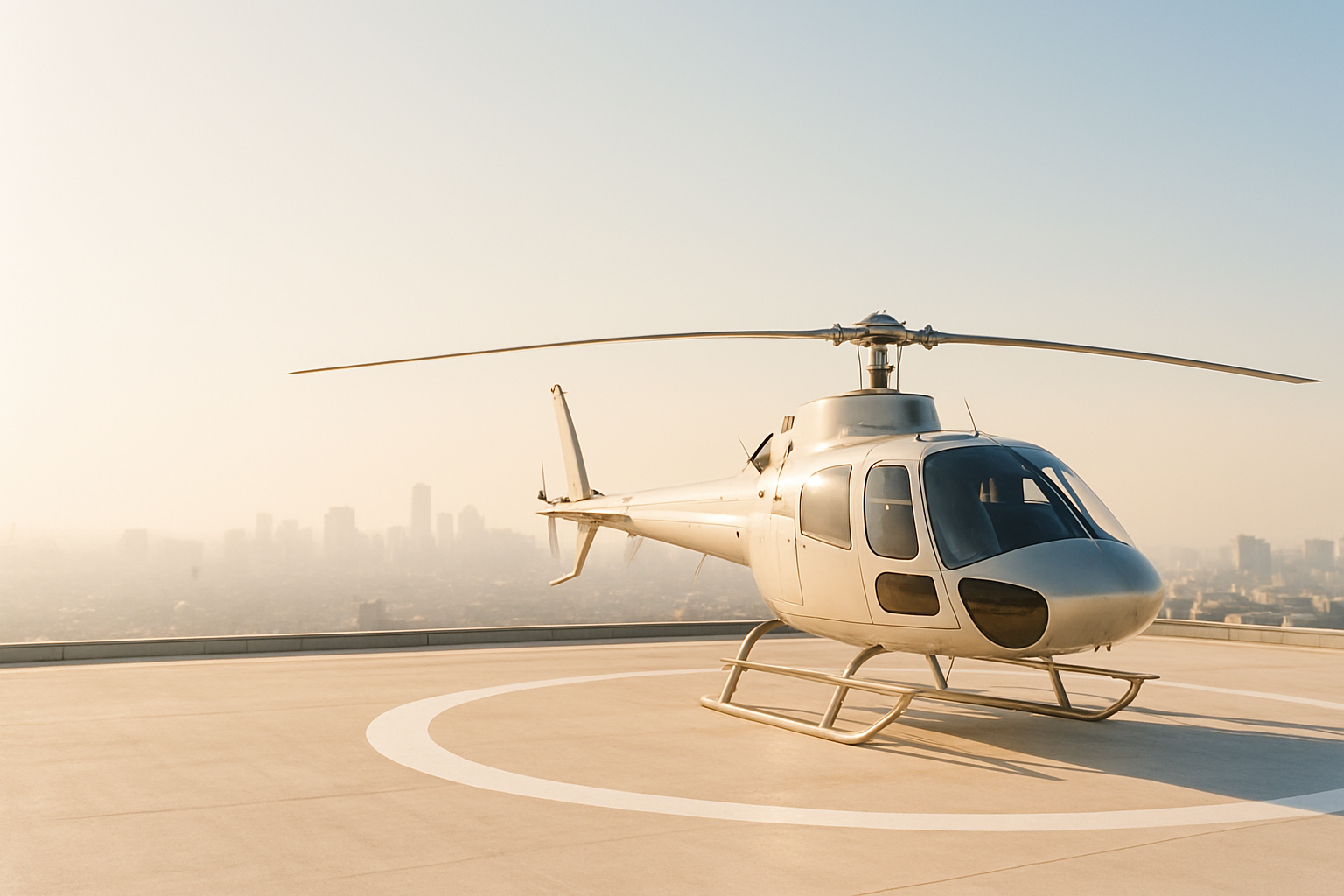
Cutting across all three is the machine itself. At the light end are single-engine turbine helicopters — the Robinson R66, the Bell 407, the Airbus H125 — nimble, relatively affordable, seating four to six, ideal for short hops in good weather. At the heavy end are twin-engine VIP helicopters like the Airbus H145 or the AgustaWestland AW139: bigger cabins, two engines for redundancy, the ability to fly in worse conditions and, crucially, over water and cities where a single engine is a harder risk to accept. The jump from single to twin is the jump from a toy-ish weekend machine to a serious piece of transport infrastructure, and the price reflects it.
Who uses it
At $1M–$5M in net worth, the helicopter is an occasional splurge, not a habit. This is the band that books a seat on a service like Blade to skip airport traffic before an important flight, or charters a helicopter once for a wedding, a proposal, or a bucket-list trip over a canyon. It is a purchase measured in hundreds of dollars, a few times a year, and it is entirely rational — a way to buy back a specific afternoon without buying anything permanent.
At $5M–$30M, the helicopter becomes a tool that gets pulled out for the trips where it genuinely wins: the summer-Friday run to a beach house, the commute from a suburb to a city center on days that matter, the hop from a regional airport to a property with no good road access. People in this band charter, often through a membership that locks in a rate and guarantees availability. They are paying for time on the calendar’s worst days, and they’ve done the math on which days those are.
At $30M–$100M, ownership starts to make sense for the first time — usually a light-to-medium single-turbine machine, flown by a contracted pilot and managed by a professional operator who handles maintenance and scheduling. The owner in this band typically has a specific, repeated route that justifies the aircraft: a main home and a weekend estate, a headquarters and a factory, a city and a coast. The helicopter is bought against a commute, not a fantasy.
At $100M+ and $1B+, the helicopter is a standing piece of the logistics operation, often a twin-engine VIP machine with a full-time flight department, and frequently paired with the private jet and the yacht. Here the helicopter is the connective tissue between the other expensive things — the machine that carries you from the jet at the airport to the house, or from the dock to the deck of a boat anchored where cars can’t go. It is rarely the headline asset; it is the thing that makes the headline assets usable.
Why they use it
The honest first answer is time, and specifically time lost to congestion. A helicopter’s entire advantage is that it ignores roads. On a clear highway it saves almost nothing once you count the drive to the pad and the boarding; in gridlock it can turn ninety minutes into nine. The people who own or charter helicopters are, almost without exception, people whose weeks contain a recurring, predictable traffic problem that money can otherwise do nothing about. The value is not speed in the abstract. It is the specific, repeated deletion of a bottleneck.
The second reason is access — reaching places the ground can’t easily deliver you to. A remote lodge, a ski valley, an island, a ranch at the end of a bad road, a yacht sitting a mile offshore. For a certain kind of property, the helicopter isn’t a luxury layered on top of the trip; it is the only practical way to arrive at all, which is part of why remote land with a helipad commands a premium.
The third is the commute, and nowhere illustrates it like São Paulo. The Brazilian megacity has the largest civilian helicopter fleet in the world — hundreds of registered aircraft making thousands of rooftop landings a day — and it got there for one blunt reason: the traffic is among the worst on the planet, and the wealthy simply flew over it. The city is the only place in the world to have built air-traffic control dedicated specifically to helicopters, with a constellation of rooftop helipads across the business districts. São Paulo is what happens when congestion gets bad enough and enough people can afford the escape hatch: the helicopter stops being exotic and becomes, for a thin slice of the city, just how you get to work.
The fourth reason is quieter — discretion and control. A rooftop-to-rooftop flight skips the terminal, the crowd, and the predictable schedule. For people who value privacy, the helicopter’s ability to land on a private pad, away from any public eye, is part of the appeal.
How it works
The machinery of getting into a helicopter runs along the same spectrum as owning one, from casual to total commitment.
Per-seat apps are the newest and most accessible layer. Blade, the best-known name in the United States, sells individual seats on short, high-value routes — most famously between Manhattan and the New York airports, a roughly five-minute flight that replaces an hour-plus in a car. In 2025 the company partnered with Skyports to relaunch its Manhattan–JFK service at an entry price of $195 a seat. It is the closest thing the industry has to a helicopter that behaves like a taxi.
On-demand charter is the workhorse. You call an operator, specify a time and route, and they send an aircraft and pilot. This is how most wealthy people use helicopters — no capital outlay, no maintenance worries, just an hourly rate and a booking. Many frequent flyers formalize it with a membership or hours-based program, pre-purchasing a block of flight hours at a fixed rate to guarantee availability and lock in pricing, the helicopter equivalent of a jet card.
Fractional and full ownership sit at the committed end. Fractional programs — buying a share of an aircraft and a set number of annual hours — exist but are far less common in helicopters than in jets, because the economics of a shared rotorcraft are trickier. Full ownership means buying the machine outright and then handing it to a management company that employs the pilot, arranges the hangar, schedules maintenance, and keeps the aircraft legal and airworthy. Almost no private owner runs a helicopter entirely alone; the operational burden is a business, and it gets outsourced to people who do it professionally.
Underlying all of it is the unglamorous question of where the thing lands. A helicopter is only as useful as its pads. Cities license a limited number of heliports, often on waterfronts or rooftops, and landing anywhere else — a private estate, a corporate campus — requires permits, zoning approval, and frequently the patience of neighbors who did not agree to the noise. The flight is the easy part. The right to touch down where you actually want to go is the constraint that shapes the whole system.
What it costs
Helicopters span a huge range, and the costs stack up in layers that go well beyond the sticker price.
A single seat is the cheap entry. Blade’s Manhattan–airport flights start at $195, and an annual Airport Pass drops the per-seat price to as low as $95. For the price of a nice dinner, you can trade an hour of gridlock for a five-minute flight — which, for someone whose time is genuinely valuable, is one of the better small luxuries money buys.
Chartering the whole aircraft runs, in 2025, from roughly $1,200 to $3,500 an hour for most machines, and past $5,000 for the largest. A light Bell 206 sits near the bottom of that range; a heavy twin like the Sikorsky S-76 charters closer to $4,700 an hour. On top of the hourly rate come the extras that quietly inflate the bill: repositioning fees to fly the empty aircraft to you, landing fees at busy heliports, fuel surcharges, and passenger surcharges that can add 10–25% to a quote.
Buying the aircraft is where the numbers become serious. A new Robinson R66, the entry point to turbine ownership, lists around $1 million. A Bell 407 runs roughly $3.3–4 million; an Airbus H125 lands in a similar band and climbs past $5 million with a VIP interior. Step up to a twin-engine VIP machine and the price roughly triples: a new Airbus H145 is estimated around $9.7 million before options, and a heavy twin like the AW139 climbs well past that. Long factory backlogs — 18 to 36 months on popular models — mean strong resale values but also that you often can’t simply buy your way to the front of the line.
Then comes the real cost: keeping it flying. Direct operating costs run from about $450 an hour for a light R66 to $740 or more for a Bell 407 — and that’s before fixed costs. Add a full-time pilot’s salary, hangar rent, insurance, scheduled maintenance, and management fees, and the all-in annual cost of owning and running a helicopter frequently surpasses $300,000 a year, often well past it for a twin with a dedicated crew. The purchase is the down payment on a decade of bills.
By band: at $1M–$5M, a helicopter costs a few hundred dollars a few times a year. At $5M–$30M, it’s tens of thousands in charter or membership fees annually. At $30M+, it’s a seven-figure aircraft plus a standing six-figure operating budget — the point at which owning finally beats chartering, and only if you fly enough to justify it.
Hidden costs and tradeoffs
The safety conversation is the real one, and it deserves honesty. Helicopters are more dangerous than airline flying and more dangerous than private jets, though the gap has narrowed dramatically. In 2024 the US helicopter industry recorded its lowest fatal-accident rate in 25 years, about 0.44 fatal accidents per 100,000 flight hours, and the five-year average sits around 0.63 — actually below the roughly 0.94 rate for general aviation as a whole. The dominant cause is not mechanical failure but pilot decision-making, especially flying by sight into weather that demands instruments. The January 2020 crash that killed Kobe Bryant, his daughter Gianna, and seven others is the textbook case: the NTSB found the pilot flew a Sikorsky S-76B into fog, became spatially disoriented, and lost control — a chain of decisions, not a broken part. The April 2025 Hudson River crash that killed a Siemens executive and his family of five plus the pilot was a sightseeing flight on a familiar route that ended in the water sixteen minutes after takeoff. Wealth buys a better machine, a better-trained pilot, and the discipline to cancel in bad weather — all of which move the odds — but it does not make the risk zero, and the honest owner knows it.
Weather is a constant tax on the whole promise. The helicopter’s value is reliability on your schedule, and the one thing that most degrades it is fog, low cloud, and wind. A single-engine machine in particular is grounded by conditions a jet would shrug off, which means the trips where you most want the helicopter — the miserable-weather days — are exactly the ones when it may not fly. The escape hatch has a weather clause.
Noise, permits, and politics. A helicopter is loud, and the places worth flying to are often places where residents fight helicopter traffic hard. Landing rights are political, heliports get capped or closed, and a private pad can take years of zoning battles. The freedom the machine promises runs straight into the ground rules of everyone who lives under the flight path.
Depreciation and lock-in. Long backlogs prop up resale values, but a helicopter is still a depreciating, maintenance-hungry asset with a thin buyer pool. Selling one well takes time, and the carrying cost keeps running the entire time it sits.
What people get wrong
“A helicopter is basically a small plane.” It isn’t, and the difference is the entire point. A plane needs a runway and covers distance efficiently; a helicopter needs only a pad and covers short, awkward, congested legs that a plane can’t touch. They solve opposite problems. Buying a helicopter to do a jet’s job — or a jet to do a helicopter’s — is the most common conceptual mistake, and an expensive one.
“Owning is cheaper than chartering.” Almost never, until you’re flying a lot. Charter has no capital cost, no pilot salary, no hangar, no maintenance risk — you pay only when you fly. Ownership loads a seven-figure purchase and a six-figure annual budget onto you whether the aircraft moves or not. The crossover point where owning wins is high — many hundreds of hours a year — and most owners who did the math honestly bought the machine for control and availability, not to save money.
“Helicopters are death traps” / “helicopters are perfectly safe.” Both are wrong. The rotorcraft accident rate is real and higher than airline flying, but it has fallen to a modern low and now runs below general aviation overall. The risk is concentrated in specific conditions — bad weather, single-engine flight over hostile terrain, pressure to complete a trip — and it responds strongly to how the machine is flown. It is neither a coin flip nor a car ride. It is a manageable risk that punishes complacency, which is exactly why the safety culture around a well-run flight department matters so much.
“The commute pays for itself.” Sometimes, but only on the right route. A helicopter earns its keep deleting a genuinely broken ground trip. Over a short, free-flowing drive, the door-to-door reality — car to pad, boarding, flight, car again — frequently loses to just driving, and the machine becomes an expensive way to feel fast rather than to be fast.
Bottom line
The answer to the Million Dollar Question is C and A — the airport-to-city dash in gridlock, and the Friday run to the weekend house. Those are the trips where an hour or more of ground crawl collapses to a few minutes of flight, and the helicopter’s advantage is decisive. New York to Los Angeles (B) is a jet’s job; the helicopter does nothing for it. And the quick cross-town drive (D) is the trap — once you count the car to the pad, the boarding, and the car at the other end, the door-to-door time often loses to simply driving. The helicopter’s entire value is congestion. Where there’s no congestion, there’s no case.
That is the truest thing about helicopters as a wealthy household’s tool: they are not a symbol or a fantasy but a narrow, powerful solution to one specific problem, and they are worth it exactly to the extent that problem is real. Used well — against a punishing commute, a remote property, a Friday the whole city is trying to leave at once — a helicopter is one of the highest-leverage ways money can buy back time, and it is the connective tissue that makes a jet and a country house and an offshore boat actually work together. Used badly — as a faster way to make short, easy trips, or as a machine to be seen in — it is a loud, expensive, weather-dependent liability with a safety margin that demands respect. The people who are happiest with their helicopters are the ones who bought a solution to a bottleneck, flew it with discipline, and never forgot that the whole point was the traffic they were flying over.
Related reading: Flying Private · Yachts · Trophy Experiences · Personal Assistants