Watches: Status, Craft, and Portable Wealth
The Million Dollar Question: In 2019, a one-off Patek Philippe Grandmaster Chime in stainless steel — no gold, no gemstones — sold at the Only Watch charity auction. What did it fetch?
A) $3.1 million B) $9 million C) $17 million D) $31 millionRead on for the answer.
A mechanical watch is a strange luxury. It tells time worse than the phone in your pocket, costs more than a car, and the people most impressed by it are the only people who will ever notice it. And yet the watch is the one object the wealthy reach for again and again — because it does three things at once that almost nothing else does. It signals status to the handful of people whose opinion they care about, it stores value in a form you can wear through an airport without a customs declaration, and it carries a story. This piece explains how watches actually function as portable wealth, why three brands dominate the conversation, and what most people get wrong about the idea that a watch is an “investment.”
What it is
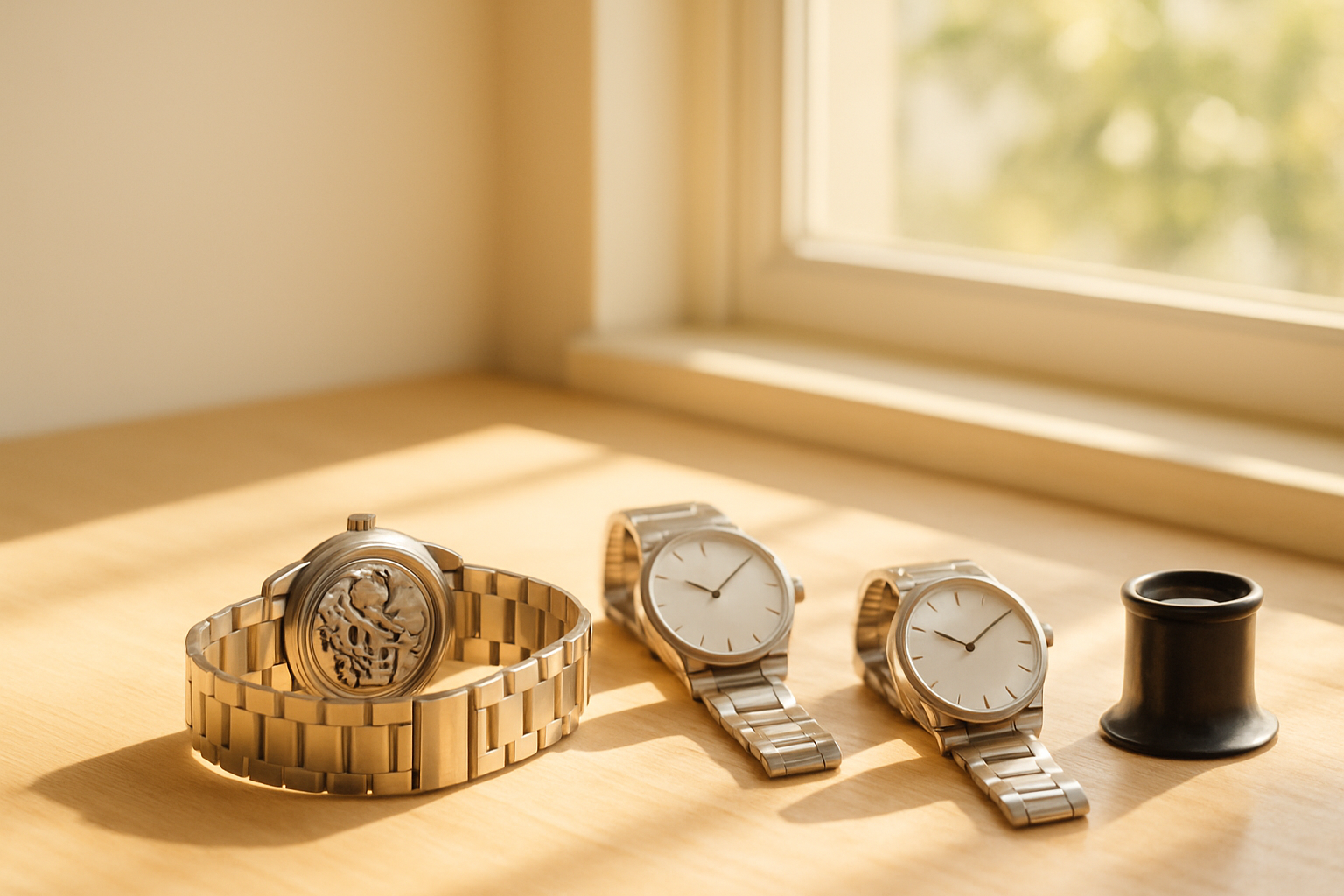
At the center of all of this is a small machine. A mechanical watch keeps time using a wound mainspring and a balance wheel oscillating several times a second — no battery, no microchip. That technology was made obsolete in the 1970s by cheap, accurate quartz, which is exactly why mechanical watchmaking survived only at the top of the market. Once a watch no longer needed to be mechanical to keep good time, the mechanical watch became something else: jewelry, a piece of engineering, and a collectible all in one.
The numbers are smaller than people assume. The entire Swiss watch industry exported CHF 26.0 billion worth of watches in 2024 — and did it on just 15.3 million units, a historic low in volume even as the value held up. Compare that to the roughly 1.2 billion smartphones sold worldwide in a year. Fine watchmaking is a tiny, high-value business where most of the money sits in a thin band of expensive pieces.
And within that band, one name towers over the rest. Rolex alone is estimated by Morgan Stanley and LuxeConsult to have generated around CHF 10.58 billion in 2024 on roughly 1.18 million watches — close to a third of the whole Swiss industry’s value from a single brand. Below Rolex sit Patek Philippe and Audemars Piguet, the two names that anchor the very top of the desirability ladder. Together those three — collectors just call them “the big three” — set the terms that every other brand reacts to.
The three do not signal the same thing, and the differences matter to the people wearing them. Rolex is the universal language: instantly recognized, broadly worn, the watch that says success to the widest audience and is understood by people who know nothing else about watches. Patek Philippe sits a register quieter and more rarefied — old money, dynastic, sold under the famous line that you never actually own one, you “merely look after it for the next generation.” Audemars Piguet, propelled by the Royal Oak, reads as the more modern and design-forward of the three, the name most associated with athletes, founders, and new wealth that wants to be seen as having taste rather than just money. A person fluent in watches reads all of this off a wrist in a half-second, which is exactly the kind of layered, insider signaling the wealthy tend to prize.
Who uses it
It helps to separate the buyers by wealth band, because they are not doing the same thing.
At the entry, you have the aspirational professional — often a HENRY, high earner not rich yet — who saves for a single “grail.” For this buyer a steel Rolex Submariner or a Datejust is a milestone purchase: the reward for a promotion, a bonus, a closed deal. They own one good watch, maybe two, and they wear them.
In the $5M–$30M band, watches become a small collection rather than a single object. The owner has a few pieces matched to occasions — a sports watch for the weekend, a dress watch for the boardroom — and starts paying attention to references, production years, and condition. This is where the hobby tips into something closer to connoisseurship.
Above roughly $30M, and certainly at $100M and beyond, you find the serious collectors. Here a watch can be a genuine asset line: vaulted pieces, auction relationships, watches bought as much for provenance as for looks. A handful of these buyers treat horology the way others treat art — as a category of alternative assets with its own dealers, auctions, and price histories.
One more distinction worth naming: this remains a heavily male market in a way most luxury categories are not. For many wealthy men, the watch is the single socially accepted piece of ornamentation — no necklace, no ring beyond a wedding band, but a five- or six-figure object on the wrist that no one blinks at.
Why they use it
The obvious answer — “because they can afford it” — explains almost nothing. Plenty of people who can afford a $40,000 watch never buy one. The wealthy who do are buying a specific bundle of things.
The first is status that only insiders can read. A logo handbag broadcasts to everyone. A watch broadcasts to almost no one — and that is the point. The person across the negotiating table who clocks a Patek Philippe Nautilus on your wrist is telling you something about themselves: that they know what it is, what it costs, and what it took to get one. It is a quiet password between people who already belong, which is precisely the kind of signaling the wealthy tend to prefer. (We cover the broader logic in Privacy: Why the Wealthy Value Invisibility.)
The second is portability of value. A serious watch concentrates an enormous amount of worth into something you can wear, slip into a pocket, or carry across a border without a paper trail. That has obvious appeal to globally mobile families and, less comfortably, to anyone who wants assets that do not sit in a traceable account. A watch is wealth you can literally walk out the door wearing.
The third is identity and continuity. A watch is one of the few luxury goods that outlives its owner intact and gets handed down. The story — bought to mark a company sale, inherited from a father, worn on a wedding day — becomes part of the object’s value. That is why the watches that command the most at auction are almost never the ones with the most gold.
There is also a quieter, more practical motive at the top of the market. A watch is one of the very few luxury purchases that can be defended to oneself as more than consumption. A $200,000 car loses most of its value the moment it leaves the lot; a $200,000 watch, if it is the right reference, might hold its value or even climb. That changes the psychology of the purchase. It lets a buyer frame an indulgence as something closer to a holding — a rationalization, but a powerful one, and a reason watches occupy a different mental category than almost everything else the wealthy spend on.
How it works
The market splits into two halves that behave very differently.
The primary market is the brand selling a new watch through an authorized dealer. For most references you simply buy it. But for the hardest-to-get steel sports models from Rolex, Patek, and AP, you don’t — you ask, and you wait. Dealers allocate scarce pieces to established clients, and a first-time walk-in is unlikely to be offered the watch they actually came for. This allocation game is deliberate: the brands produce less than the market wants, which protects the aura of scarcity and pushes the overflow demand into the second half of the market.
The secondary market is where everyone else buys — and where the real price lives. This is the world of pre-owned dealers, platforms like Chrono24 and WatchCharts, and the auction houses. It is also large and growing fast: the Boston Consulting Group and others estimate the pre-owned watch market at roughly $24–27 billion, already close to a third of the entire watch business and expanding faster than sales of new watches. For the most coveted references, the secondary price is the only price that matters, because that is the only place you can actually get the watch.
At the very top sits the auction circuit — Phillips (whose watch department is run by the influential Aurel Bacs), Christie’s, and Sotheby’s — where provenance turns a watch into a trophy. This is where the records get set: Paul Newman’s own Rolex Daytona sold for $17,752,500 at Phillips in 2017, and Gérald Genta’s personal Audemars Piguet Royal Oak — designed by the man himself — went for CHF 2,107,000 at Sotheby’s in 2022. In both cases the story did most of the work.
What it costs
Real watches span an enormous range, and the brackets are worth spelling out.
$5,000–$15,000 buys the entry-level grails: a steel Rolex Submariner, Datejust, or Oyster Perpetual at retail, an Omega Speedmaster, a Tudor. These are the watches most wealthy people actually wear day to day.
$15,000–$50,000 is the heart of the “big three” steel sports category — a Royal Oak, a Nautilus, a higher-end Rolex — at retail. The catch is that retail is often theoretical. Because of allocation and demand, the price you can actually pay on the secondary market has at times run well above the list price.
$50,000–$250,000 covers precious-metal versions, complications, and the steel sports references in periods when the secondary market runs hot. A discontinued Patek Philippe Nautilus 5711 retailed around $35,000 in its final years, then traded on the secondary market for well into six figures after it was discontinued in 2021.
$250,000–$1,000,000+ is the world of grand complications, rare vintage, and significant provenance. And the ceiling, when story and rarity combine, has no real limit: the first Tiffany-blue-dial Nautilus sold at charity auction for $6.5 million in December 2021 against a retail price near $52,000.
Hidden costs and tradeoffs
The sticker price is the beginning, not the end.
Mechanical watches need servicing — a full overhaul every several years that can run from several hundred to a few thousand dollars per watch, more for complications. A collection of a dozen pieces carries a real maintenance budget. Then there is insurance: a dedicated valuables policy or rider, because most homeowner’s coverage caps watches well below their value.
Theft is the cost no one likes to discuss. A watch is wealth worn in the open, and the same visibility that makes it a status signal makes it a target. Street robberies of high-value watches in major cities have pushed some owners toward “beater” watches in public and the real pieces in the safe — which rather undercuts the point of owning them.
There is also the problem of authenticity. As prices climbed, so did the sophistication of fakes — not just crude counterfeits but “franken-watches” assembled from genuine and replacement parts, or replacements of a single component (a dial, a bezel) that can quietly halve a watch’s value. At the collecting level, originality is everything, and verifying it requires expertise most buyers don’t have. That is part of why the trusted dealers and auction houses can charge what they do: they are selling authentication as much as the watch.
And then there is illiquidity in the wrong references. The hyped steel sports watches are easy to sell; almost everything else is not. Sell an ordinary precious-metal dress watch and you may recover half of what you paid, after a dealer’s margin. The watches that hold value are a narrow slice of the market, and the rest depreciate like any luxury good.
What people get wrong
The biggest myth is that “watches always go up.” They do not. What went up was a specific, narrow set of steel sports watches from three brands during a particular boom — roughly 2020 to early 2022 — when low interest rates, pandemic savings, and a flood of new collectors sent secondary prices to levels that, in hindsight, were a bubble. When conditions changed, those prices fell hard. The Nautilus 5711 that traded for well over $200,000 at the 2022 peak later cooled by a large margin. Anyone who bought at the top as an “investment” learned that watches can drop like anything else.
The second misunderstanding is treating a watch like a stock. A watch pays no dividend, costs money to maintain and insure, can be stolen, and trades with wide spreads between what a dealer pays and what they charge. The honest framing is not investment but store of value with a social dividend: a place to park money in an object you also get to enjoy and wear, that has historically held value b