Fashion: Taste, Signaling, and Personal Presentation
The Million Dollar Question: In July 2025, Jane Birkin’s own original Hermès bag — the battered prototype the entire line is named after — sold at Sotheby’s in Paris. For how much?
A) About $1.2 million B) About $3.5 million C) About $10.1 million D) About $22 millionRead on for the answer.
Clothing is the only part of a wealth portfolio that walks around in public. That makes it the most-watched line in the budget and, oddly, the most misread. This piece walks through what wealthy households actually spend on clothes, where the money goes once it stops going to logos, how the tiers of tailoring and allocation really work, and who the signal is aimed at.
What it is
Fashion, in the context of wealth, is two different things wearing the same clothes.
The first is the classic display function that Thorstein Veblen described in 1899 as conspicuous consumption: buying visible, costly things precisely because they are visible and costly, so that other people can see that you can afford them. Logos, monograms, recognizable silhouettes, and status handbags all do this work. They are legible at a distance, to strangers, with no explanation required.
The second is nearly the opposite. The sociologist Elizabeth Currid-Halkett has documented what she calls inconspicuous consumption — the pattern in which high-income households shift spending away from visible goods and toward things that are expensive but hard for outsiders to price: education, services, time. Applied to clothing, the same instinct produces garments with no visible branding at all, where the expense is buried in the fiber, the cut, and the number of hours a human being spent on it. Nobody across the room can see what a jacket cost. The people who can are a much smaller audience, and that is the point.
Both modes coexist, often in the same closet, and both sit inside a very large industry. Personal luxury goods — clothing, leather goods, jewelry, watches, beauty — came to about €358 billion in 2025, roughly $415 billion, according to the Bain-Altagamma Luxury Goods Worldwide Market Study, inside a total luxury market of roughly €1,443 billion including travel, hospitality, cars, and dining. Fashion is a slice of a slice — but it is the slice everybody sees.
Who uses it
The honest answer is that everybody buys clothes and the differences appear in what the clothes are asked to do.
In the $1M–$5M band, wardrobes look much like those of any professional household with more room in the budget. Spending concentrates in a small number of visible pieces — a good coat, one recognizable bag or watch, decent shoes — and the rest is ordinary. This is where logo goods do the most work, because a single legible item can carry the whole signal, and where the purchase is most likely to be an event rather than a routine.
In the $5M–$30M band the pattern changes. Buyers at this level are often the first to encounter made-to-measure and hand-cut tailoring, and the first to develop relationships with specific shops rather than specific brands. Clothing starts being bought in categories — six shirts, two suits, a coat that will last fifteen years — rather than one item at a time. The visible-logo share tends to fall.
In the $30M–$100M band and above, clothing becomes a system. Wardrobes are maintained rather than assembled, often with help; garments are made, altered, and replaced on a rolling basis; and the brands involved are frequently ones a non-specialist has never heard of. This is the band where allocation relationships matter — where the constraint on buying something is not price but whether the house will sell it to you.
Above $100M and into $1B+, the pattern is less about escalation than about indifference. Some of the wealthiest people dress with conspicuous plainness, and some spend heavily on couture and archive pieces; there is no single house style. What is consistent is that price has stopped being a filter at all.
One thing worth noting: the growth in luxury spending is not coming from the top. Bain’s 2026 analysis found that in the US, upper-middle-class households were increasing their luxury spending at roughly twice the rate of wealthier cohorts, and consumers under 35 were outpacing older ones. The category expands from below.
Why they use it
Beyond the obvious, four motives do most of the work.
Legibility to a chosen audience. Every wardrobe is a message, and the interesting question is who it is addressed to. Loud branding addresses everyone. Unbranded, materially expensive clothing addresses a small group that can identify a fabric, a shoulder, or a shoemaker’s last on sight — and is invisible to everyone else. Choosing the second is choosing a smaller, more specific audience, which is often exactly the intent.
Time. A wardrobe that fits, coordinates, and survives is a wardrobe that requires no decisions. For people whose schedules are the scarce resource, the appeal of clothing that works without thought is substantial, and it explains a lot of the plainness at the top: the same jacket in three colors is not a lack of imagination, it is a removal of a daily problem.
Durability. Hand-cut tailoring and heavy natural fibers are bought with a fifteen-year horizon. The cost per wear on a $7,000 jacket worn weekly for a decade is not obviously worse than on a $400 one replaced every two years — and the wearer knows it.
Belonging. Certain garments function as membership cards inside particular industries and cities. Knowing what the room wears is a form of fluency, and getting it wrong is legible too. This is also why the signal keeps moving: once a mark becomes widely recognized, it stops distinguishing anyone, and the people using it to distinguish themselves move on.
Bain’s researchers frame the broader shift as one from social validation toward self-actualization — luxury moving from what people own toward how they live. That is consultant language for a real change: the audience for the signal is getting smaller and more internal.
How it works
There are four rough tiers of how clothing gets made, and they cost very different amounts for reasons that are mostly about labor.
Off-the-rack is finished clothing in standard sizes, usually altered slightly at the hem and waist. Nearly all wealthy people’s clothing is this, including at the top.
Made-to-measure starts from an existing pattern and adjusts it to the wearer’s measurements. It is faster and cheaper than full custom work and covers most of what people mean when they say “tailored.”
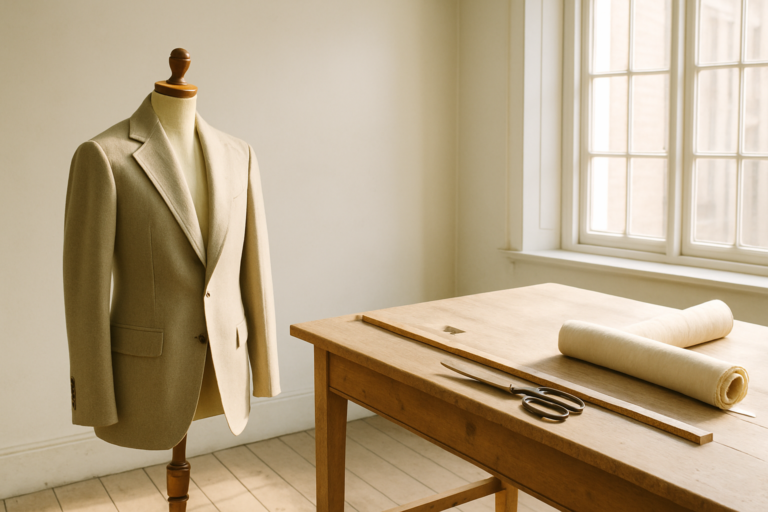
Hand-cut tailoring — the Savile Row model — starts from nothing. A cutter drafts an individual paper pattern, the garment is basted and fitted multiple times, and much of the stitching is done by hand. A single two-piece suit represents roughly 60 to 80 hours of skilled labor spread across months and several fittings. The price is essentially the wage bill.
Couture is the same idea applied to womenswear at the highest level, with pieces made to order over hundreds of hours in a small number of Paris houses.
Alongside the making sits a second system: allocation. The scarcest goods are not sold to whoever shows up with money. Hermès, for the best-known example, does not operate a formal public waitlist for its most sought-after bags; availability is limited, and access in practice tends to follow an established relationship with a store and a purchase history across the rest of the range. Hermès itself simply states that it cannot guarantee the availability of any given item. The effect is a market where the price is not the barrier — the queue is.
And there is now a third system: resale. Roughly half of luxury shoppers check the secondhand market before buying anything new, per Bain’s 2026 update, and online searches for vintage bags have more than doubled year over year. For a small number of references, resale prices sit above retail. For the vast majority of clothing, they sit far below.
What it costs
Start with the number that reframes everything. Across all US households, apparel and services came to $2,001 a year — about 2.5% of total spending — in the Bureau of Labor Statistics’ 2024 Consumer Expenditure Survey, against average total outlays of $78,535. Households in the highest income quintile spent about $150,342 in total. Clothing is a small line even for people with a lot of lines.
Now the pieces themselves.
Hand-cut tailoring. A two-piece suit from a Savile Row house starts in the region of £4,600–£6,500 — roughly $6,000 to $8,800 at recent exchange rates — with Huntsman publishing starting prices in that range. Rarer cloths push it well past that. Made-to-measure typically runs a half to a third of the hand-cut price; good off-the-rack tailoring, less again.
Rare fiber. Vicuña, a wild South American relative of the alpaca, produces the finest animal fiber in commercial use — around 12 microns — and Loro Piana notes the animals can be shorn only once every three years. The arithmetic is brutal: Robb Report puts vicuña cloth at roughly $1,800–$3,000 per yard, and it can take dozens of animals’ fleece to make one coat. A finished vicuña overcoat runs in the region of $25,000 to $30,000 and carries no visible marking whatsoever. That is the purest form of the inconspicuous signal: a coat that costs as much as a car and looks, to almost everyone, like a nice tan coat.
Status leather goods. Standard-leather Birkins are reported to retail in the $13,500 to $16,300 range in the US depending on size, with exotic skins running into six figures, and Sotheby’s own buying guide describes the gap between retail and resale that follows from limited availability. Prices have been raised repeatedly in recent years.
The ceiling. In July 2025, Jane Birkin’s personal prototype — the original, with its non-removable strap and years of wear — sold at Sotheby’s Paris for €8.6 million, about $10.1 million, a world record for any handbag, as CNN reported at the time. That price is not for a bag. It is for a founding document.
Hidden costs and tradeoffs
Maintenance and storage. Natural fibers demand upkeep: cleaning, pressing, moth control, cedar, rotation, resoling, and space. A large wardrobe of good clothing is a small operations problem, and above a certain scale it becomes somebody’s job.
The relationship is an obligation. Hand-cut tailoring binds a buyer to a specific cutter and house. Changing shops means starting the pattern over. Fittings take real time in real cities. The service is excellent and it is not portable.
The allocation treadmill. Where scarce goods are distributed by relationship, the practical route to buying the scarce thing is to buy a great many unscarce things first. Buyers end up spending in order to earn the right to spend, which is a strange position to be in and an expensive one.
Reputational exposure. Visible spending invites visible scrutiny, and increasingly that scrutiny reaches back up the supply chain. In July 2025, an Italian court placed Loro Piana under judicial administration over subcontractors alleged to have breached labor and safety law; the brand was not itself under criminal investigation, terminated the supplier relationship, and the measure was lifted early after the company completed a remediation program, with the company saying it had run 2,400 supply-chain audits since 2024. The episode is a reminder that “the finest materials in the world” is a claim about outcomes, not about how they were produced.
Depreciation. Almost all clothing loses most of its value the moment it is worn. The exceptions are narrow and well known, and treating them as the rule is the most common expensive mistake in the category.
What people get wrong
That the wealthy spend a large share of their money on clothes. They do not. Even at high incomes, apparel is a small percentage of outlays, and the research on high-income households points the other way — toward services, education, and time. Individual garments get more expensive faster than total clothing budgets grow.
That dressing quietly means dressing cheaply. The plain coat is usually the expensive one. Removing the logo does not remove the cost; it moves the cost somewhere a camera cannot find it. A cashmere sweater with no marking on it can cost several times a heavily branded one, and that is often exactly why it was chosen.
That clothing is an investment. For a handful of Hermès references and a small set of watches, resale can hold up or exceed retail. For everything else — including most designer clothing, including most handbags — resale runs at a steep discount. The record-setting Birkin was a piece of cultural history with a documented owner, not a category benchmark. Buying a bag expecting it to behave like the one Jane Birkin carried is a misunderstanding of what was actually sold.
That the logo is the signal. It still is, for one audience. But at higher wealth levels the signal has migrated into things that require knowledge to read: the fiber, the shoulder line, the fact that a garment fits a specific body and no other. That migration is not accidental. A signal anyone can buy stops sorting anyone, so the sorting moves to a signal that requires either money and knowledge, or a relationship that took years to build.
Bottom line
The answer to the Million Dollar Question is C — about $10.1 million, or €8.6 million, for Jane Birkin’s own original bag at Sotheby’s Paris in July 2025.
What that sale illustrates is the whole logic of the category in a single lot. The object was worn, scuffed, and functionally ordinary; nearly all of its value came from the story attached to it and the impossibility of getting another. Scaled down several thousand times, that is what wealthy households are buying across the rest of the wardrobe — not fabric by the yard, but fit, rarity, hours of human labor, and access to something that cannot simply be ordered. The spending stays a small line in the budget. The signal it sends keeps getting quieter, more expensive, and aimed at fewer people. Anyone trying to read wealth off a wardrobe from across the room is looking at the part that was designed to be seen, which is usually the least expensive thing in it.
Related reading: Watches: Collecting, Wearing, and the Resale Market · Jewelry: Beauty, Status, and Stored Value · Wealth Levels: Life at $1M, $10M, $100M, and $1B · Status: How the Wealthy Signal · Art: Collecting, Investing, and the Trophy Market