
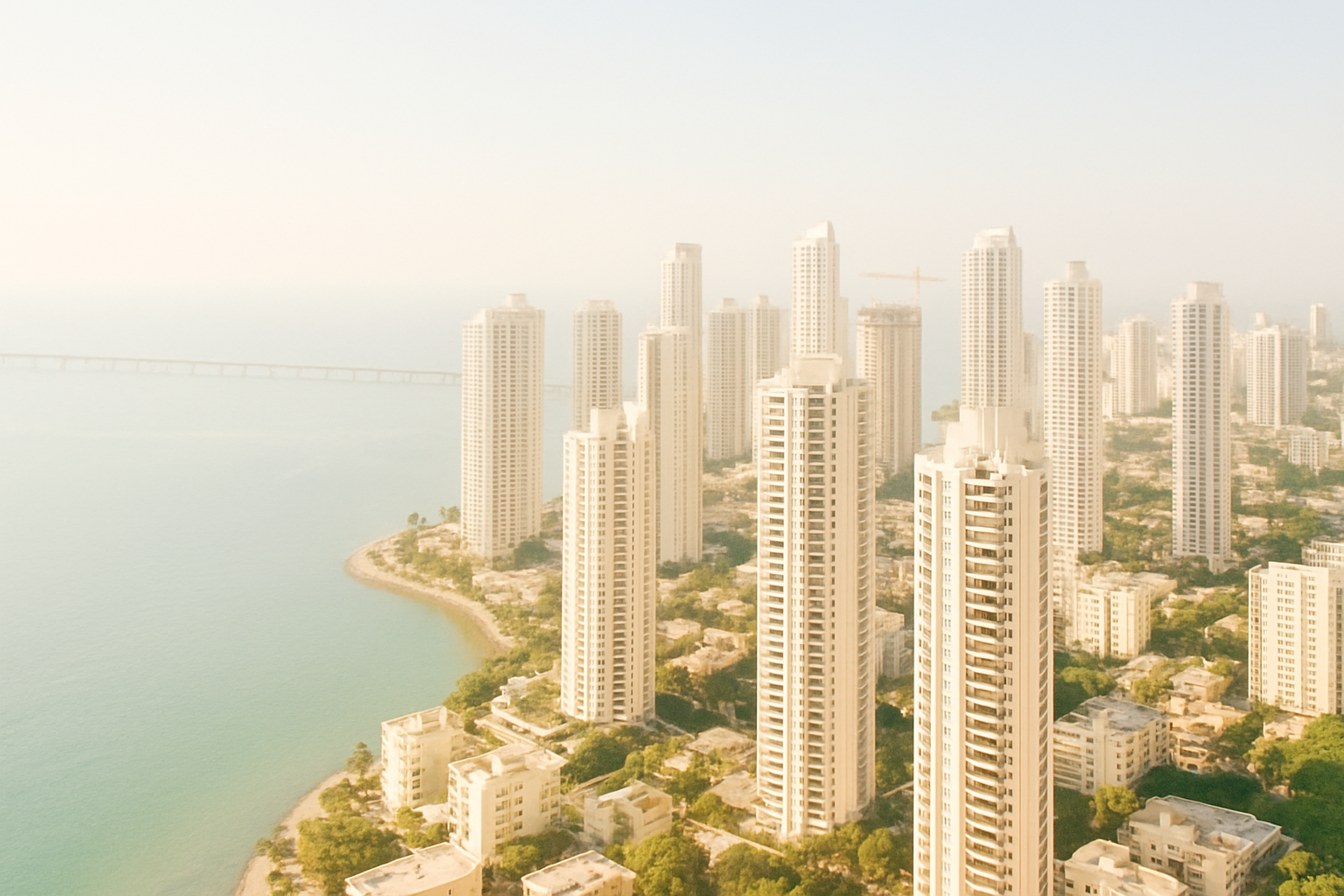
How Millionaires Live In: Mumbai
The Million Dollar Question: Knight Frank measures how many square metres of prime residential property one million US dollars buys in each of the world’s expensive cities. In Monaco it buys 16. In New York, 34. How much does it buy in Mumbai?
A) About 20 sq m B) About 34 sq m C) About 60 sq m D) About 96 sq mRead on for the answer.
Every city in this series has a local specific — the one fact that changes what wealth costs and how it behaves. In Lagos it was that the state does not supply what states usually supply, so the rich buy it privately.
Mumbai is close to the opposite. The state supplies a great deal: a low murder rate, working courts, a public land registry that publishes what people actually paid, toll-free expressways, a currency that has drifted rather than collapsed. What it does not supply is land. And what it does not let an individual do — as opposed to a company — is move money out of the country in any quantity.
Those two constraints shape almost everything about how a fortune behaves here. Money that cannot spread horizontally and cannot personally emigrate does the two things left to it. It goes up, and it stays inside the family holding company.
A note on currency. Rupee figures are converted at about ₹95.5 to the dollar on 28 August 2026. Indian reporting uses lakh (100,000) and crore (10 million); ₹1 crore is roughly $105,000. The rupee has fallen steadily rather than suddenly — it was near ₹83 two years ago — so dollar figures for Indian assets drift downward even when nothing local changes.
How the money is made
Four engines, and the ranking is not the one outsiders expect.
Inherited industrial conglomerates, which are still the base layer. The 2026 Barclays Private Clients Hurun India Most Valuable Family Businesses List values the country’s top 300 family businesses at ₹138 lakh crore — about $1.45 trillion — with the top three families alone worth roughly 9% of India’s entire listed market capitalisation. Ninety-five of the 300 are headquartered in Mumbai, against 58 in the Delhi region and 26 in Kolkata. Mumbai is not primarily where Indian fortunes are made. It is where they are held.
Petrochemicals, telecoms and retail, in one company. Forbes puts Mukesh Ambani at around $88 billion in late August 2026, almost all of it Reliance Industries. Gautam Adani, at around $85 billion, runs ports, power and airports out of Ahmedabad but is building one of his group’s largest projects in Mumbai. Both figures move daily and the two men trade places.
Pharmaceuticals and financial services. The buyer of India’s most expensive apartment is neither a technology founder nor a scion: Leena Gandhi Tewari chairs USV, a Mumbai pharmaceutical company. Pharma, private banking and asset management have produced a deep bench of nine- and ten-figure fortunes that almost never get written about abroad.
And then the listed-equity boom that made everyone else richer. Hurun’s India Rich List for 2025 counted 451 Mumbai entrants — up from 255 in 2021 — and 91 billionaires in the city; its global list in March 2026 put India third in the world at 308 billionaires, with Mumbai on 95.
How many people this actually is. Henley & Partners and New World Wealth’s most recent city ranking, the World’s Wealthiest Cities Report 2025, places Mumbai 27th globally with more than 51,000 resident dollar millionaires and 25 billionaires, and 69% millionaire growth over the decade to 2024. Delhi is the only other Indian city in the global top 50, at 31,200.
Two health warnings on that number. It is a modelled estimate from a private research firm, not a census. And Henley’s related migration work has been seriously criticised for resting substantially on scraped LinkedIn profiles rather than tax residence; Henley’s 2026 migration report dropped country-level flow estimates altogether. We use the city counts because they are the best available and directionally consistent with Hurun’s independent count, not because we trust their third digit. Fifty-one thousand millionaires in a metropolitan area above 20 million is about one in four hundred — a far denser wealthy population than Lagos, a far thinner one than New York.
The land problem
Here is the answer to the Million Dollar Question. Knight Frank’s Wealth Report 2026, published in April, finds that one million dollars buys 96 square metres of prime Mumbai property, against 16 in Monaco, 33 in London, 34 in New York and 62 in Dubai. The answer is D.
That looks like cheapness, and against Monaco it is — though note this measures prime property, not ordinary housing. It is also closing fast: Mumbai prime prices rose 8.7% year on year, making it the tenth fastest-appreciating prime market in the world, up from 21st. The same $1 million bought 106 square metres in 2020.
The reason is geography, and it is genuinely unusual. The urban planner Alain Bertaud’s study of Mumbai’s floor-space conundrum makes the point with one statistic: within 25 kilometres of Churchgate, water occupies 66% of the surface area. In Jakarta the figure is 22%; in Seoul, 5%. The built-up area inside that radius is 212 square kilometres, against Seoul’s 360 and Jakarta’s 1,438. Five road crossings connect the peninsula to the mainland.
Then the city compounded the geography with policy, and then stopped. Nariman Point was zoned at a floor space index of 4.5 in 1964; most of the island city was cut to 1.33 under the 1991 rules and stayed there for a generation, which is Bertaud’s central complaint — Mumbai combined close to the lowest permitted density in the world among cities above five million people with among the highest actual built density, and about 4.5 square metres of residential floor space per person when he measured it in 2009.
The current development plan reversed that. Under DCPR 2034 the base index is still low, but premium charges, transferable development rights, fungible area and cluster and transit-oriented incentives take the achievable figure far higher — how much higher is disputed, with Knight Frank’s redevelopment study citing up to 5.4 on roads above 18 metres and more for old cess buildings, against summaries putting the practical ceiling nearer 3.0, which is also what Knight Frank estimates projects actually achieve.
Which means permission is no longer the binding constraint. Occupancy is. Every buildable plot in Mumbai already has a building on it and people inside it, so new supply is a negotiation rather than a planning decision. Knight Frank recorded 910 society-level redevelopment agreements between 2020 and mid-2025, which it estimates could yield 44,277 free-sale homes worth ₹1.31 trillion by 2030 — 73% in the western suburbs, only 416 units in South Mumbai, on a supply-side estimate the firm cautions ignores financing and phasing. And the city builds up: the tall-buildings council’s database records 113 completed buildings above 150 metres, 15th in the world, ahead of Toronto and Singapore. New supply in Mumbai means buying somebody out first.
And the prices are public, which is the second unusual thing. Maharashtra runs an official e-search portal for registered property documents, with Mumbai records digitised back two decades, which is why India’s trophy transactions are reported with the buyer’s name, the carpet area and the stamp duty paid rather than as broker gossip. In May 2025 Leena Gandhi Tewari bought two duplexes at Naman Xana in Worli for ₹639 crore — about $67 million — for 22,572 square feet of carpet area, or ₹2.83 lakh a square foot. That is roughly $32,000 a square metre, but measured on carpet area, which is not how the international indices count; on a comparable basis it is nearer $22,000. Even discounted, one Worli duplex now trades at close to the average prime rate Knight Frank implies for New York, in a city whose average prime rate is a third of New York’s. The record and the average have come apart. Weeks later a company associated with the Godrej family’s Tanya Dubash paid ₹225.76 crore for a duplex in the same tower: ₹13.55 crore of stamp duty, exactly 6%, and a registration fee of ₹30,000, because the registration fee is capped.
Antilia belongs in this section, not the celebrity one. Mukesh Ambani’s house on Altamount Road is 27 storeys and 173 metres tall, completed in 2010 — which places it somewhere in the eighties among Mumbai buildings by height — on a plot of 4,532 square metres. Almost every number attached to it is unsourced. The “$1–2 billion” cost traces to a Forbes piece written in April 2008, two years before the building was finished; neither Ambani nor Reliance has ever published a construction figure; the “600 staff” has no named source at all; the rooftop helipads were never cleared to operate.
The one detail worth keeping is the architects’. In 2007 Perkins & Will told Architectural Record the building is largely a corporate meeting facility and the family occupies roughly 35,000 square feet at the top — under a tenth of the 400,000 square feet everyone quotes. “The world’s largest house” is a category error. It is a tower with a house on top, which is what you build when the ground is the scarce thing.
The land underneath was an orphanage trust’s, sold in the early 2000s for ₹21.05 crore — roughly $4.3 million at the rate then — to Antilia Commercial Private Limited rather than to Ambani personally. Maharashtra’s Waqf Board later told the Bombay High Court the sale breached the Wakf Act; the buyer’s answer was that the trust was registered under the Bombay Public Trust Act, so the Waqf Board had no jurisdiction. On 28 July 2025 a division bench dismissed the long-running public interest litigation, holding the question already adjudicated. No court has found the sale unlawful.
Three kilometres north is Dharavi: about 259 hectares, redevelopment awarded in November 2022 to Adani Properties on a ₹5,069 crore bid through a vehicle 80% owned by Adani and 20% by the state. The project’s live counter shows 99,068 homes numbered and 91,325 surveyed, and eligibility turns on a date: a ground-floor residence occupied on or before 1 January 2000 qualifies for rehousing outright, occupancy between 2000 and 2011 qualifies on payment, occupancy from 2011 to November 2022 qualifies only for rental housing — and anyone who arrived after that is not eligible at all. The losing 2018 bidder lost in the Bombay High Court in December 2024 and obtained a Supreme Court notice, without a stay, in March 2025.
The point is not the moral contrast, which writes itself. It is that in Mumbai, slum redevelopment and luxury supply are the same transaction. Under the project’s reported terms, developers elsewhere in the city are required to source a share of their transferable development rights from Dharavi — so the towers going up in the suburbs are, in a literal accounting sense, built on entitlements generated by rehousing Dharavi.
What a $5 million household looks like
Take a household with $5 million and put it in Worli, Bandra West or the older parts of Malabar Hill.
The apartment is the balance sheet. At Knight Frank’s prime rate, $5 million is under 500 square metres — a large flat, not a compound, and in a trophy tower it is a good deal less. Buying it costs another 6% in Maharashtra stamp duty (5% base plus a 1% metro cess; 5% for a female sole buyer), plus that capped ₹30,000 registration fee. On a ₹40 crore apartment, stamp duty is ₹2.4 crore — a real number, and one of the few places the Indian state taxes wealth at all.
School is priced in dollars and looks like Manhattan. The American School of Bombay charges roughly $34,450 for K–5 and $37,180 for Grades 11–12, with a one-time enrolment fee of up to $30,000. Dhirubhai Ambani International School publishes no schedule; reported annual tuition runs from about ₹1.7 lakh in the early years to roughly ₹9.65 lakh — about $10,100 — in Grades 11 and 12, and the middle-school figure differs by a third between aggregators.
Staff are plural, and this is where a Mumbai household diverges hardest from a Western one at the same net worth. There is no reliable wage survey; agency listings put a live-in maid at roughly ₹20,000–40,000 a month, or $210–420, with a 20–25% premium in South Mumbai. Maharashtra has no notified minimum wage for domestic workers — the work is not a scheduled employment, and the state’s 2008 welfare-board legislation created registration and benefits rather than a floor. Treat those wage figures as indicative; nobody publishes a good one.
Cars are the opposite story. An imported luxury car carries a basic customs burden of roughly 110% — the 2025 budget cut the headline rate and added a cess, leaving the load broadly unchanged — and then GST at the 40% demerit slab applies on top of the duty-inclusive value. A car is one of the few things that costs meaningfully more here than in London.
And the commute, unlike São Paulo’s, was solved publicly. The Atal Setu sea link opened in January 2024 at an approved ₹17,843 crore, the coastal road is toll-free, and the Bandra–Worli Sea Link costs about a dollar. The by-the-seat helicopter operator BLADE India flies Juhu to Pune and Shirdi — intercity, not rooftop to rooftop, and private helipads in residential areas need approvals rarely granted. In São Paulo the rich fly over the traffic. In Mumbai they moved closer to the office, which is why the peninsula is priced the way it is.
The security picture, and why Mumbai is not Lagos
This is where the comparison with the last city in this series breaks completely, because the stereotype runs the other way.
India’s National Crime Records Bureau published Crime in India 2024 in May 2026. Mumbai recorded 107 murders, a rate of 0.6 per 100,000 — among the lowest of the 19 metropolitan cities NCRB tracks, against Delhi’s 3.1 and an all-India rate of 1.9. By murder rate this is one of the safer very large cities in the world.
So the wealthy here are not buying protection from ambient street crime the way a Lagos or Johannesburg household is. They are buying against two narrower things.
The first is terrorism, and the reason is 26 November 2008, when ten gunmen killed 166 people across the Taj Mahal Palace, the Oberoi, Nariman House and Chhatrapati Shivaji Terminus. Indian luxury hotels have looked like airports ever since — undercarriage scanners, walk-through detectors, lift-level access control. The cost is mostly unpublished, but one line item surfaced this year: in July 2026 the municipal corporation served the Taj a ₹22.3 crore demand notice for occupying public road space with the anti-ram bollards it installed after the attacks, backdated to 2009.
The second is the state’s own VIP protection system, which has no Western equivalent. India grades protectees X, Y, Z and Z+, with Z+ carrying around 55 personnel including armed central police commandos. Mukesh Ambani received Z cover in 2013 and was upgraded to Z+ in September 2022; Gautam Adani was granted Z the same year. Crucially, in the Ambanis’ case the family pays: in February 2023 the Supreme Court directed that their Z+ cover extend across India and abroad at their own cost. The security is public, the bill is private, and the allocation is a government decision rather than a purchase.
Below that tier the private guarding industry is large and badly measured. The trade body CAPSI claims a ₹1 lakh crore industry employing roughly ten million people; the Home Ministry told Parliament in 2022 there were 16,427 valid licences and that agency numbers are not centrally maintained. We cannot reconcile the two.
The money that cannot leave
Now the constraint that has no analogue in any other city in this series.
A resident Indian individual may remit US$250,000 per financial year abroad under the Reserve Bank’s Liberalised Remittance Scheme — a limit set in 2015 and unchanged since — and that one cap has to cover travel, school fees, medical bills, gifts to relatives, foreign property and foreign shares alike. Overseas investment by an individual counts against the same allowance. Above ₹10 lakh, remittances for investment purposes carry a 20% tax collected at source, refundable against the year’s tax bill but a cash-flow cost meanwhile; the 2026 budget cut the rate to 2% for education and medical remittances and left the investment rate alone.
Four members of a family can therefore legally move $1 million a year between them. That is a two-per-cent drip against a $50 million fortune and nothing at all against a $5 billion one. The aggregate reflects it: total outflows under the scheme in 2025-26 were $28.98 billion, of which $16.87 billion was international travel; foreign equity and debt took $2.65 billion and overseas property $528.7 million.
But be careful what that proves. Indian money does leave the country — it just cannot leave personally. An Indian company may commit up to 400% of its net worth, or a billion dollars a year, abroad under the automatic route, and Indian firms made outward commitments of roughly $48.6 billion in 2025-26. A family member who becomes non-resident escapes the cap entirely. Mauritius and Singapore have been among the largest sources of inbound investment into India for two decades, which tells you what has been sitting offshore all along. And the scheme caps flow, not stock: money already outside compounds outside.
So the correct statement is narrower than the usual one. A wealthy Indian family cannot do what a wealthy Lagos family does — buy the London house in its own name, quietly, this year. It can move capital as a company. The individual is fenced in; the holding company is not.
There is one recent attempt to square this at home. At the GIFT City financial centre in Gujarat, the regulator’s 2025 fund management regulations allow a Family Investment Fund with a $10 million minimum corpus — an offshore-style vehicle on Indian soil. Domestic uptake has been slow, because resident Indians can fund it only $250,000 at a time; the first successful registration under the new rules, in April 2026, went to a foreign family.
Meanwhile most of the money stays, and needs somewhere domestic to go. That is the demand side of the property market described above, and it is why the family office arrived here so fast: from about 45 in 2018 to more than 300 today, managing over $30 billion.
What status actually signals
Status in Mumbai runs on different rails from New York or London, and three of them are worth naming.
Control, not liquidity. Promoter families still own 49.8% of the market capitalisation of NSE-listed companies as of December 2025 — a five-year low, and still roughly half the market, with private Indian promoters alone on 32.2%. Selling down is a status event in the wrong direction, which is why so much Indian wealth is illiquid by choice. SEBI’s rule that at least 25% of a listed company be publicly held is, for many families, a ceiling they sit against rather than a floor they clear.
The family settlement is the local equivalent of the estate plan. India abolished estate duty with effect from 16 March 1985 and abolished the wealth tax from assessment year 2016-17. There is no inheritance tax and no wealth tax. The new Income-tax Act, 2025, in force from 1 April 2026, was explicitly a rewrite “without altering the underlying tax policy” — so it introduced neither. Long-term capital gains on listed equity sit at 12.5%, short-term at 20%, and the top marginal income tax rate lands near 39% under the new regime.
What breaks Indian fortunes is therefore not the state. It is the family, and the instrument is a negotiated settlement agreement. The Ambani brothers’ split rested on a family arrangement dated 18 June 2005, described in the Supreme Court’s later judgment in the litigation that followed. The Godrej group divided under a family settlement agreement of 30 April 2024, closed that July, separating the listed Godrej Industries Group from the unlisted Godrej Enterprises Group. Reliance’s own succession was set out at the 2023 annual meeting, when Mukesh Ambani said he would remain chairman five more years and the board appointed his three children as non-executive directors.
Giving is institutional, and mostly mandatory. The EdelGive Hurun India Philanthropy List 2025 recorded 191 philanthropists giving ₹10,380 crore — about $1.1 billion — led by Shiv Nadar at ₹2,708 crore and Mukesh Ambani at ₹626 crore. Set that against corporate social responsibility, which India made compulsory: Section 135 of the Companies Act requires qualifying companies to spend 2% of average net profits, and the government’s own data put FY2023-24 CSR spending at ₹34,909 crore. The mandate moves roughly three times what the country’s largest individual donors do voluntarily — a real difference from American philanthropy, where the named foundation is both the main channel and the status signal.
The cricket franchise is the other institutional signal, and unusually it has a published price: Houlihan Lokey values the IPL at $20.6 billion in 2026 and the Mumbai Indians brand at $264 million, against Reliance’s winning $111.9 million bid at the 2008 auction.
What people get wrong
That the Ambani wedding had a price tag. It did not, or none anyone can source. The July 2024 ceremony generated estimates from $75 million to $600 million, and a survey of them shows the widely repeated $600 million figure has no attribution behind it at all. The family has never disclosed a number, and the serious papers covered the scale without certifying a price.
That “no inheritance tax” makes Indian dynasties durable. It removes one cause of dissolution and leaves the others intact. A tax-free transfer to four heirs still divides the holding company four ways, and the Godrej and Ambani cases are what that looks like in practice.
That capital controls have trapped Indian wealth at home. Individuals are capped at $250,000 a year, and personal overseas property buying under that scheme came to $528.7 million across the entire country last year. But Indian companies committed roughly $48.6 billion abroad in the same period, and the Mauritius and Singapore structures are decades old. The constraint binds people, not balance sheets — which is one more reason the balance sheet is where Indian wealth lives.
That Antilia tells you something about Mumbai housing. It tells you about one family. What tells you about Mumbai housing is an island with five road exits, about 4.5 square metres of dwelling space per person the last time anyone credibly measured it, and 910 housing societies queuing to be knocked down and rebuilt.
Bottom line
Wealth in Mumbai buys the same things it buys anywhere. What differs is the shape of the constraint.
In Lagos, the first tranche of money buys reliability, because the state does not supply it. In Mumbai the state supplies reliability tolerably well — the roads got built, the murder rate is low, the courts function slowly but they function, and the registry will tell you what your neighbour paid. What it does not supply is space, and what it will not let an individual do is take money out. So the money piles up on a peninsula that is two-thirds water inside its own commuting radius, in towers on land that had to be cleared of something else first, held through companies the family will not sell down — because the company is both the thing that compounds and the only entity here with a passport.
The absence of an inheritance tax is the most underrated fact about Indian wealth. It means the pressure that breaks up fortunes in Britain or the United States does not exist here — and that the pressure which does break them up, the family itself signing a settlement agreement, carries the entire load.
Lagos wealth is defended against the currency. Mumbai wealth is defended against the siblings.
Methods and sources. City millionaire counts are Henley & Partners and New World Wealth modelled estimates from the World’s Wealthiest Cities Report 2025, not a census; no 2026 edition of that report appears to exist, and Henley’s separate migration reporting has been substantively criticised, which is why the millionaire count is used and no migration flow figure is. Billionaire counts are Hurun’s and are estimates. Net worth figures for named individuals are Forbes’ real-time estimates on the dates given. Prime property comparisons are Knight Frank’s Wealth Report 2026, measuring what US$1 million buys at prime rates; transaction figures are from registered documents reported via Business Standard and are verifiable through Maharashtra’s public e-search portal, which distinguishes Mumbai from most emerging-market property markets. Neighbourhood per-square-foot averages were deliberately omitted: the listing portals disagree by wide margins and none of them publishes registry medians. Geography figures are Alain Bertaud’s 2013 analysis, which remains the standard reference; his floor-space-per-person estimate is dated 2009 and is described that way. The permitted-density figures under the 2034 development plan are genuinely contested between sources and are reported as a range rather than reconciled. Skyscraper counts are the Council on Tall Buildings and Urban Habitat’s completed-building figures, which are lower than Wikipedia’s because Wikipedia counts topped-out and under-construction towers. Antilia’s dimensions are CTBUH’s; every cost and staffing figure attached to that building in circulation is unsourced media repetition and is described that way above rather than repeated. Dharavi figures are from the project’s own official portal and from the reported bid; the population is genuinely unknown because the census enumerates wards, and the project’s total cost could not be traced to a primary government resolution, so it is not given. Crime figures are NCRB’s Crime in India 2024, published May 2026; NCRB computes city rates on 2011 census populations, which means Mumbai’s true current rate is likely lower than stated. Private security industry figures are a trade body’s claim and are contradicted by the Home Ministry’s own licence data; both are given. Domestic wage figures come from staffing agencies with a commercial interest and no audit, and should be read as indicative only. School fees for Dhirubhai Ambani International School are media-reported and differ by a third between aggregators; the school publishes nothing. Tax provisions are cited to the Income Tax Department, the budget memorandum and the government’s own press release on the Income-tax Act, 2025. LRS limits and flows are RBI data as reported. Membership terms for Mumbai’s older clubs were checked and could not be sourced to anything publishable — the widely circulated thirty-year waiting list belongs to the Delhi Gymkhana, not the Bombay Gymkhana, and is not repeated here. All rupee conversions use a single dated rate and will drift.
This draft was fact-checked line by line before publication and the check changed it substantially in two places. First, an earlier version said Mumbai’s floor space index is still 1.33 under the current development plan and built the “no room to build” argument on that. It is not: 1.33 is the 1991 figure, and the 2034 plan raised the achievable density considerably. The argument has been rewritten around what is true — permission is no longer the binding constraint, occupancy is — which is a better version of the same point and now connects the redevelopment and Dharavi passages properly. Second, an earlier version said flatly that Indian capital cannot leave the country. That is true of individuals and false of companies, which may commit up to 400% of net worth abroad under the automatic route and committed roughly $48.6 billion in the last financial year; the section has been rewritten to say the narrower and more interesting thing, which is that the fence runs around the person rather than the balance sheet. The check also removed an unsourced ₹150 crore valuation attached to the Antilia land sale that implied bad faith without support, corrected a comparison that mixed two different property datasets mid-sentence and compared a single record transaction to a city average, corrected a Knight Frank ranking of price growth that had been read as a ranking of price level, added the fourth and harshest Dharavi eligibility tier that the original omitted, dropped an unsourced company count and an unsourced Manhattan zoning figure, narrowed a claim about who pays for VIP security from businesspeople generally to the one family the cited order concerns, and replaced three-significant-figure billionaire net worths with rounded ones.
Related reading: How Millionaires Live In: Lagos · Dynasties: Families That Turn Wealth Into Power · Inheritance: The Transfer of Wealth Between Generations · ZIP Codes: Where the Wealthy Live · Residency and Citizenship: Why the Wealthy Buy Options Across Borders · Family Office: How the Very Rich Organize Their Lives and Money