
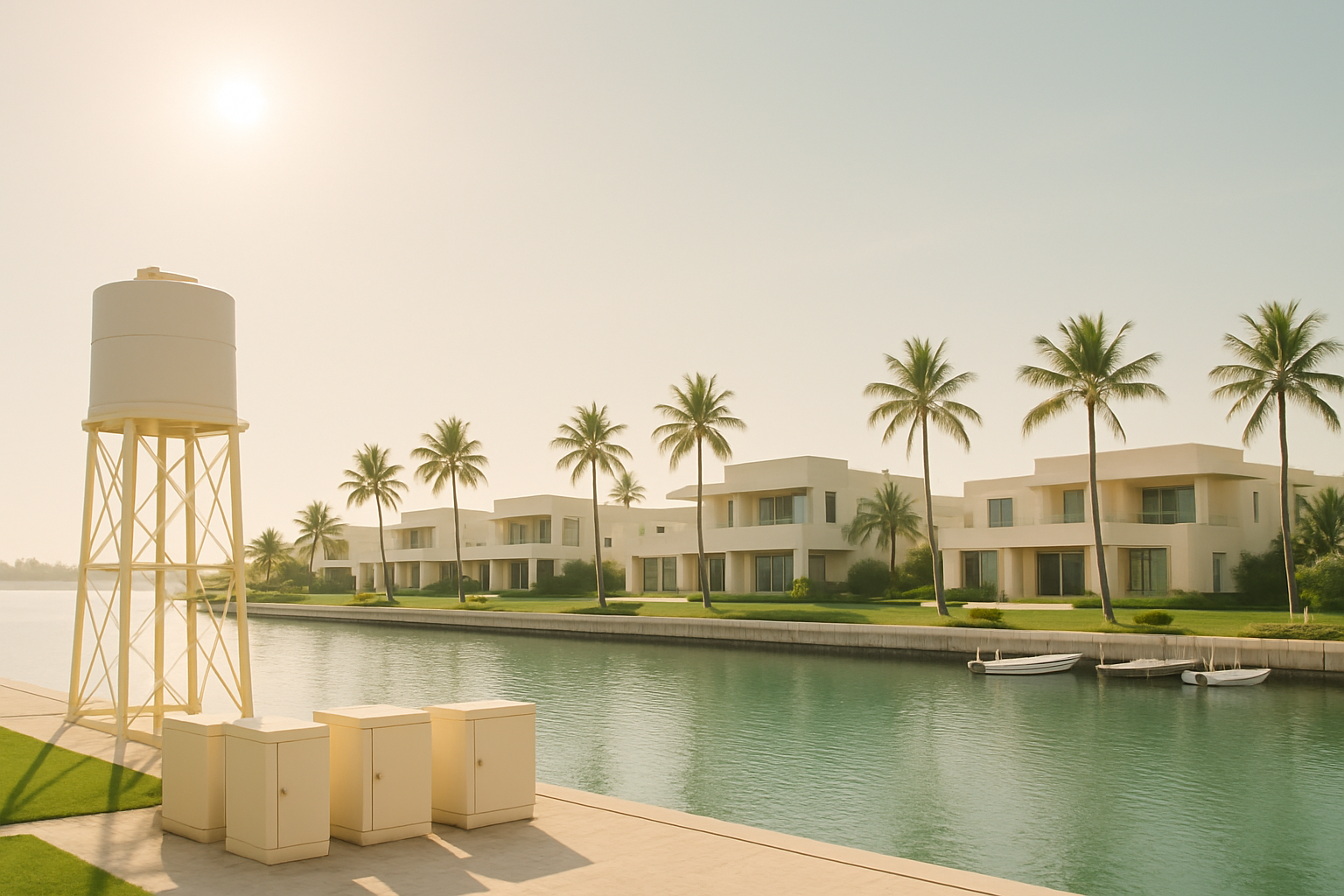
How Millionaires Live In: Lagos
The Million Dollar Question: Nigeria’s national grid has an installed capacity of about 13,600 megawatts. On an average day in January 2026, how much of that was actually available to send out to a country of roughly 240 million people?
A) About 11,500 MW B) About 8,200 MW C) About 4,900 MW D) About 2,100 MWRead on for the answer.
Every city in this series has a local specific — the one fact that changes what wealth costs and how it behaves. In Lagos it is that the state does not reliably supply the things a state usually supplies, so anyone with money buys them privately.
That sounds like a hardship story. It is not, or not only. It is an accounting story. A wealthy household in Lagos runs a small utility company on the side — power generation, water treatment, waste, road maintenance, security — and pays for all of it out of the same income that, in another city, would buy a second home. The money is real and the standard of living is high. It is just spent on a different list.
This piece works through that list, and then through the thing that has done more damage to Lagos fortunes in the last three years than any of it: the exchange rate.
A note on currency, because the whole piece depends on it. Naira figures are given as naira, with dollars converted at the official rate on 10 August 2026, about ₦1,363 to the dollar. The parallel market on the same day was nearer ₦1,410–1,425. Which rate you use changes every number below by four or five per cent, and there is no neutral choice.
How the money is made
Four industries, and they are not the four people expect.
Oil, but less than you think. Nigeria is a major exporter, but very little of the private wealth in Lagos was made by pulling crude out of the ground. It was made adjacent to it — trading, distribution, servicing, licences. The one genuine industrial exception is the Dangote refinery in the Lekki Free Trade Zone, which reached its full 650,000 barrels a day in February 2026, making it the largest single-train refinery in the world. It cost roughly $20 billion and took about a decade. Nigeria spent fifty years exporting crude and importing petrol; one private project reversed that.
Cement, which is the actual answer. Africa’s largest fortune is a building-materials fortune. Forbes’ 2026 Africa ranking puts Aliko Dangote at $28.5 billion — its global list carries $28.6 billion — built primarily on Dangote Cement. The clearest single-year move belongs to Abdul Samad Rabiu of BUA, whose estimated net worth rose 120% — about $6.1 billion — to $11.2 billion, on a 135% rally in BUA Cement shares, taking him from sixth to third on the continent.
Cement is the tell. In a country building itself, the person selling the inputs captures more reliably than the person doing the building.
Telecoms. Mike Adenuga, at about $6.5 billion, made his money in mobile networks through Globacom and in oil through Conoil. Licensed network businesses have been the second great fortune engine here, for the ordinary reason that a licence to serve two hundred million people is worth having.
Banking, and then fintech. Nigerian commercial banking produced a deep bench of nine-figure fortunes across the 1990s and 2000s. Fintech is now doing the same thing faster. As of early 2026, Flutterwave is valued at roughly $3 billion, OPay at $2.75 billion, Moniepoint and Interswitch at about $1 billion each, and Paystack at $0.5 billion, having been acquired by Stripe for $200 million in 2020.
That last group matters out of proportion to its size, because it is the first Lagos wealth engine that is dollar-denominated at the source. A cement fortune is a naira fortune with a currency problem. A venture-funded fintech is priced, funded and often banked in dollars. Two different asset classes wearing the same suit.
How many people this actually is. Henley & Partners and New World Wealth’s Africa Wealth Report 2025 puts Lagos at about 3,400 resident dollar millionaires, inside a national total of roughly 7,200 millionaires, 20 centi-millionaires and three billionaires; a separate Henley exercise counts 12 centi-millionaires in the city. In a metropolitan area of more than twenty million, 3,400 works out at about one dollar millionaire for every six thousand people. It is a very small room.
What a $5 million household looks like
Take a household with $5 million in net worth — comfortably inside the top tier here, nowhere near the top of it — and put it in Ikoyi, Victoria Island or the better part of Lekki.
Start with the house, and immediately run into the fact that nobody agrees what one costs. Banana Island, the reclaimed peninsula off Ikoyi that functions as the city’s most concentrated address, is listed on two major portals at prices five times apart. Nigeria Property Centre puts the average asking price for a house there at about ₦4.5 billion — roughly $3.3 million. PropertyPro puts the same average near ₦825 million, about $605,000. Dollar-denominated listings on the same island run from around $600,000 for a two-bedroom apartment to $8 million for a waterfront residence.
None of these are transaction prices. Lagos has a land registry but no public price register, so there is no verified record of what anything sold for — only what sellers asked. A five-fold gap between two portals covering one small island is the clearest possible statement of how thin and how opaque this market is.
School behaves the same way. Published figures for British International School Lagos vary by a factor of four depending on which aggregator you read — one puts annual tuition at ₦4.5 million to ₦9.1 million, another at ₦18 million to ₦35 million — and the school publishes no schedule. That is $3,300 to $26,000 a child. Even at the top of the range it is affordable against a $5 million balance sheet, which is the point: the binding constraint on this household is not the price of anything educational or imported.
Staff are plural and normal: driver, cook, house help, security, gardener, often a nanny. Domestic labour is inexpensive relative to a fortune of this size, so a Lagos $5 million household typically employs more people than a $5 million household in Chicago or Munich does. Cheap labour and expensive infrastructure produce a household that is staff-heavy and machine-light.
And the third line, the one with no equivalent in any wealthy Western city, is the plant.
The infrastructure tax
Here is the answer to the Million Dollar Question. Nigeria’s regulator, NERC, reports installed generating capacity of 13,625 megawatts. In January 2026 the average actually available for dispatch was 4,901 megawatts, a plant availability factor of 36%. The answer is C.
For roughly 240 million people, that is about 20 watts a head — two LED bulbs’ worth, if it were shared evenly, which it is not.
How much more is lost between the power station and the customer is genuinely disputed. The generators’ association says more than 2,500 megawatts a day is stranded because the transmission network cannot evacuate it; the transmission company rejects that and puts undispatched capacity at 345 megawatts, arguing the shortfall is upstream. Nobody outside the industry can adjudicate that. What is not in dispute is that both a generation problem and a delivery problem exist.
The consumer-facing structure is a banding system, A to E. Band A customers pay the premium tariff in exchange for a promised minimum of twenty hours a day, and that tariff went from ₦67 to ₦225 per kilowatt-hour in April 2024 before being revised down; Lagos distributors now charge ₦209.50, about 15 US cents, roughly what a household in Germany or California pays.
Band A is a feeder classification rather than a neighbourhood one, and it covers only about 15% of customers nationally — but most of the affluent island feeders are in it. That is itself the point: the premium tariff is what you pay to be inside the small fraction of the country the grid is actually trying to serve.
Except twenty hours is a promise, not a delivery, and a household cannot run on a promise. So it also owns generators — usually two, so one can be serviced — plus an inverter bank and batteries to cover the switchover, plus a diesel tank, plus somebody whose job includes ordering diesel. Diesel self-generation runs at roughly $0.54 to $0.62 a kilowatt-hour on a full-cost basis, against about $0.15 on the grid: three to four times the tariff.
Nationally, the World Bank counts more than 22 million generators supplying about 26% of Nigerian households and 30% of small businesses. The rich end of that distribution is not buying a small petrol set for the evenings. It is buying a redundant private power station and running it as the primary source, with the national grid as backup — an inversion of what the words “grid” and “generator” imply.
Water works the same way. Municipal supply is not something a Lagos household plans around, so the house has a borehole, a treatment stage, storage and a pump — and the pump needs power, which is why diesel delivery to borehole pumps is a standing productised service in Lagos rather than an emergency call.
Bundle it and you get the service charge. On a rented apartment in a decent Lagos estate the components are itemised: generator diesel or gas ₦15,000–₦60,000 a month, water ₦3,000–₦10,000, satellite internet ₦25,000–₦38,000, waste collection ₦1,500–₦4,000 — call it $33 to $83 all in. Those are apartment-scale numbers. A standalone house on Banana Island running two generators and its own borehole is an order of magnitude above that, and nobody publishes the figure.
The logical end point is to stop patching and build the utility from scratch, which is what Eko Atlantic is: nine million square metres reclaimed from the Atlantic behind a sea revetment engineered for a thousand-year storm, with its own gas-fired power plant, its own water treatment and underground drainage, and explicit independence from the national grid. Reclamation passed 80% by early 2026. Published resident targets vary between 250,000 and 300,000 depending on the document, which is a fair signal of how much of it is still projection.
Eko Atlantic gets written about as a luxury development, and it is one. But the product it is selling is municipal competence, supplied privately, at a price. That is the Lagos wealth story in one parcel of land.
The security tax
The numbers here need handling carefully, because the well-known national figures do not describe the Lagos rich — and because the headline source is contested.
Nigeria’s National Bureau of Statistics reported about 2.24 million kidnapping incidents and ₦2.23 trillion in ransom paid between May 2023 and April 2024, with roughly 65% of affected households paying and an average payment of ₦2.7 million — under $2,000 at today’s rate. Two caveats, both material. The NBS pulled the report from its website within days and said its systems had been compromised; the police disputed the figures, and the methodology has been publicly criticised. And converting a trillion-naira annual total is awkward in its own right: struck at rates prevailing across that year it lands somewhere between about $1.7 billion and $2.4 billion, and considerably higher at pre-float rates.
Read those numbers properly anyway. An average ransom of ₦2.7 million is not a wealth-target number. It is a mass-market number. As SBM Intelligence’s work on the economics of the trade sets out, Nigerian kidnapping is overwhelmingly rural, high-volume, and aimed at ordinary households who can raise a few thousand dollars among relatives. The scale is a national tragedy. It is not primarily a description of what happens to millionaires in Ikoyi.
What the wealthy in Lagos buy against is narrower: targeted abduction of a known person, usually involving inside information, a driver, or a predictable routine. Hence the spending pattern — gated estates with layered access control, vetted drivers, varied routes, discretion about children’s schedules.
The most expensive security product in Lagos, though, is not a guard. It is not having to be on the road. Traffic between the mainland-facing suburbs and the island business district is measured in hours: Badore to Victoria Island can take four hours by road and about twenty minutes by boat. The state has been pushing water transport hard — the Omi Eko programme launched at the Five Cowries Terminal in Ikoyi in October 2025 with a fleet of electric ferries and full rollout targeted for 2030 — but the wealthy solved this privately first, with their own boats and, above all, by living on the island so the commute never happens.
Buying a house in Ikoyi rather than a larger house in Lekki is usually described as a status purchase. Much of it is a time-and-exposure purchase.
The currency, and where the money goes when it leaves
Now the part that dominates everything else.
On 14 June 2023 the Central Bank of Nigeria abandoned its managed exchange rate. The official rate that day was ₦464.5 to the dollar; a week later it was ₦708.2 — a third of the currency’s value gone in seven days. It kept going: an average near ₦1,450 through 2024, and about ₦1,363 official today.
Do the arithmetic from a Lagos household’s point of view. A naira asset worth $1 million on the eve of the float — a house, a share portfolio, a business valued in local terms — is worth about $341,000 today, having lost none of its local value and having been neither sold nor mismanaged. Roughly 66% of its dollar value evaporated because the unit of account moved.
That is why the millionaire counts fell so hard, and the two figures in circulation are not in conflict once you check the base years. Henley’s Africa Wealth Report 2025 has Nigeria’s dollar-millionaire population down 47% from 2015 to 2025. Its Private Wealth Migration Report 2025 has it down 53% from 2014 to 2024, from 15,000 to 7,200. Different reports, different windows, same finding: something close to half the country’s dollar millionaires stopped being dollar millionaires, mostly without anything happening to them personally.
There is a defence, and every wealthy household here knows what it is: do not hold naira. The result is a set of behaviours that look like paranoia from outside and are simply arithmetic from inside — dollar bank accounts where permitted, dollar-priced property, hard assets, and, at the top, assets in another country entirely.
Where it goes when it leaves is comparatively well documented, though not as well as the phrase “public register” implies. Reporting on Nigerian banking principals buying in London includes Femi Otedola’s £53 million house in St John’s Wood and Access Bank chief executive Roosevelt Ogbonna’s reported £15 million purchase in Hampstead — about $72 million and $20 million at current rates. The same reporting links the late Herbert Wigwe, who died in 2024, to over 100 London properties through offshore entities; that is a journalistic reconstruction of corporate ownership rather than a line in the Land Registry, and no purchase was individually dated. It should be read as a claim about structures, not a count of houses.
The stated reasons for buying are unglamorous and, on the evidence, accurate: an independent legal system, enforceable property rights, and a currency that does not lose two thirds of its value in three years. Nigerian buyers have kept buying in London through successive increases in UK property taxation, which tells you what they think they are paying for. It is not yield. It is jurisdiction. Dubai runs second, for similar reasons plus proximity and a friendlier visa regime.
One more thing changed the calculation this year, though not in the way most summaries suggest. The Nigeria Tax Act 2025, signed on 26 June 2025 and effective 1 January 2026, consolidated most of the country’s tax law. It folded capital gains into income, abolishing the old flat rate so individual gains are now taxed at marginal rates up to 25%, with the corporate rate on gains going from 10% to 30%. The first ₦800,000 of income is exempt.
What it did not do is introduce worldwide taxation of residents — the repealed Personal Income Tax Act already did that, and the new Act exempts foreign dividends, interest, rent and royalties brought into Nigeria through approved channels. What changed is the residence test, now broad enough to catch people with substantial economic or immediate-family ties, and the treatment of indirect transfers. For a family with a London house, Dubai property and a Lagos business, the question is no longer only what is taxed but who counts as resident. It is early to say what enforcement looks like. It is not early to say that every Lagos family office spent the first half of 2026 asking.
What status actually signals
Status here does not run on the same signals as in New York or London, and getting this wrong produces most of the bad writing about African wealth.
Land is the base layer. Property, and specifically Lagos Island property, is the asset everyone understands. It is inflation-resistant, it can be priced in dollars, it cannot be expropriated by a currency decision, and it is legible to everyone who matters. A large house in Ikoyi does what a large share portfolio does elsewhere.
Generosity is a public office. The wealthy here are expected to carry an extended network — school fees, medical bills, weddings, funerals, business capital for relatives and hometown obligations. This is not charity in the Western sense, with a foundation and a strategy. It is a continuous, non-optional, personally administered transfer, and it is the single largest recurring outflow from many Lagos fortunes. Declining it costs standing in a way that declining a charity ask in Greenwich does not.
Discretion is not the default. Much of this site’s material describes rich people optimising for invisibility. That instinct exists here too, driven by security, but it competes with an older expectation that a person of substance is visible and present at obligations. Weddings, funerals and religious institutions are where wealth is displayed, and the display is participatory rather than aloof.
Foreign schooling is the status good with the longest half-life, because it is the one purchase that cannot be devalued by the central bank. And traditional chieftaincy titles and senior positions in large churches and mosques convey standing that money alone does not. There is no clean American analogue for either.
What people get wrong
That Lagos fortunes are mostly oil money. Oil is the country’s export base and the source of the government revenue that funds a great deal of adjacent contracting. But the biggest legible private fortunes in Lagos today are cement, telecoms, banking and refining. Nigeria’s largest fortune is a building-materials fortune.
That the millionaire collapse means fortunes were lost. Mostly it means the measuring stick moved. A Lagos business owner whose company is worth exactly what it was in 2023 in local terms, with the same customers and the same margins, may have dropped out of the dollar-millionaire count without a single bad quarter. Dollar-denominated counts are the right tool for comparing countries and the wrong tool for describing what happened inside one.
That the infrastructure spending is a rounding error. It is not, and more importantly it is a fixed cost that does not scale down. Power at three to four times the tariff, water from your own well, security at the gate and a private road surface are charged per household regardless of how rich the household is. That makes them regressive within the wealthy tier: an enormous burden at $1 million of net worth, an irritation at $50 million.
That capital flight is unpatriotic hoarding. It is currency risk management by people who watched a third of the value disappear in a week in June 2023 and are not interested in a rerun. The same people are, in most cases, still running Nigerian businesses employing Nigerian staff. Holding a house in London and a factory in Ogun State is not a contradiction; it is a hedge.
That Lagos wealth is small and shrinking. Three billionaires, twenty centi-millionaires nationally, and a city count of 3,400 sound modest against London or New York, and the last decade’s direction was down. But Henley forecasts Lagos and Nairobi as the two African centi-millionaire populations most likely to grow by more than 150% by 2040. Forecasts that far out are worth about what forecasts that far out are usually worth. The dollar-denominated fintech cohort is the reason to take this one at least half seriously.
Bottom line
Wealth in Lagos buys the same things it buys anywhere — space, staff, schooling, travel, distance from inconvenience. What is different is the order of purchase and what sits at the top of it.
In most rich cities, the first million buys comfort and the marginal million buys pleasure. In Lagos, the first tranche buys reliability — power that stays on, water you can drink, a road that survives the rainy season, a gate, a vetted driver, a commute that does not eat four hours. Only after that does the money start buying the things people photograph. A Lagos household at $5 million spends a share of income on privately supplied municipal services that a Zurich household at $5 million spends on nothing at all, because in Zurich it arrives with the address.
And the entire structure sits on a currency that fell by two thirds against the dollar in three years without anyone doing anything wrong. That single fact explains the London houses, the dollar-priced listings on Banana Island, the preference for land over paper, and the fact that the most reliable way to get rich in Lagos this decade has been to earn in dollars.
The infrastructure tax is the visible cost of being wealthy here. The currency is the invisible one, and it is much larger.
Methods and sources. Millionaire and centi-millionaire counts are from Henley & Partners and New World Wealth — the Africa Wealth Report 2025 for the Lagos city figure, national totals via Vanguard, and a separate Henley centi-millionaire count via How we made it in Africa. These are modelled estimates from a private research firm, not a census. The 47% and 53% decline figures come from two different Henley reports over two different decades (2015–2025 and 2014–2024) and are consistent with each other, not competing. Grid installed capacity, January 2026 dispatch and the 36% availability factor are NERC figures reported by Punch; the watts-per-head figure is our own arithmetic on 4,901 MW and a population of roughly 240 million, and is illustrative rather than an engineering statement. The stranded-power dispute is the generators’ association’s claim against the transmission company’s rebuttal and is presented unresolved because it is unresolved. Band A tariff history is from The Conversation, which also carries the World Bank generator statistics; the current ₦209.50 Lagos rate is from Ikeja Electric. Diesel self-generation costs are from a Nigerian energy-industry trade analysis published by a commercial power exhibition, which is the best public breakdown we found and should be read as industry rather than independent analysis. Property figures are asking prices from listing portals, not transactions; Lagos maintains a land registry but no public price register, and the five-fold gap between two portals covering the same island is reported rather than reconciled because we could not reconcile it. School fees are similarly unreconciled between aggregators, and the school publishes no public schedule. Kidnapping and ransom figures are Nigeria’s National Bureau of Statistics household survey covering May 2023 to April 2024, withdrawn from the NBS website days after release and methodologically criticised; they are included with those caveats because they are so often cited without them, and because they describe rural mass-market kidnapping rather than wealthy urban risk. Billionaire net worth figures are Forbes estimates and carry that publication’s usual uncertainty. Tax changes are from the Nigeria Tax Act 2025 as summarised by EY, Bloomberg Tax and Mondaq; the Act took effect on 1 January 2026 and there is not yet an enforcement record. London property purchases attributed to named individuals are from BusinessDay; the properties linked to Herbert Wigwe are a journalistic reconstruction of offshore corporate ownership, not a registry count, and are described that way above. Observations about generosity obligations, chieftaincy titles and religious standing describe well-documented social practice, not any individual. All naira-to-dollar conversions use a single dated rate and will drift. This draft was fact-checked line by line before publication and the check changed it substantially: an earlier version misread a $6.1 billion increase in Abdul Samad Rabiu’s fortune as its starting value, computed an 84% rise from it, and wrongly accused several outlets of printing an error — the correct figure is Forbes’ 120%, and that passage has been rewritten and the accusation removed. The check also caught a Banana Island average five times too low, which collapsed an argument about naira-versus-dollar pricing signalling seller distress; that argument has been cut and replaced with the discrepancy itself. It corrected the Band A tariff from a superseded ₦225 to the current ₦209.50, re-sourced the 4,901 MW dispatch figure to NERC, flagged the stranded-power figure as contested, corrected Nigeria’s population from 230 to roughly 240 million, established that the 47% and 53% millionaire declines reconcile rather than conflict, corrected the claim that the Nigeria Tax Act 2025 introduced worldwide taxation of residents when the repealed Act already did, added the withdrawal of the NBS crime survey, and replaced a private security vendor’s marketing page with SBM Intelligence’s research.
Related reading: ZIP Codes: Where the Wealthy Live · Personal Security: Protection, Privacy, and Risk · Residency and Citizenship: Why the Wealthy Buy Options Across Borders · Outside the Rankings: Oligarchs, Kleptocrats, and Wealth That Isn’t Counted · Gold: Wealth Preservation, Fear, and Status

One Comment