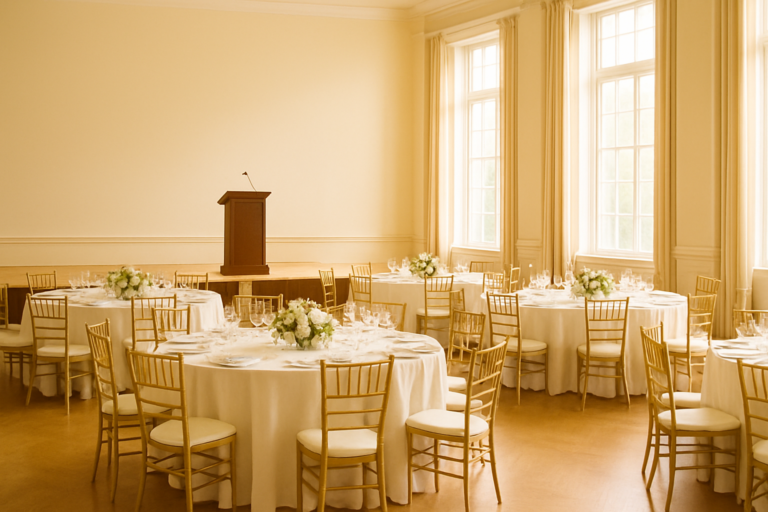

Hosting: Dinners, Salons, and the Private-Entertaining Economy
The Million Dollar Question: Between 2003 and 2024, how did the amount of time the average American spent attending or hosting social events change?
A) Up about 15% B) Roughly flat C) Down about 25% D) Down about 50%Read on for the answer.
Private entertaining is one of the few things wealthy households spend real money on that produces nothing you can hold afterward. This piece explains what it actually consists of, who staffs it, what a dinner and a house party and a production-scale event each cost, and why the most expensive version is usually not the one people want to be invited to.
What it is
Private entertaining covers a wider range than the phrase suggests. At one end is the weeknight dinner for eight in someone’s dining room. At the other is a multi-day event with a producer, a security plan, and a guest list flown in from three continents. In between sit the formats that actually structure social life at higher wealth levels: the weekend house party, where the guests stay; the recurring salon, where the point is the conversation and the room is assembled for it; and the standing table — a host who serves dinner on the same night every month and lets the invitation list do the work.
The useful distinction is not size but ownership. Hospitality you buy — a restaurant’s private room, a club’s dining floor, a hotel ballroom — comes with a venue’s rules, a venue’s staff, and a venue’s other customers. Hospitality you stage happens on your terms: your house, your table, your list, no one walking past. That difference is the entire product. It is why members’ clubs charging four and five figures a year are booming among people who could host at home, and why people who host at home rarely bother with the clubs.
The form is old. The Paris salons of the eighteenth century — Madame Geoffrin’s Mondays and Wednesdays chief among them — were a woman’s living room operating as an institution: writers, painters, and philosophers convened on a schedule by a host with no formal power except the ability to decide who came. Gertrude Stein ran the same play at 27 rue de Fleurus a century and a half later. Perle Mesta did it in Washington. In each case the host’s asset was not the food. It was the list.
Who uses it
Hosting scales with wealth, but not in the way most people picture. It scales in frequency and infrastructure, not in per-evening extravagance.
At $1M–$5M, entertaining is a hobby with a budget. There is a dining room, probably a good one, and dinner happens a handful of times a year. The host cooks or hires a caterer for the occasions that matter. Nothing is staffed.
At $5M–$30M, the house is built for it — a kitchen that can absorb an outside chef, a table that seats twelve without a leaf, outdoor space. Help is brought in per event: a chef for the evening, a server or two, someone to clean up. This is the band where the phrase “we had people over” starts meaning something logistically real.
At $30M–$100M, staff become standing rather than hired. There is a chef on payroll, often a house manager, and entertaining moves from event to routine. Knight Frank’s Wealth Report 2026 counts 713,626 people worldwide above the $30 million line, with 89 more crossing it every day — this is the tier where the private-entertaining economy gets most of its customers.
At $100M+, hosting becomes a distributed operation. Multiple residences means multiple kitchens, multiple staffs, and a calendar that follows a season: winter somewhere, August somewhere else, and a social obligation attached to each. At $1B+ — 3,110 people globally — some entertaining stops resembling hosting altogether and becomes event production, with outside firms, contracts, and a communications plan.
Why they use it
The honest answer is that hosting buys something nothing else on the wealth menu can: the ability to reliably assemble a specific set of people in one room.
Everything else at high wealth levels is purchasable on demand. A plane can be chartered in four hours. A house can be rented for a season. A chef can be hired for a night. But there is no market where you can buy the attendance of eleven specific people on a Thursday. You either have the standing to summon them or you do not, and the only way to build it is to have been a host people wanted to say yes to for a long time. Convening power is earned, slowly, and it does not transfer with a wire.
That is why hosting sits so close to business at these wealth levels. Deals, board seats, co-investments, and introductions move through private rooms far more than through conference rooms — which is also the logic of the conference circuit, just at institutional scale and with a registration fee. A dinner for ten is the same instrument, owned outright.
There is a second motive that gets less attention: control. In a restaurant, the room belongs to someone else, the next table is close enough to hear you, and the evening ends when the venue says so. In your own dining room, the guest list is closed, the phones can go in a bowl, and a conversation can run to two in the morning. For people who spend most of their public life managed, that is not a small thing.
And there is a third, quieter one. Hosting is the last domain where taste is legible without being announced. Anyone can buy a good bottle. Assembling a table where the conversation works is a skill, and people notice.
How it works
Behind a routinely-hosting household sits a small labor system.
The chef is the anchor role. At the standing-staff tier this is a full-time employee who plans menus, sources, and cooks daily, with entertaining folded into the job. The house manager or estate manager runs the household as an operation — vendors, schedules, other staff, and the logistics of an evening for thirty. A butler, where one exists, runs service itself: the table, the pour, the choreography of courses. Above a certain scale, an outside event producer takes over anything that involves a marquee, a stage, or a road closure.
Two models coexist. The buy-in model — hire a chef and staff per event through an agency — is normal up to about $30 million in net worth and stays common well above it for anything unusual. The standing model puts the same people on payroll, which costs far more and buys something specific: a team that already knows the house, the family’s preferences, and the guests’ names. That knowledge is the real asset, and it is exactly what the current market is failing to retain, for reasons in the next section.
The guest list is where hosts actually spend their attention. A dinner table has a hard capacity — twelve is roughly the limit at which one conversation can still hold — so every seat is a decision with a cost. Experienced hosts think in terms of combinations rather than individuals: who has not met whom, who will draw out whom, who cannot be seated together. The seating plan is a governance document with a tablecloth. At larger formats the logic inverts — a cocktail party of eighty is designed for circulation and lets guests self-select, which is why it does less work per hour but reaches more people.
Discretion is now formally part of the arrangement. Industry data compiled in the Morgan & Mallet “Beyond the Butler” report found that 77% of personal-assistant placements in Los Angeles required a nondisclosure agreement, with blanket social-media bans standard across household roles. The people serving dinner have signed something.
What it costs
Take the tiers in order.
Hired-in dinner, no standing staff. Plated catering in the United States generally runs $50–$120 per person for a formal sit-down, before a service charge that typically adds 18–22%. Costlier proteins can add up to $40 a head. A private chef for the evening, plus a server, plus wine chosen rather than grabbed, puts a good dinner for twelve somewhere in the range of $2,000 to $6,000 all in, depending on city and ambition. That is a real number, but it is not a wealth-defined one — it is roughly what the same dinner costs whether the host has $5 million or $500 million.
Standing staff. This is where the cost becomes structural. A full-time private chef in an American household now commands $100,000 to $300,000 a year, with the top of that range reserved for chefs with fine-dining credentials or specialized dietary training. A household or house manager runs $150,000 to $250,000; a butler up to $180,000; a senior personal assistant up to $250,000. Salary is not the total: placement specialists put the all-in figure at 30–50% above base once benefits, payroll taxes, and housing are counted, and a live-in arrangement in an expensive city adds $30,000–$60,000 of real value. Food budgets for a chef’s household run roughly $2,400–$3,200 a month before any entertaining. A principal who budgets $200,000 for a chef and spends closer to $280,000 has mistaken the sticker for the price.
Produced events. Event planners typically charge 10–20% of the total budget, which means the fee itself signals the tier. A significant private party with a producer, rentals, staffing, and a build-out starts around $50,000 and has no ceiling.
The production tier. The 2025 Bezos–Sánchez wedding in Venice is the reference point people reach for, and it is worth stating precisely: press estimates put the three-day event at €40–48 million, roughly $46.5–55.6 million, across about 200 guests — on the order of $50,000 a head, according to those estimates. None of the figures were confirmed by the couple. It is a useful number for exactly one purpose: showing how far the top of the distribution sits from everything below it. It is not a dinner party at scale. It is a different product.
Hidden costs and tradeoffs
The staff you pay for keep leaving. The most striking figure in the household-labor data is not the $300,000 chef. It is tenure: average time with a family has fallen from roughly twenty years historically to about three. Since the value of standing staff is accumulated knowledge — the house, the preferences, the guests — a three-year cycle means paying top-of-market wages for a permanent state of retraining. Much of the salary inflation in this market is the price of churn rather than the price of skill.
Your house stops being entirely yours. Standing staff means people in the kitchen at seven in the morning and someone in the pantry during an argument. Households that entertain often trade a measure of domestic privacy for the capability, which is one reason the NDAs exist and one reason some very wealthy families deliberately do not staff up.
Reciprocity is a debt. Invitations accumulate obligations. A household that hosts well finds its calendar filling with events it now has to attend, and at some wealth levels the social season stops being optional. People describe it, accurately, as a job with no salary.
The performance problem. Hosting has become content. Supper clubs and pop-up dinners grew 18% on Eventbrite in a year, brands now sponsor influencers’ dinner parties outright, and one hosting expert quoted in that reporting estimates that nearly one in four hosts now plan gatherings with content-friendly moments in mind. The wealthy version of this is not TikTok, but the instinct is the same: staging an evening to be seen having it. The tell is guests reaching for their phones before their forks.
What people get wrong
That the budget scales with the net worth. It mostly does not. A twelve-person dinner costs roughly the same for a household worth $5 million and one worth $500 million. What scales is frequency, staffing, and number of houses it happens in. The wealthy host is not spending ten times as much per evening; they are having the evening ten times as often, in four locations, with people already on payroll.
That the food is the point. It is the least important variable. Hosts with genuine convening power tend to serve unfussy, repeatable food — the same roast chicken, the same table, every month. The predictability is a feature: it removes the evening’s risk and lets the guest list carry the weight. The elaborately produced dinner is more often the mark of someone building social standing than someone who has it.
That “the salon is back.” The revival is real at the cultural level but heavily commercial. Much of what is presented as a return to intimate gathering is a brand activation with a menu, and the format’s economics run through sponsorship. That does not make it worthless — a good room is a good room — but it is a marketing surface as much as a social movement.
That spending more improves the evening. Past a fairly low threshold, additional spending buys spectacle, and spectacle competes with conversation. Bigger rooms, louder music, more courses, and more guests all reduce the number of real exchanges per person. Most of what makes an evening work — the list, the seating, the timing, the host’s attention — is not for sale.
That hosting is optional at the top. It is closer to infrastructure. Households that stop hosting find their access narrowing within a few years, because invitations flow toward people who issue them.
Bottom line
The answer to the Million Dollar Question is D: down about 50%. Between 2003 and 2024, the time Americans spent attending or hosting social events fell by half, according to American Time Use Survey data — and for Americans aged 15 to 24 the decline was closer to 70%. In 2023, just 4.1% of Americans said they attended or hosted a party or ceremony on a typical weekend or holiday. For comparison, Robert Putnam found that as recently as the 1970s the average American household entertained friends at home about fifteen times a year.
That collapse is why the private-entertaining economy is worth understanding. As hosting became rare everywhere, the ability to convene became scarcer and therefore more valuable — and at the top of the wealth distribution, people responded by buying the infrastructure that makes it repeatable: the chef, the house manager, the second and third dining room. What they cannot buy is the part that matters. The staff make the evening possible. The list makes it worth attending. A household can spend $300,000 a year on a chef and still find that nobody particularly wants to come, and a host with a rented apartment and a good roast chicken can have a waiting list. Money makes hosting easy. It does not make you a host.
Related reading:
- Private Clubs: Membership, Status, and Access — the paid, outsourced version of the same social function.
- Staff: Outsourcing Daily Life — the labor system that makes repeat hosting possible.
- Chefs, Nannies, and Household Help: The Labor Behind Affluent Life — the specific roles priced in this piece.
- The Conference Circuit: Davos, Sun Valley, Aspen, and the Rooms Where Wealth Networks — convening power at institutional scale.
- Wealth Levels: Life at $1M, $10M, $100M, and $1B — the bands these hosting tiers map onto.