
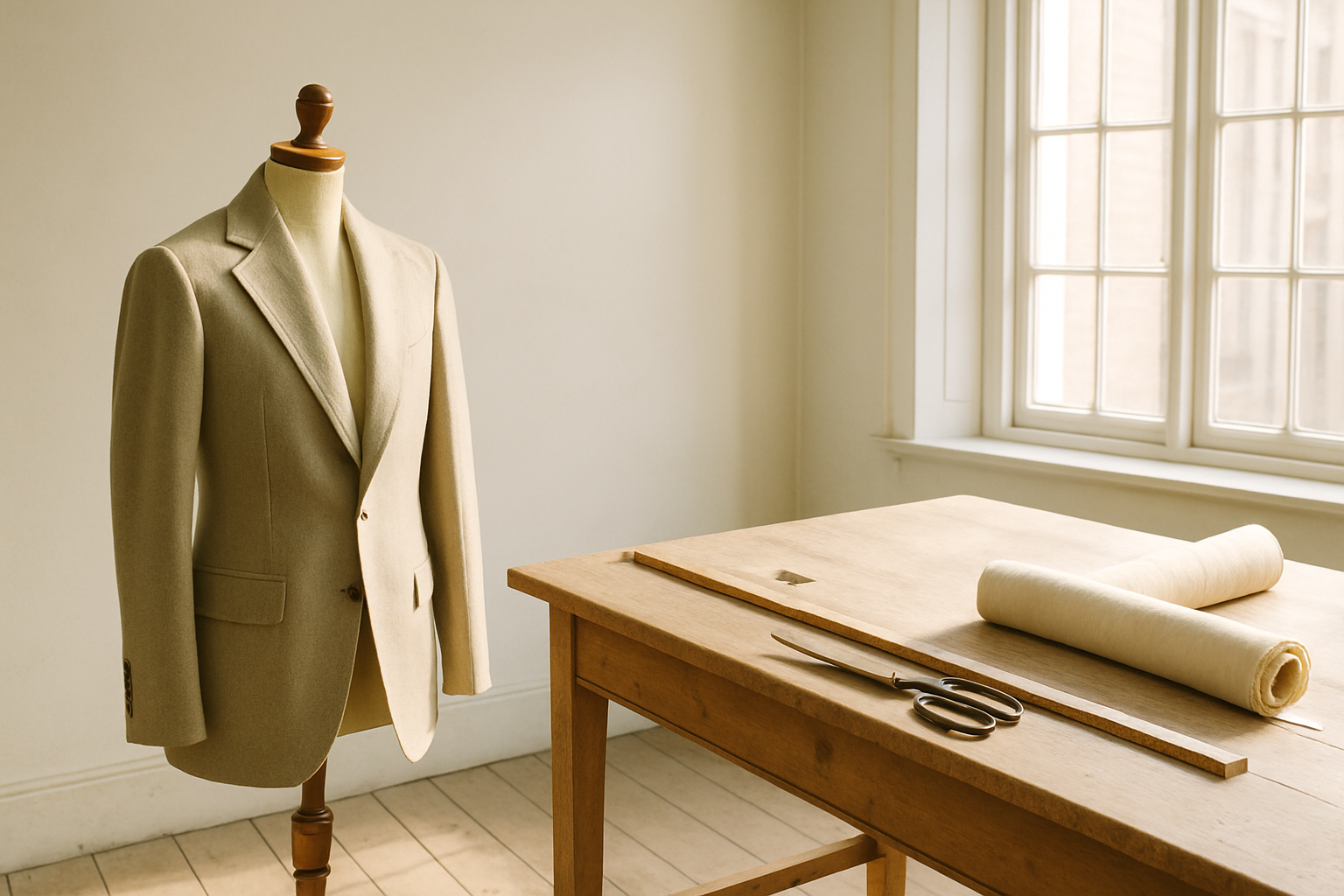
The Bespoke Economy: Savile Row, John Lobb, and Made-to-Measure
The Million Dollar Question: Under the trademarked Savile Row standard, how many hours of hand-work must a suit receive at minimum before it can legally be called “bespoke”?
A) 10 hours B) 25 hours C) 50 hours D) 200 hoursRead on for the answer.
Almost every menswear brand in the world calls something “bespoke.” In one specific London postcode, that word is trademarked, and using it without meeting the standard is a legal problem, not a marketing choice.
What it is
“Bespoke” gets used loosely enough that it’s worth starting with the definition that actually has teeth. The Savile Row Bespoke Association — the trade body whose members occupy the street the word is named after — holds a collective trademark on the specific label “Savile Row Bespoke,” and to carry it a house must meet a defined set of requirements: at least 50 hours of hand work per garment, a choice of over 2,000 cloths, an expert cloth consultant on the premises, hand-sewn buttonholes and a long list of hand-finished details, an individually cut paper pattern made by a Master Cutter, and construction on or immediately around Savile Row itself.
The bare word “bespoke,” on the other hand, turned out to have no such protection. In a widely covered 2008 case, Britain’s Advertising Standards Authority rejected a complaint against a Bond Street tailor, Sartoriani, that advertised suits as “bespoke” despite sending measurements to a factory in Germany where garments were finished partly by machine — a process closer to made-to-measure. The ASA ruled that the public no longer associates “bespoke” specifically with fully hand-cut, hand-sewn tailoring, so the word itself was fair game; only the compound label “Savile Row Bespoke” remains a protected collective mark. Norton & Sons director Patrick Grant, arguing the other side, put the craft distinction plainly: “Only by cutting it by hand, sewing it by hand and eye, and refitting it over and over again do you get a fitting that is truly bespoke.” He was right about the distinction and still lost the case — which is exactly why a knowledgeable buyer treats “bespoke” as a claim to verify rather than a synonym for expensive.
One rung down sits made-to-measure: a standard block pattern adjusted to a customer’s measurements, machine-assembled, usually delivered in weeks rather than months, and priced accordingly. True bespoke starts from nothing — a fresh paper pattern drafted for one body, cut and fitted by hand across multiple sessions, with the finished garment existing nowhere else. The difference is not degree, it’s category.
Savile Row itself has been doing this since the early 1800s, when Beau Brummell’s understated tailoring displaced the embroidered court dress of the previous century and set the template — fit and cut over ornament — that the street still sells today. The Savile Row Bespoke Association describes the Row today as home to “more than a dozen bespoke tailoring businesses, employing over 100 working craftsmen” — a footprint that has held up remarkably well even as the ready-to-wear industry around it has consolidated hard. In 2008, at the time of the Sartoriani dispute, the association counted 15 member tailors; the core has stayed in that range since.
Who uses it
$1M–$5M. The entry point, usually one or two commissions rather than a wardrobe. A first bespoke suit, ordered for a milestone — a wedding, a promotion, a first serious bonus — and then evaluated hard on whether it’s worth repeating. This band supplies Savile Row’s largest customer count and its highest first-order attrition; a meaningful share never place a second commission once they’ve priced out the ongoing relationship.
$5M–$30M. The category becomes a standing habit rather than an event. A regular tailor, a regular shirtmaker, and a rotation through the wardrobe every few years as garments wear out or bodies change. This is also where shoes and shirts join suits — the point at which someone with disposable time and money starts optimizing the whole wardrobe rather than one flagship piece.
$30M–$100M. Full bespoke across categories — suits, shirts, shoes, sometimes leather goods through a house like Hermès — maintained as a coordinated wardrobe with a small circle of craftspeople who know the client’s preferences without being told. The relationship, not the garment, is the asset being purchased at this level.
$100M+. Splits by generation the same way taste instruction does elsewhere. Old-money clients often inherit a house relationship along with the fortune — a family has used the same Savile Row tailor for three generations, and switching would be a genuinely strange thing to do. New-money clients, disproportionately tech and finance wealth built in the last fifteen years, are the fastest-growing segment industry-wide, and they are visibly younger than the historical Savile Row customer base, a shift multiple house principals now describe openly rather than treating as an embarrassment to the brand.
Why they use it
Fit that mass production structurally cannot deliver. An individually drafted paper pattern accounts for the asymmetries every real body has — one shoulder lower than the other, one arm longer — that a standardized block pattern averages away. This is the plain, non-status reason bespoke exists at all: at a certain price point, “it doesn’t fit quite right” stops being an acceptable answer.
Quiet signaling. A well-cut bespoke suit is legible almost entirely to other people who own one — the drape, the buttonhole stitching, the way the shoulder sits without a ripple. It is nearly invisible to everyone else, which is precisely its appeal to a buyer who has already worked out that logo-forward luxury reads as trying too hard. It’s the tailoring equivalent of the quiet-luxury shift that shows up across categories once someone has enough money that they no longer need to prove it.
Longevity economics. A well-made bespoke suit can be relined, let out, taken in, and re-pressed for decades; the pattern itself is kept on file at the house indefinitely, so a repeat or repaired order doesn’t require rebuilding from scratch. Amortized over 15–20 years of wear and multiple alterations, the cost-per-wear on a genuinely used bespoke wardrobe can undercut a rotating closet of fast-replaced off-the-rack suits — a case that’s easier to make in theory than most owners actually bother to run the numbers on.
Access and relationship. Ordering bespoke means a standing relationship with a Master Cutter who will, over years, come to know a client’s preferences, body changes, and occasions well enough to make recommendations unprompted. That relationship — not any single garment — is what regular customers describe as the actual product.
How it works
The process starts with a consultation covering cloth, style, and occasion, followed by measurements taken not from a tape alone but by eye — cutters are trained to read posture and movement, not just numbers. Huntsman, for instance, takes an average of 30 separate measurements for a first suit. From those measurements the Master Cutter drafts an individual paper pattern from scratch, which becomes the permanent record of that client’s shape at the house.
From there: a baste fitting in unfinished cloth to check the basic shape, then typically at least two or three further fittings as the garment is built up in stages, with the tailor unpicking and re-sewing sections between each one — jacket sleeves set in by hand, buttonholes and lining felled by hand, all conforming to SRBA working standards. Total hand-work runs from the association’s 50-hour floor up to more than 80 man-hours at houses like Huntsman, spread across a 6–12 week build. A first commission from consultation to delivery commonly runs two to three months; repeat orders, working from the pattern already on file, move faster.
The apprenticeship pipeline behind all of this nearly broke. Tailors interviewed in a wire report syndicated across US outlets in September 2025 described a genuine “drought of apprentices” in the years before, and Henry Poole’s managing director Simon Cundey told the same reporters the average age in his workshop was around 55 when current staff member Jinny Seals joined in the early 2000s. The formal Savile Row Bespoke Association apprenticeship scheme, launched in 2007, has now graduated over 100 people, and Cundey described a “big surge” in applications over the past year and a half — credited, plausibly, to a broader post-pandemic pull toward stable, hands-on trades and away from office work.
The houses themselves have not been immune to ordinary business risk. Huntsman — one of the street’s most recognizable names, its profile boosted considerably by the Kingsman films, whose producer Pierre Lagrange bought the house in 2013 — modernized under new ownership with e-commerce and a ready-to-wear line alongside the bespoke business. Gieves & Hawkes, one of the Row’s oldest names, fell into administration in 2022 after its Chinese parent group’s debt crisis and was bought out of administration by Mike Ashley’s Frasers Group later that year. A centuries-old craft doesn’t make a house immune to a bad parent-company balance sheet.
What it costs
Suits. Huntsman’s bespoke suits start from £6,000; Anderson & Sheppard and Henry Poole both start close to £5,000, before cloth upgrades, additional garments (waistcoats, trousers beyond the first pair), or a given house’s higher rate for more elaborate handwork. A full three-piece from a top house in a rarer cloth — vicuña, heavy hand-loomed tweed — can run well past £10,000.
To put those numbers in context: a standard off-the-rack suit from a well-regarded ready-to-wear brand runs roughly £800–£2,000, and a good made-to-measure suit sits somewhere in the £1,500–£4,000 range. Full bespoke starts above where made-to-measure tops out — the categories overlap in marketing copy far more than they overlap in price.
Shirts. Turnbull & Asser’s bespoke program starts at $545 per shirt, with a four-shirt minimum on a first order. Charvet, the Paris house that has outfitted French heads of state since the 19th century, starts noticeably higher, with bespoke shirts beginning around €580 and rising well past that with fabric and detailing.
Shoes. John Lobb’s bespoke program starts around $8,000 a pair, reflecting 50-plus hours of handwork per shoe. By the house’s own account, a first pair typically takes six to seven months while a new wooden last is carved and refined; once that last is on file, subsequent pairs usually arrive in three to four months and need no further fitting. George Cleverley’s bespoke shoes run from roughly £3,800.
Leather and travel goods. Hermès Sur Mesure — the house’s dedicated bespoke workshop in Pantin, France — takes commissions ranging from customized standard bags to entirely one-off objects, with pricing set project by project and never published. It is the category’s clearest example of “if you have to ask the list price, the list price isn’t the point”; access to the program at all is the actual gate.
The unifying pattern. Bespoke runs 5 to 15 times the price of the equivalent off-the-rack item across every category here — not evenly, and not because the materials cost that much more, but because a large share of the price is buying labor hours and a paper pattern that will never be resold, reused, or amortized across another customer.
Hidden costs and tradeoffs
Time is the real price. A first bespoke wardrobe — suit, shirts, shoes — realistically takes the better part of a year to assemble across multiple houses’ schedules, and every fitting generally requires being physically present, which is its own constraint for a client who travels for a living.
Illiquid by design. A bespoke garment fits exactly one body. Unlike a watch or a car, there is essentially no resale market for a used bespoke suit or a made-to-last shoe, because the entire value proposition is a pattern cut for someone else. What looks like an appreciating craft object from the outside is, financially, closer to a service purchase that happens to leave behind a physical good.
Institutional risk. The client is not just buying a garment, they’re betting on a small private business surviving. Gieves & Hawkes’s near-collapse is the cautionary case: a client with a decades-old pattern on file at a house that changes hands or folds can lose both the relationship and, depending on how the transition goes, the pattern archive itself.
The apprenticeship pipeline is a bottleneck, not a guarantee. A recent surge in applications is genuinely good news for the craft’s survival, but it takes years to train a cutter to the standard the SRBA requires, and a wave of new apprentices today doesn’t translate into more Master Cutter capacity for a decade or more. Demand can outpace supply well before any house runs out of business.
The client does real work too. Multiple fittings, considered feedback, and patience with a slow process are inputs the customer has to supply. A bespoke commission handled passively — show up, get measured, wait — tends to produce a noticeably worse result than one where the client engages with the fitting process the way the tailor expects.
What people get wrong
“Bespoke” is a protected, verifiable claim. It mostly isn’t — not even in Britain. Only the compound label “Savile Row Bespoke” is a legally protected collective mark, binding on SRBA member houses alone. The 2008 Advertising Standards Authority ruling found that the bare word “bespoke” had drifted far enough into everyday marketing language that a Bond Street tailor sending measurements to a part-machine factory in Germany was allowed to use it too. Everywhere outside that one specific collective mark, “bespoke” is functionally an unregulated word, routinely applied to what is, by any technical definition, made-to-measure. The honest question to ask any tailor using the word is not “is this expensive” but “is this hand-cut from an individual pattern, and how many hours of hand-work does it get” — the SRBA’s own 50-hour floor is a reasonable benchmark to hold anyone to.
“It’s a dying craft.” This was a defensible read of Savile Row a decade ago and it is a dated one now. The apprenticeship surge documented in 2025 reporting — piles of CVs where there used to be a drought — suggests the craft found a new pipeline of interest precisely as remote-work-era professionals started looking for tangible, hands-on trades. The story worth telling in 2026 is a turnaround, not an obituary.
“It’s an old-money habit.” The customer base has visibly shifted younger and more tech-and-finance-heavy over the past decade, a trend house principals now discuss openly rather than downplay. Kathryn Sargent — who became the first woman to serve as head cutter at Gieves & Hawkes and then, in 2016, the first woman to open her own house on Savile Row after 15 years learning the trade — is herself part of a broader modernization of who cuts bespoke garments, not just who buys them.
“The price is for the fabric.” Cloth is a real cost, but the dominant cost is labor: 50 to 100-plus hours of a trained craftsperson’s time per garment, which is why a bespoke suit in ordinary wool costs multiples of an off-the-rack suit in genuinely exceptional cloth. The hours, not the fiber, are what’s being sold.
Bottom line
The answer is C — 50 hours. That’s the Savile Row Bespoke Association’s trademarked minimum for hand-work on a garment before it can legally carry the word “bespoke” — alongside requirements for an individually cut paper pattern, hand-sewn construction details, and production within roughly 100 yards of the street itself.
What the bespoke economy actually sells, across tailoring, shirting, shoes, and leather goods alike, is not the finished object but a multi-year relationship with a specific craftsperson who holds a client’s pattern on permanent file. That’s why it resists being bought quickly regardless of budget — a first commission is, by design, a worse version of what a fifth commission from the same house will be — and it’s why the category has proven durable even as the businesses behind it have not always been: houses fold, get sold, and get modernized, while the underlying trade, if anything, looks healthier now than it did ten years ago.
Related reading: Old Money and New Money · Acquiring Taste: How the Wealthy Learn What’s ‘Good’ · Watches: Status, Craft, and Portable Wealth · Fashion: Taste, Signaling, and Personal Presentation · Private Clubs: Membership, Status, and Access