The Million Dollar Question: Auction houses kept setting new watch-sale records all through 2026. Over that same stretch, roughly how far below its April 2022 peak did the broad secondary market for ordinary luxury watches — the Rolexes and Pateks collectors actually trade day to day — remain, according to data reported in October 2026?
Read on for the answer.
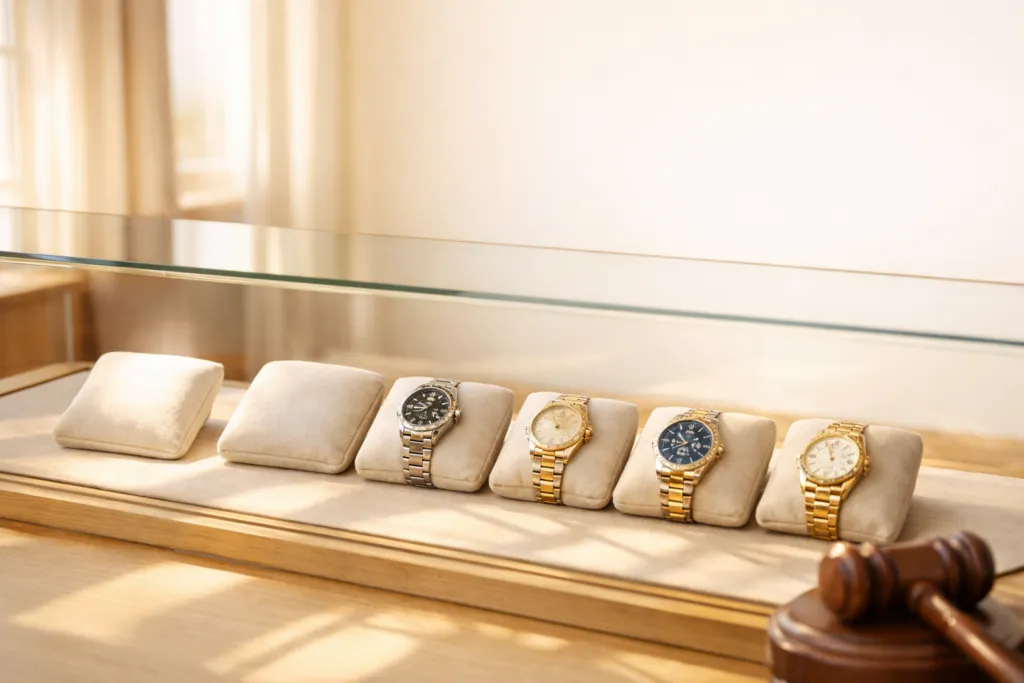
A handful of watches have sold for more than most houses. The full record list is shorter than people assume, dominated by two brands, and driven by factors that have almost nothing to do with the metal in the case. More interesting: the record books kept getting rewritten throughout 2026 at the same time the ordinary resale market for luxury watches was still digging out from its worst slump in years. Those two facts coexist, and untangling why is the point of this piece.
What it is — the record list
At the very top sits the Patek Philippe Grandmaster Chime Ref. 6300A-010, a unique stainless-steel piece sold at Christie’s Geneva on November 9, 2019, for CHF 31 million — about $31 million at the time — making it the most expensive wristwatch ever sold at auction, per Guinness World Records. It was made for the eighth edition of Only Watch, a biennial charity auction where brands each contribute one unique piece and the full hammer price — no buyer’s premium — goes to research into Duchenne muscular dystrophy.
Before 2019, the overall record belonged to a different kind of object entirely: the Patek Philippe Henry Graves Supercomplication, a 1932 pocket watch commissioned by the banker Henry Graves Jr., which sold at Sotheby’s Geneva on November 11, 2014, for just under $24 million. It held the title for five years. Third on the all-time list, and the most famous name on it, is Paul Newman’s own Rolex “Paul Newman” Daytona Ref. 6239, sold by Phillips in New York on October 26, 2017, for $17,752,500 — a record for a wristwatch at the time, before the Grandmaster Chime passed it two years later.
Beyond the top three, the list thins out fast and stays almost entirely Patek Philippe and Rolex: a stainless-steel Patek Ref. 1518 sold for roughly $11.1 million at Phillips Geneva in 2016; a pink-gold Ref. 1518 sold for roughly $9.6 million at Sotheby’s New York in 2021; a Rolex Daytona nicknamed the “Unicorn” sold for roughly $5.9 million in 2018; and a second Paul Newman Daytona, the “Big Red,” sold for roughly $5.5 million in 2020, per Wikipedia’s tracked auction-result list, cross-checked against the individual auction houses’ own releases. Every one of the roughly fifteen watches that have ever cleared $5 million at auction is a Patek Philippe or a Rolex.
A detail worth flagging now, because it resurfaces in the “what people get wrong” section below: two of the top five all-time results — the Grandmaster Chime at #1 and the steel Ref. 1518 at #4 — are stainless steel, the least precious metal a watch can be made from. The gold and platinum pieces most people picture when they imagine a record-breaking watch mostly sit well down the list, if they appear at all.
Who’s actually bidding
The room — or, more often, the phone bank — for a record-tier lot is small. Major sales draw a mix of long-time private collectors bidding directly, dealers and advisors bidding on behalf of clients who prefer to stay anonymous, and increasingly the brands themselves: Patek Philippe and Rolex have each bought back historically significant pieces at auction for their own museum collections, a buyer category that didn’t meaningfully exist a generation ago. Phone and online bidding dominate the highest lots; most winning bidders are never publicly identified, and auction houses routinely decline to confirm buyer identity even when press speculation runs hot.
That anonymity is itself part of the draw. A watch is one of the few assets a person can hold, insure, and eventually resell without the ownership trail that comes with real estate or securities — a theme this site covers in more depth in Watches: Status, Craft, and Portable Wealth. The record sales are really a magnified version of the same motive that drives ordinary collecting at every wealth level: discretion, portability, and a story worth telling.
The sales themselves follow a fixed global calendar that collectors track closely: two major seasons a year, typically a May sale in Geneva and a November sale split across Geneva, New York, and Hong Kong, with the major houses timing their marquee lots to land in whichever city currently has the deepest pool of active bidders for a given category. A single evening sale can run a few hundred lots in a few hours, with the room, the phones, and online bidding all live simultaneously — which is part of why a surprise result can move so fast that even specialists are caught off guard by a final price well above the pre-sale estimate.
Why these specific watches get to eight figures
It is tempting to assume the record-holders are the most lavish objects — the most gold, the most diamonds, the most complications. The opposite is closer to true. The Grandmaster Chime record-holder is stainless steel, a metal that costs the brand almost nothing relative to gold or platinum. What actually drives the price is rarity (a true one-off, or a production run small enough that only a handful of comparable examples will ever exist), documented provenance (an original owner whose identity adds a story — Paul Newman’s own watch, worn and photographed by Newman himself, commands a premium no comparable Daytona without that history could match), and brand mystique concentrated almost entirely in two houses whose waiting lists and heritage have compounded for a century. A production Rolex Submariner or Patek Nautilus, however well made, sells new for somewhere in the $10,000–$50,000 range precisely because it isn’t rare in the way these record pieces are.
How the auction mechanics work
A watch lot’s advertised “price” is usually the hammer price plus the buyer’s premium the auction house adds on top — typically in the 20%–26% range at major houses on standard lots, scaled down at higher price tiers. Only Watch is the exception that explains why its results read as “clean” eight-figure numbers: no buyer’s premium, and the full hammer price goes to the designated charity. Standard sales at Christie’s, Sotheby’s, and Phillips run on pre-sale estimates, condition reports, and authentication by in-house specialists before a lot is ever offered; for vintage pieces, that condition report — original dial, original movement, no replaced parts — often matters as much to the final price as the watch’s rarity on paper.
The scale of a strong sale season has itself kept climbing. Phillips’ own release on its May 9–10, 2026 Geneva sale — “The Geneva Watch Auction: XXIII” — put the two-day total at CHF 74,846,995 (about $96.3 million), selling 224 of 225 lots and setting, by the house’s own count, 43 individual world records across different references and categories. The top lot of that specific sale, a Patek Philippe Ref. 2523 “South America” world-time wristwatch, brought CHF 7,961,000 (about $10.2 million) — a huge result for a single lot, and still nowhere near cracking the all-time top three above. That gap is worth sitting with: an entire record-breaking auction season can happen without producing a single watch that approaches the Grandmaster Chime, the Graves Supercomplication, or the Newman Daytona.
What it costs to play at every tier
Collecting watches runs across a very wide range, and the record sales above sit at the extreme far end of a ladder most buyers never approach. Entry-level vintage collecting runs roughly $1,000–$50,000 — worn examples of once-common references, often with condition issues that keep prices modest. Serious-collector territory runs $50,000–$500,000: clean examples of desirable vintage references, or current-production pieces from the most in-demand brands bought above retail on the secondary market. Blue-chip, investment-grade pieces — the kind that regularly appear in major-house sales and hold value across market cycles — run roughly $500,000–$5 million. Above that is the record tier covered here: a handful of unique or exceptionally rare pieces that have each cleared eight figures, a population that has not grown past the mid-teens in the entire history of watch auctions. At every tier, the buyer’s premium discussed above adds a meaningful percentage on top of whatever the paddle price looks like in the room. A worn vintage Rolex Submariner from the 1970s might change hands for $8,000–$15,000 at the entry tier; a clean vintage Daytona in the serious-collector range can run $80,000–$300,000 depending on dial and reference; a pristine, fully documented steel Patek chronograph from the 1950s or ’60s is a plausible blue-chip buy in the low millions. The record tier above that isn’t really a market in the usual sense — it’s a population small enough that each sale is its own event, not a data point on a pricing curve.
The weekly email
How wealth actually works, once a week
The new explainers, the Million Dollar Question and the numbers behind them, in one short email. Free, and no ads.
We send a confirmation link first. One-click unsubscribe in every email; your address is never shared.
Hidden costs and tradeoffs
A watch worth six, seven, or eight figures needs insurance well beyond a standard homeowner’s policy — most serious collectors carry a scheduled fine-art-style rider that lists each piece individually, with its own appraised value, and premiums that scale with that value. Authentication risk runs in both directions: buying on the gray market (outside an auction house or authorized dealer) without a verified provenance trail exposes a buyer to counterfeit movements, replaced parts sold as original, or outright fraud, which is part of why the major houses’ in-house authentication is worth the premium they charge to sell through them. Even “liquid” record-tier pieces are illiquid in practice — finding the next buyer for a $20 million watch takes real time and the right auction calendar, not a quick private sale. And there’s an opportunity cost that’s easy to overlook: capital tied up in a watch, however prestigious, earns no income and no dividend while it sits in a vault. Moving a record-tier piece at all — to a sale, to a safety-deposit box, to a new owner — typically means specialized transit insurance and bonded courier handling rather than a padded envelope, another line item that scales with the watch’s appraised value rather than its physical size.
What people get wrong
The biggest misread is treating a record sale as a readout on the whole watch market. It isn’t. Auction records and the broad resale market measure genuinely different things: a record is the price two or three motivated bidders were willing to pay for one specific, irreplaceable object on one specific night, while the broad market reflects what thousands of ordinary transactions — a used Rolex Datejust changing hands between a private seller and a dealer — are actually worth. By WatchCharts data reported by Forbes in October 2026, the overall secondary-market price index for tracked luxury-watch brands rose for a fifth consecutive quarter in Q3 2026 — up 1.2% on the quarter and 8.3% year over year — yet remained roughly 29% below its April 2022 peak, a figure independently corroborated by Velociphile’s read of the same Q3 2026 tracker. That recovery was real but uneven: Rolex posted its smallest quarterly gain in seven quarters (+0.5%), while Patek Philippe rose 2.6% on the quarter and 17.6% year over year. Meanwhile a Morgan Stanley study of inventory at six major brands, cited in the same Forbes report and dated October 13, 2026, found the total value of watches listed for resale up 5.7% in the quarter and 19.3% year over year — record levels for every brand tracked — with new listings outpacing sales across the board and Rolex’s absorption rate (how quickly listed watches actually sell) at its lowest since Q3 2024. Record auctions and a glutted, still-recovering resale market were happening at the same time, in the same industry, for related but genuinely different reasons.
The second mix-up is assuming the “most expensive watch ever” title has always belonged to a wristwatch. For five years it belonged to a pocket watch — the Henry Graves Supercomplication — which is exactly why Guinness tracks “most expensive wristwatch sold at auction” as its own separate category from the broader “most expensive watch.” The two titles have different histories and, at times, different holders.
The third is assuming a watch is reliably “an investment.” It can be, for a tiny sliver of record-tier and blue-chip pieces with the rarity and provenance described above — the same Forbes report notes Patek Philippe trading at a 16.3% premium over retail and Rolex at 10.3% as of Q3 2026. But most watches, including most luxury watches, depreciate the moment they leave the shop like any other manufactured good. The same report put Cartier’s secondary-market value at 25.9% below retail and IWC’s at 41.2% below — brands with real heritage and real craftsmanship that simply don’t carry the same resale premium as the two names that dominate the record list above.
Bottom line
The Final Answer is C. The broad secondary market for luxury watches remained roughly 29% below its April 2022 peak as of the most recently reported data in October 2026, even after five straight quarters of gains — the same stretch in which Phillips alone set 43 individual auction records in a single May 2026 sale. A record sale is a story about one unique object, its provenance, and the handful of bidders who wanted it that specific night; it is not a readout on what an ordinary Rolex or Patek is worth to resell next year. Those are two different markets wearing the same name, and the gap between them is the single most useful thing to understand before treating any watch as a reliable store of value.
Related reading: Watches: Status, Craft, and Portable Wealth · Art: Collecting, Status, and Alternative Investment · Cars: Luxury, Collecting, and the Cost of Ownership · Wine: Luxury, Collecting, and Wealth Signaling · Jewelry: Beauty, Status, and Stored Value
Methods and sources. The all-time auction record list and dates are drawn from Wikipedia’s tracked list of most expensive watches sold at auction, cross-checked against the individual auction houses’ own releases and Guinness World Records for the current record holder, Bloomberg and Phillips’ own press release for the Paul Newman Daytona sale, and Monochrome Watches for the Only Watch auction model. The May 2026 Geneva sale total, record count, and top lot are from Phillips’ own press release, dated May 10, 2026. Secondary-market figures are from the WatchCharts data reported in Forbes, October 20, 2026, independently corroborated by Velociphile, October 15, 2026. This is not financial advice; watch values vary enormously by piece, condition, and provenance, and anyone considering a watch as an investment should treat auction records as a poor guide to ordinary resale value. See Editorial Standards.