
Paths to Millions: How First-Generation Wealth Is Actually Built
The Million Dollar Question: What is the most common job among US millionaires?
A) Doctor B) Investment banker C) Engineer D) Founder
Read on for the answer.
A working map of the channels by which people actually reach $1 million in net worth — what each path pays, how long it takes, what it costs, and where the cultural picture of “self-made wealth” most often misleads. The on-ramp companion to Wealth Levels.
What it is
This piece covers first-generation wealth: net worth above $1 million built by the holder rather than inherited. Inheritance is the subject of separate pieces (Inheritance and Generational Wealth); this one is about how someone who started without a meaningful inheritance gets to the first tier described in Wealth Levels.
“Self-made” turns out to be more contested than it sounds. The figure most-quoted in the US — that 79% of millionaires received no inheritance from their parents or other family members — comes from Ramsey Solutions’ National Study of 10,000 millionaires. A narrower Bank of America Private Bank definition — “no inheritance and a middle-class-or-poor upbringing” — yields just 27%. Both numbers are correct; they answer different questions. This piece uses the broader definition (no meaningful inheritance) throughout, but flags the contention because almost every “self-made” claim is sensitive to where the line is drawn.
The data is heavily US — that is where the household-wealth research is best — with a brief global note: at the billionaire level, roughly 67% globally are self-made, but the share varies sharply by country, with Asia historically more inheritance-driven than the US. The patterns described below are mostly American and mostly post-1980.
Who reaches each tier
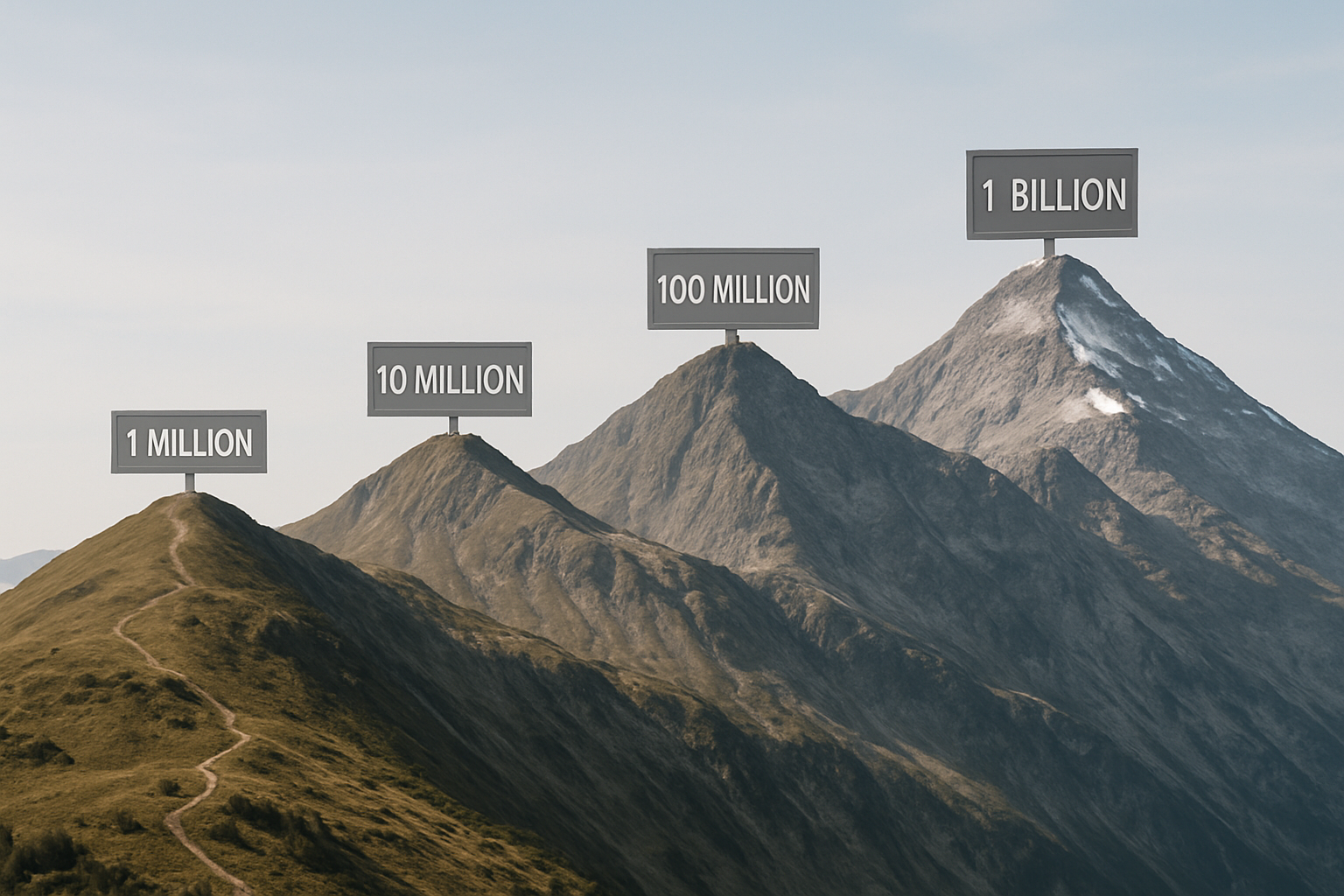
Across the canon we use the four-tier framework from Wealth Levels: $1M, $10M, $100M, $1B. The path mix changes sharply by tier.
- $1M–$5M. Almost entirely career income plus retirement savings plus housing equity, accumulated over thirty to forty years. The Ramsey data is built on this band: median age in the 50s, dual-income coastal-metro households over-represented, paid-off home, decades of 401(k) contributions.
- $5M–$30M. The first tier where an equity event — an IPO, an acquisition, a partner-track promotion with carry — typically shows up as the driver rather than as a contributor.
- $30M–$100M. Almost always business equity or a senior financial-services career: private-equity partner, hedge-fund principal, large-firm partner. Inherited wealth shows up here too, usually as a fraction of a larger family pool.
- $100M+. Almost always equity in a single business — founder, large early investor, second- or third-generation heir to a still-private company.
- $1B+. Always single-business equity at the time the threshold is crossed, with rare exceptions for a handful of asset managers and hedge-fund founders.
The shape on the way up is consistent: more people reach the lower tiers via slow-and-reliable channels; more people reach the upper tiers via concentrated equity. The transition is not at $1M or at $1B — it is somewhere between $5M and $30M, where consistent saving stops being enough on its own.
Why these paths and not others
The five themes that recur across this site — time, access, privacy, risk, complexity — show up here too, but as choices the person walking the path has to make.
Long-tenure career paths trade speed for reliability. Engineering, accounting, teaching, management, law: process-based work that compounds over decades. The variance is low; the time horizon is long.
Equity-comp paths trade concentration for upside. Tech equity, biotech RSUs, finance bonuses converted into stock. The upside is real but the worker’s wealth and their employer’s fortunes become the same bet, often in the same metro.
Founder paths trade time and certainty for a small chance of a very large outcome. Seven-plus years of below-market salary, opportunity cost on the conventional career, and — for the great majority — no equity payoff at the end.
Professional-practice paths trade a long training tail for a high-floor career. Law partner, surgeon, dentist, accountant: a decade or more of post-undergraduate work before the equity curve begins to bend.
The piece does not moralize about the choice. The honest framing is that faster paths are higher-variance and slower paths are more reliable. Most readers walk a slower path whether they intended to or not.
How it works — the channels
Walking the channels in rough order of how many millionaires they actually produce.
1. Career income plus 401(k) and index investing — the modal path.
This is the path most US millionaires actually walk, and the one the cultural picture of wealth most consistently underweights. The top five careers among millionaires in the Ramsey National Study are engineer, accountant (CPA), teacher, management, and attorney. Doctor does not make the top five. Eighty percent of those millionaires invested in their company’s 401(k); 93% credit hard work over a big salary; one third of them never earned $100,000 in a single year of their working life. Time horizon: thirty to forty years. The lever is the savings rate and the compounding window, not the income.
2. Equity compensation in tech, biotech, and senior finance.
Public-company RSUs, options at growth-stage companies, deferred stock at investment banks. The first $1M typically arrives ten to twenty years into a senior career, on top of base salary. Concentration risk is the trap: a senior engineer at one of the public tech companies can have 60–80% of their net worth in their employer’s stock, often without realizing the position has drifted that far. Geographic constraint is real — most of these jobs are in five to six US metros — and the family lives in one of the ten most expensive housing markets as a precondition.
3. Professional-practice partnerships.
Equity partner at a major law firm, owning a specialty medical or dental practice, becoming a Big Four accounting partner. The shape is consistent: seven to twelve years of training and apprenticeship at sub-equity income, followed by a decade or more as a junior partner before the curve really bends. The floor is high; the ascent is slow. Median age reaching $1M tends to land in the early-to-mid 50s. Burnout is the standard failure mode — particularly in medicine.
4. Real estate.
Developers, multi-family landlords, syndicators, and the much larger group of professionals who buy two or three rental units alongside a primary career. Capital-intensive at entry, debt-leveraged, hands-on. Often a side path stacked on top of one of the careers above. Generational continuity is high — “real estate families” persist across decades because the assets and the operating know-how transmit together.
5. Founder exits.
The visible path. Per 80,000 Hours’ synthesis of Harvard Business School research by Shikhar Ghosh on more than 2,000 VC-backed companies, the average founder exit is around $5.8 million — a number that hides enormous variance because it is dominated by a small number of large outcomes. Roughly 30–40% of VC-backed companies liquidate completely, returning zero to all shareholders; another 35–45% return less than the capital invested. The result, in plain terms, is that about 75% of venture-backed founders end up with $0 from their equity. Median acquisition value, per Founder Collective’s analysis, is around $44 million; founders retain roughly 18% equity at exit on average (versus 73% for bootstrapped founders). Average time to exit: 7.5 years.
Million Dollar Question — sidebar: Roughly what share of US millionaires never earned $100,000 in any single year? About one third. Income and wealth are different things; consistency and compounding do most of the work.
6. Senior finance carry and partnership.
Private-equity partner, hedge-fund principal, general partner with carried interest. Different economics from equity comp — deferred compensation, long lock-ups, claw-back provisions, cyclical realizations. This path has its own piece in Hedge Funds and Private Equity; for our purposes here, it is one of the few channels where an individual can reasonably expect $30M+ within twenty years if they make partner at a successful fund.
7. Sales and commission ladders.
Routinely undervalued by readers who think of “sales” as low-end work. Top-decile enterprise software reps, senior commercial real estate brokers, top financial advisors, and top automotive luxury salespeople reach $1M faster than equity-comp engineers in many years. Variance is high — bad years can be very bad — but the ceiling on income, and therefore on savings rate, is unusual.
8. Inheritance — explicitly excluded.
This is the first-generation piece. Inheritance accounts for the other side of the Ramsey ledger and is covered in Inheritance and Generational Wealth. For context: in 2025, 91 inheritors received a record $297.8 billion, up 36% from the year before, even as fewer people inherited.
9. Marriage.
A real path to wealth, but not first-generation in the sense this piece means. One-line acknowledgment, full treatment in Marriage and Prenups.
10. Lottery and other sudden-wealth events.
Real, vanishingly rare, and unstable. The data on what happens after is its own subject — see Sudden Wealth.
What it costs
The unromantic time-and-tradeoff cost of each channel.
Career-plus-401(k). Time: thirty to forty years. Other costs: living below your means consistently for that whole window, automating savings, accepting that the compounding is invisible until the last decade, and resisting lifestyle inflation through every promotion. The “millionaires next door” pattern shows up in the data because it is the cause, not the consequence — the people who made it have undistinguished cars and a starter-home upgrade in their mid-forties.
Equity comp. Time: ten to twenty years on top of a senior salary. Other costs: living in one of the most expensive metros for the duration, accepting concentration risk in a single employer’s stock, periodically diversifying out of that position even when momentum says to hold, and the psychological cost of watching paper wealth swing 30% in a quarter. A typical senior public-tech engineer in 2024–2025 saw their stock concentration rise sharply, then in some cases retrace meaningfully.
Professional practice. Time: seven to twelve years of training, then ten more before the equity curve bends. Other costs: high educational debt load, deferred household formation, and — in medicine especially — measurable rates of burnout and exit from the profession.
Real estate. Time: variable, but compounds with hold period. Other costs: debt risk, hands-on management work that is real even when “passive,” vulnerability to local rate cycles and zoning changes.
Founder. Time: 7.5 years average to exit. Other costs: 75% probability of zero equity payoff at the end, foregone career income, identity merger with the company, marital strain, and the opportunity cost relative to a senior engineering or finance role at a public company over the same window. The expected-value comparison is genuinely close — the founder path’s headline numbers are heavily skewed by a few enormous outcomes.
The honest summary across all paths: there is no fast path that does not also have a high failure rate. The reliable paths take decades.
Hidden costs and tradeoffs
Each path has burdens its inhabitants did not necessarily anticipate.
Burnout, particularly in medicine and senior law. The high-floor paths buy their floor with sustained intensity over two decades. The exit rate in those professions is real and underreported in the cultural picture.
Concentration risk in equity-comp careers. When your job and your wealth are the same bet, your downside is correlated. The standard advice — diversify out of employer stock as it vests — is often ignored because the stock has been going up. When it stops, the concentration matters all at once.
Identity merger on founder paths. The founder is the company until exit. That is part of why founders accept the long odds — but it is also why even successful founders often find the years after the exit harder than expected, and why marriages strain through the build years.
Geographic concentration. The equity-comp path requires living in five to six US metros. The professional-practice path requires being where the patients or partners are. The flexibility readers might assume in a wealth-building career is often not there in practice.
Survivorship bias in the cultural narrative. Every founder profile in the press is a winner. The 75% who got zero do not get profiled. Every successful tech-equity story is one where the company kept going up. The professional-practice millionaires are statistically the most common kind of self-made millionaire, and they are the least visible because their lives and houses are not photogenic.
A theme that ran through Wealth Levels carries here: the “everyone above me has it figured out” delusion. The press picks the visible cases; the numbers are dominated by quiet ones.
What people get wrong
Five corrections, in roughly the order they cause confusion.
1. The visible paths are not the modal paths. The cultural picture of the millionaire — founder, hedge-fund partner, surgeon — accounts for a small minority of US millionaires. The Ramsey study’s top five — engineer, accountant, teacher, management, attorney — accounts for the bulk of them.
2. Income is not wealth. About one in three US millionaires never earned $100,000 in a single year. The lever is the savings rate and the compounding window, not the salary. Two engineers who each earn $120,000 for thirty years and save 25% will end up well past $1M; two consultants who each earn $300,000 and save 5% may not.
3. “Self-made” is a spectrum, not a binary. Almost everyone who reaches $1M had at least one of: parental help with college, a small inheritance under $100,000, family help with a first house, a spouse with a stable income through a startup or training phase, or stable health. The 79% Ramsey figure tracks “no inheritance” — it does not track “no advantage.” The piece’s framing is honest about this without being defeatist about it.
4. The founder path is much worse than its press. About 75% of venture-backed founders end up with $0 from their equity. The average $5.8M exit headline is dominated by a small number of very large outcomes. This does not mean the founder path is irrational — for the right person with the right idea and the right safety net it can be — but it is much closer to a high-variance bet than the cultural picture suggests, and most of the people taking it are operating with a wildly inflated estimate of their own probability of success.
5. Lottery and sudden-wealth events are real but tiny and unstable. They show up in the cultural picture out of all proportion to their actual share of US millionaires. The deeper treatment lives in Sudden Wealth and Falls from Grace — both of which are darker pieces than this one, for good reason.
Bottom line
The modal path to a US millionaire is unromantic, slow, and reachable. It looks like an engineer or an accountant or a teacher with a thirty-year career, an automated 401(k), a paid-off house in their late fifties, and a Honda in the driveway. The most common job among US millionaires is engineer. The romantic paths — founder, finance, sudden inheritance — are real, and for the small minority who reach the exit they pay extraordinarily well, but the expected value is much lower than the cultural picture suggests and the failure mode is brutal.
What happens once the threshold is crossed — the operational regimes, the staff, the tax planning, the family dynamics — is the subject of every other post in this canon.
Related reading on How Millionaires Live:
- Wealth Levels: Life at $1M, $10M, $100M, and $1B — the destination map this piece’s on-ramp connects to.
- Sudden Wealth: Liquidity Events, Lottery Winners, Athletes, and Inheritance Shocks — what happens at the moment the wealth arrives.
- Falls from Grace: Bankruptcies, Frauds, and Reversed Fortunes — when the wealth doesn’t last.
- Generational Wealth: How Long Fortunes Actually Last — what happens to the number across generations.
- [Hedge Funds