

The Forbes 400: The 1982 List, 44 Years Later
The Million Dollar Question: The first Forbes 400, published in 1982, had 436 entries. How many of those same individuals (not heirs, not relatives) were still on the list in 2025?
A) 4 B) 13 C) 34 D) 69Read on for the answer.
The first Forbes 400 came out in the autumn of 1982. It looks different now. The richest individual on it was a shipping magnate most people today have never heard of. The second-richest individual was the heir to an oil company that had not yet been sold. About a dozen entries belonged to descendants of a gunpowder maker who had died in 1834.
Forty-four years later, that first list is a natural test of the oldest question about great fortunes: do they last?
This piece does that test, name by name and family by family, using the 1982–2025 panel behind our Forbes 400 history page. It isn’t the first attempt. Robert Arnott, William Bernstein and Lillian Wu did it in the Cato Journal in 2015, and Human Progress has published the results. Their numbers and ours appear side by side below, along with the reasons they differ. The answer depends on whether you count people or families, and it shifts once you look at why each fortune left.
The first list
Forbes set out to name the 400 richest Americans. The academic panel we use records 436 entries for 1982, because ties at the bottom push the count past 400 and some fortunes appear both under a family name and as individual members. In that data the lowest entry is $75 million. Forbes’s own retrospectives put the 1982 floor a little higher, at $91 million in one account and $100 million in another, so the sources disagree at the margin. Forbes gives the 1982 list’s combined worth as $92 billion. Summing every row in the panel gives about $125.9 billion, but that sum counts part of the du Pont fortune twice (once as family-level rows, once as individual members), so we use Forbes’s figure for the total.
Those figures are in 1982 dollars. Converted with the CPI-U annual average (96.5 in 1982 against 321.943 in 2025, a factor of about 3.34), the panel’s $75 million floor becomes roughly $250 million in 2025 dollars and Forbes’s $92 billion total roughly $307 billion. The median entry was $166 million then, or about $554 million today.
Compare 2025. Forbes’s cutoff that year was $3.8 billion, and the 400 together held about $6.65 trillion. After inflation, the threshold is about 15 times higher than in 1982 and the list’s combined wealth about 22 times higher (about 16 times if you use the panel’s inflated row sum instead of Forbes’s total). (The sibling post on the price of admission follows the threshold year by year.)
Oil and inherited fortunes dominated the 1982 list. The single largest block of money was not an individual’s but a family’s: the du Ponts, listed both as family-level entries and as a long run of individual heirs. Because the panel records part of that fortune twice, we don’t put a single dollar figure on it here. The top individual was Daniel K. Ludwig, the supertanker pioneer, at $2 billion. Gordon Getty, heir to Getty Oil, came next at $1.4 billion. Other big blocks belonged to Rockefellers, Hunts, Basses, Mellons, Phippses, Hearsts, Fords and the Cargill-MacMillans.
Plenty of the newer kind of money was there too, though in smaller amounts: Sam Walton at $690 million, Warren Buffett at $250 million, a Nike co-founder named Phil Knight at $275 million, and David Packard and William Hewlett. The question is what happened to all of them.
How fast the people left
First, the strict test: is the same person still on the list? An heir taking a parent’s place doesn’t count here. That case is family continuity, and it gets its own section below.
Measured this way, the 1982 group shrank fast:
- 1987 (5 years): 200 of the 436 entries still listed, 46%.
- 1992 (10 years): 176, or 40%.
- 1997 (15 years): 102, or 23%.
- 2002 (20 years): 80, or 18%.
- 2007 (25 years): 53, or 12%.
- 2012 (30 years): 34, or 8%.
- 2017 (35 years): 24, or 6%.
- 2025: 13, or 3%.
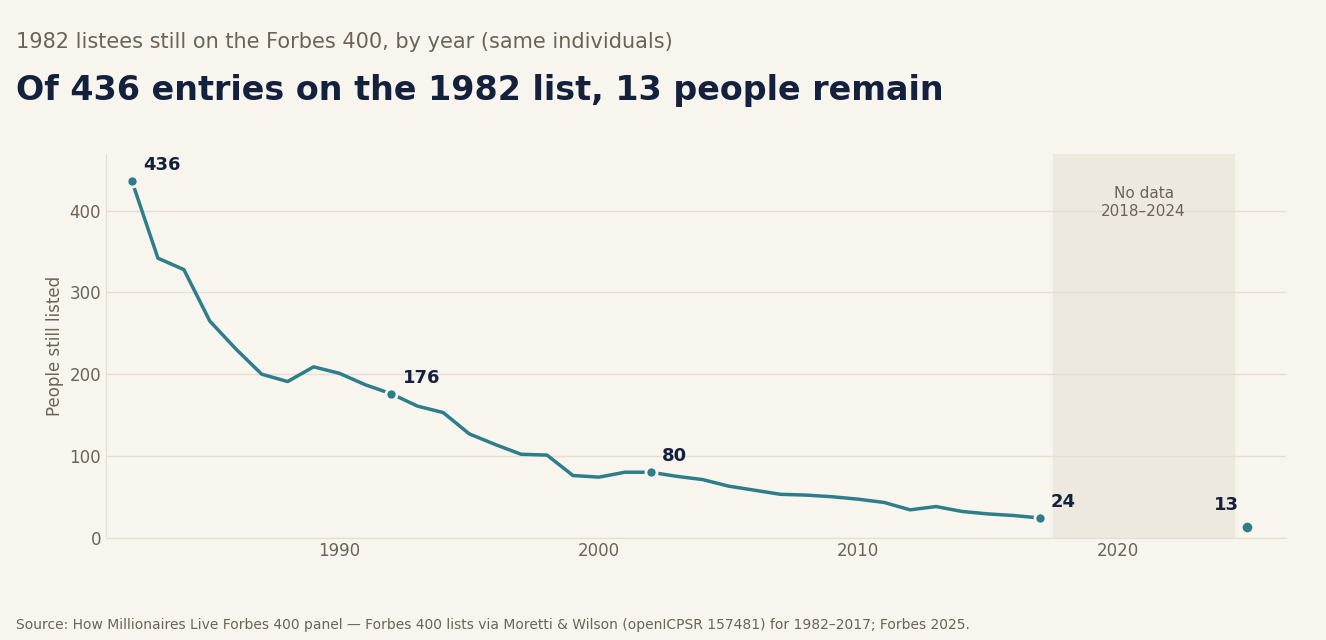
The steepest drop came right at the start. Sixty entries appeared in 1982 and never again. By 1986, 174 of the 436 (two in five) had made their last appearance. The cutoff doubled from $75 million to $150 million by 1984 and reached $225 million by 1987. Of the 174 early leavers, 71 never had a listed net worth above $150 million at any point. Many of them were not ruined. The bar simply rose past them.
The median 1982 entrant stayed on the list for seven and a half years in total. That is longer than the five-year median for everyone who has appeared since 1982. On average, the first list was stickier than the lists that followed, but only modestly.
One gap needs stating plainly. The academic dataset under the panel covers 1982 through 2017 without a break. We added 2025 directly from Forbes. We have no data for 2018–2024, so the chart breaks there and we don’t estimate the missing years. The 13 is a 2025 count. It doesn’t tell us when the others between 2017 and 2025 dropped off.
How our count compares
Other people have counted this before, and their figures sit close to ours.
In “The Myth of Dynastic Wealth: The Rich Get Poorer” (Cato Journal, Fall 2015), Arnott, Bernstein and Wu reported that only 34 names from the 1982 list remained on the 2014 list, and that 24 had appeared on every list in between. They also counted families. The 2014 list included members or descendants of 69 of the original families, and only 36 of those families had appeared on every list since 1982. Human Progress, the Cato Institute’s data site, summarised the same work in 2016 as “over 71 percent of Forbes 400 listees and their heirs lost their top 400 status between 1982 and 2014,” and keeps a related dataset on the erosion of inherited wealth.
Forbes itself counted 36 members of its debut issue still on the 2012 list. Our panel has 34 individuals from 1982 still listed in 2012 and 24 in 2017. That is roughly consistent with both counts, though none of the three is quite the same measurement. The differences come down to definitions:
- Names versus people. The Cato authors counted names. Our panel counts people, linking each one across years by name and a consistent age. A family entry and an individual can both be a “name.” Only the individual is a person.
- People versus families. Their 69 counts a family as surviving if any descendant is listed, including people who joined after 1982. That measures family continuity, which is a separate question from ours. Both questions are worth asking.
- Years. They stop at 2014. We have 2017 and 2025, and nothing in between.
None of this is new research. The finding that most of the 1982 list is gone has been published, cited and argued about for a decade. What follows is the family-by-family story the summary numbers leave out.
The thirteen
The answer to the Million Dollar Question is B: 13. Thirteen people who were on the 1982 list in their own right were on the 2025 list as well. They are Warren Buffett, Charles Koch, Phil Knight, Philip Anschutz, Donald Bren, Donald Newhouse, Leonard Stern, Donald Trump, Ray Lee Hunt, Gordon Getty, George Lucas, Ronald Lauder and Sid Bass. (The other options are the Cato counts: 34 names in 2014 and 69 families.)
They didn’t get there the same way, and the inflation-adjusted numbers show how different their paths were.
The compounders. Buffett was listed at $250 million in 1982, about $834 million in 2025 dollars. In 2025 Forbes put him at $150 billion, roughly 180 times his 1982 worth after inflation. Charles Koch grew about 83-fold in real terms and Phil Knight about 39-fold. Each of them still owned most of one growing company four decades later: Berkshire Hathaway, Koch Industries, Nike.
The steady builders. Donald Bren (Irvine Company real estate) grew about 16-fold in real terms, Philip Anschutz about 6-fold, Donald Newhouse about 8-fold and Leonard Stern about 5-fold. George Lucas was a new name in 1982. He sold Lucasfilm to Disney in 2012, and Forbes had him at $5.4 billion in 2025.
The holders. Gordon Getty was at $1.4 billion in 1982, about $4.7 billion in 2025 dollars, and Forbes had him at $5.5 billion in 2025. That is about 18% more in real terms over 43 years. Sid Bass shows the same pattern: $1 billion then, about $3.3 billion in today’s money, and $3.8 billion in 2025, which was exactly that year’s cutoff. Both kept their fortunes roughly intact in real terms. Over the same years, the list’s total grew roughly twentyfold after inflation.
That last group matters most. A fortune that keeps its real value for 43 years has done well by any normal standard, and it still ends up at the bottom of the list. Most of the 1982 group didn’t fall off the list because they lost money. The list grew past them.
Together the thirteen held $6.2 billion in 1982 and $355 billion in 2025. That is 5.3% of the 2025 total. Their 1982 share was 6.7% of Forbes’s $92 billion total, or 4.9% of the panel’s larger row sum, so as a group they roughly held their ground, within about a percentage point and a half. None of the other 423 entries is on the 2025 list in person.
Still there, through heirs
The strict person-level test treats every death as an exit, which is a fair way to count people and a poor way to judge whether a fortune lasted. For that, you need families, and family continuity has to be checked by hand. Our panel can group surnames automatically, but a surname is only a hint. In 2025 there are Hunts, Johnsons, Davises and Browns on the list who are unrelated to the 1982 families with those names. Johnelle Hunt of the J.B. Hunt trucking company has no connection to the H.L. Hunt oil family. The families below have been checked against public records.
Walton. Only Sam Walton was listed in 1982, at $690 million. He died in 1992. In 2025 five Waltons were on the list: his sons Rob and Jim, his daughter Alice, his daughter-in-law Christy and his grandson Lukas, at between about $20 billion and $118 billion each. Forbes counts the family as the richest in America (Forbes’s 2020 ranking put it at $247 billion). The Walton fortune grew rather than eroded because it stayed together in one company and one family holding vehicle. That structure is covered in One Fortune, Explained: The Waltons.
Mars. Forrest Mars Sr. was listed in 1982 at $1 billion and died in 1999. In 2025 six Marses were listed: his children Jacqueline and John at $42.2 billion each, and four grandchildren at $10.5 billion each. The company is still private and still owned by the family.
Koch. In 1982 the panel had three Koch brothers. Charles is still listed in person. David died in 2019, and his widow Julia Koch was on the 2025 list at $81.2 billion. Forbes described the family in 2020 as owning 84% of Koch Industries. William Koch, the third brother on the 1982 list, is no longer on it.
Pritzker. Three Pritzkers were on the 1982 list. After Jay Pritzker died in 1999, the family split its business into 11 pieces worth roughly $1.4 billion each, a breakup that drew a lawsuit from younger relatives and took until 2011 to complete. You might expect a split like that to scatter the money below the cutoff. Instead, six Pritzkers were on the 2025 list, among them Jay’s son Thomas and Illinois governor J.B. Pritzker, at between $3.9 billion and $6.7 billion each.
Newhouse. Donald Newhouse is one of the thirteen. He died in May 2026 at 96, so the count of 1982 originals on the list has fallen again since 2025. His brother S.I. “Si” Newhouse Jr., also on the 1982 list, died in 2017. The family still owns Advance Publications.
Hunt and Bass. In both families one branch kept going while others didn’t. Ray Lee Hunt, a son of H.L. Hunt and head of Hunt Oil, is listed in person. Sid Bass is too, and his brother Robert, who doesn’t appear in the 1982 data, joined later and was at $6.1 billion in 2025.
Getty. Gordon Getty is listed in person, which makes the Getty fortune a survivor. But Getty Oil, the company behind it, is gone: Texaco bought it in 1984 after a takeover fight that ended in one of the largest civil damages awards in American history. The fortune outlived the company that produced it.
Cargill-MacMillan. This family shows why a surname check isn’t enough. Our panel’s automatic grouping finds no MacMillan on the 2025 list. But Pauline MacMillan Keinath, a great-granddaughter of Cargill’s founder, is listed under her married name. She was No. 158 on the 2025 Forbes 400 at $8.5 billion, well above the cutoff. She was not on the 1982 list herself, so this is family continuity, not personal continuity. Forbes counts 21 billionaires among the roughly 100 family members who own most of Cargill, and many of them are individually worth less than the Forbes 400 cutoff. The family’s money is still enormous. It is just divided among too many people for most of them to clear the 400 cutoff individually.
Fell off, or gone
The families that left the list did so in a few recognizable ways. “Fell off” and “gone” mean different things.
Diluted below the line: du Pont. The du Ponts were the largest fortune on the 1982 list, and our panel last shows any du Pont individually in 1998. The family stayed rich. Forbes’s 2020 family ranking put the du Ponts at $16 billion spread across about 4,000 members. That works out to an average of about $4 million per member. Divide a fortune among enough descendants and nobody in the family is in the top 400 anymore, even though the family as a whole is still very wealthy. The 1982 Carpenter and May entries, du Pont relatives by marriage, left the list earlier.
Diluted, plus time: Rockefeller. Seven Rockefellers were on the 1982 list. The last was David Rockefeller, who died in March 2017 at 101. Our panel shows him through 2016, and no Rockefeller appears after that. Forbes still estimates the family’s wealth, at $8.4 billion in 2020, spread across several generations of heirs.
Held in trust: Hearst. Four Hearsts were on the 1982 list. None are on it now, but the company is intact. Under William Randolph Hearst’s will, the Hearst Corporation is held by a trust run by thirteen trustees, five from the family and eight from outside, and the trust doesn’t end until every family member alive at his death in 1951 has died. Forbes valued the family at $21 billion in 2020. Family members are beneficiaries of the trust. They don’t own the shares outright, so none of them shows up as an individual on the 400.
Control without the money: Ford. The Fords still steer Ford Motor through a special class of shares that carries 40% of the voting power on about 2% of the stock. The family keeps control of the company, but the actual money, split across several generations, is too small per person to make the list. Forbes’s 2020 family ranking left the Fords out altogether, describing their fortune as largely dissipated over multiple generations.
Lost: the silver Hunts. In 1979–80, Nelson Bunker Hunt and his brother William Herbert Hunt tried to corner the silver market, building up about 100 million ounces as the price rose from about $11 to near $50. It collapsed, culminating in “Silver Thursday” on 27 March 1980. Litigation followed for years, and the brothers filed for Chapter 11 in 1988. This is the only family here where heirs actually lost the money. The timing is the odd part. The crash happened in 1980, two years before the first list, and Nelson Bunker Hunt still appeared on it. The losses took the rest of the decade, and years of litigation, to play out. Their half-brother Ray Lee Hunt is still listed.
Given away: Ludwig, Packard, Hewlett. Daniel Ludwig, No. 1 in 1982, had already taken about a billion dollars of losses on his Jari pulp project in the Brazilian Amazon and sold it in 1981. He had no acknowledged heirs. When he died in 1992, his fortune went to cancer research through the Ludwig Institute and the Ludwig Centers. David Packard (died 1996) left about $4 billion, the bulk of his estate, to the David and Lucile Packard Foundation. William Hewlett (died 2001) left his estate to the William and Flora Hewlett Foundation, whose assets roughly doubled to $8.5 billion when it arrived. These fortunes weren’t lost or diluted. Their owners gave them away on purpose.
Ended with the founder. Many of the 1982 entries were founders with no successor fortune at that scale. Their money passed to children, charities and the tax authorities in amounts too small to get any one heir onto the list, and with a cutoff that kept rising, it didn’t take much to drop below it. The panel doesn’t code a cause for every departure, so we can only say that more of these exits look like dilution and death than like ruin.
Taken together, the 1982 fortunes fall into four groups. Some lasted because the money stayed together in one company owned by one family: Walton, Mars, Koch, Newhouse, Cargill. Some lasted through the founder in person: Buffett, Knight, Anschutz, Bren. Many ended up spread across descendants until no individual made the cutoff: du Pont, Rockefeller, Ford, Phipps, Mellon. A few were deliberately given away, or in one case lost.
What people get wrong
“The rich stay rich, and the list proves it.” The list shows close to the opposite at the person level. Of 436 entries in 1982, 13 people remain, and 174 had made their last appearance by 1986. More families than people survived, but even counting heirs, Human Progress summarised the Cato work as more than 71% of listees and their heirs gone by 2014.
“Shirtsleeves to shirtsleeves in three generations.” The proverb gets the outcome partly right and the mechanism wrong. The du Ponts and Rockefellers didn’t go back to shirtsleeves. They became thousands of comfortably wealthy people instead of a few enormously wealthy ones. Falling off the Forbes 400 means losing your place relative to the new money, not losing the money. A $4 million average inheritance is a lot of money and still an exit from the list. (Our post on how long fortunes actually last goes into the broader evidence.)
“Dropping off means losing money.” Mostly not. Gordon Getty and Sid Bass roughly kept their fortunes’ real value for 43 years and finished near the bottom. The cutoff rose about fifteenfold in real terms. Any fortune that only kept up with inflation was going to fall out.
“Splitting a fortune always kills it.” The Pritzkers split theirs into eleven pieces and still had six people on the 2025 list. Splitting a fortune hurts its odds of staying on the list, but it doesn’t decide the outcome. What counts more is whether the pieces stay in businesses that keep growing.
“Survival means the same person.” “The Waltons are still on the list” is family continuity. “Warren Buffett is still on the list” is personal continuity. The 1982 data supports the second claim for only 13 people. The churn post uses the same distinction across every year’s list, not just 1982’s.
Bottom line
The 1982 list was mostly oil, inheritance and real estate, and almost all of it has been replaced. Thirteen people from it are still on the list in 2025. Some of the families also kept going after the original person died, mainly those whose money stayed in one growing, family-controlled company (Walton, Mars, Koch, Newhouse, Cargill), plus the Pritzkers, whose split pieces kept growing.
Most of the rest didn’t lose their money. Their fortunes were divided among more and more heirs, given to foundations, or held in trusts, while the cutoff rose from about $250 million to $3.8 billion in today’s dollars, with $4.4 billion needed in 2026. The Forbes 400 measures where a fortune stands relative to the newest fortunes, and new fortunes keep arriving. Very few old ones can keep pace with that, and the person-level count for 1982 reflects it: 436 entries, and 13 of the same people 43 years later.
Methods and sources. Person-level figures come from our Forbes 400 panel. For 1982–2017 it is built on the Forbes 400 panel deposited by Enrico Moretti and Daniel J. Wilson for “Taxing Billionaires: Estate Taxes and the Geographical Location of the Ultra-Wealthy,” American Economic Journal: Economic Policy 15(2), 2023, pp. 424–466 (openICPSR project 157481). For 2025 it uses the Forbes 400 as published by Forbes. The panel has no data for 2018–2024, and we don’t interpolate. The 1982 list total cited is Forbes’s published $92 billion; the panel’s row sum ($125.9 billion) is higher because it records part of the du Pont fortune twice, and we do not publish a summed du Pont figure for that reason. Survival counts are “listed in that year” (people who left and later returned count in the years they appear) and use all 436 entries of the 1982 list as the denominator, including a small number of family-level entries. Individuals are linked across years by normalized name plus a consistent age. The figures reflect the corrected identity build of 1 October 2026, which fixed short-form 2025 names and a two-year age error in the 2015 source year. Family continuity was not taken from surname matching. Each family named as surviving was checked against public records, and the Cargill-MacMillan case shows why. Real-dollar figures use the BLS CPI-U, US city average, annual average (series CUUR0000SA0), in 2025 dollars. The 2025 annual average is computed from eleven months because October 2025 CPI was never published. The 1982 multiplier is 321.943 ÷ 96.5 ≈ 3.34. The thirteen survivors’ shares of total wealth (6.7% of Forbes’s 1982 total or 4.9% of the panel row sum; 5.3% in 2025) and their real growth multiples were computed from their listed net worths against each year’s list total. “Last listed” years for families are our panel’s last year with a matching individual before 2025. Reasons for exits are not coded in the panel for every person, and the explanations above rely on the cited sources. Forbes published its 45th Forbes 400 on 15 September 2026 with a $4.4 billion cutoff and $8 trillion combined. Those figures are cited for context and are not yet in the panel. Comparison figures come from Arnott, Bernstein and Wu, Cato Journal 35(3), 2015, pp. 447–484, and Human Progress.
Related reading: Anatomy of the Forbes 400: Who’s Actually On the List · The Forbes 400: The Price of Admission · The Forbes 400: Churn · Generational Wealth: How Long Fortunes Actually Last · Dynasties: Families That Turn Wealth Into Power · Billionaire Rankings: How Extreme Wealth Is Counted · Forbes 400 history, 1982–2025 (interactive)