Buying an Island: Privacy, Power, and the Ultimate Trophy
The Million Dollar Question: A newly wealthy buyer finds a beautiful 40-acre Caribbean island listed for $2 million and assumes that number is roughly what it costs to own a private island. What is he most badly underestimating?
A) The property taxes
B) The purchase price — islands always sell for far more than they list for
C) Everything that comes after the purchase — building it, powering it, and running it, costs that can dwarf the sticker price and never stop
D) Nothing; $2 million buys a turnkey islandRead on for the answer.
Of all the things the wealthy buy, a private island is the one that most reliably makes other people sigh. A jet is transport, a yacht is a toy, a mansion is a bigger version of a thing everyone already owns — but an island is a whole world, bought and owned by one person or one family. It is the trophy that says the owner has enough not just to buy a place in the world but to buy a small piece of it outright. And yet the private island is also one of the most misunderstood purchases in luxury, because the number that makes the headline — Ellison paid $300 million, Branson paid $180,000 — tells you almost nothing about what it actually costs to own one. This piece is about the gap between buying an island and owning one, and about what people are really purchasing when they buy a rock in the sea.
What it is
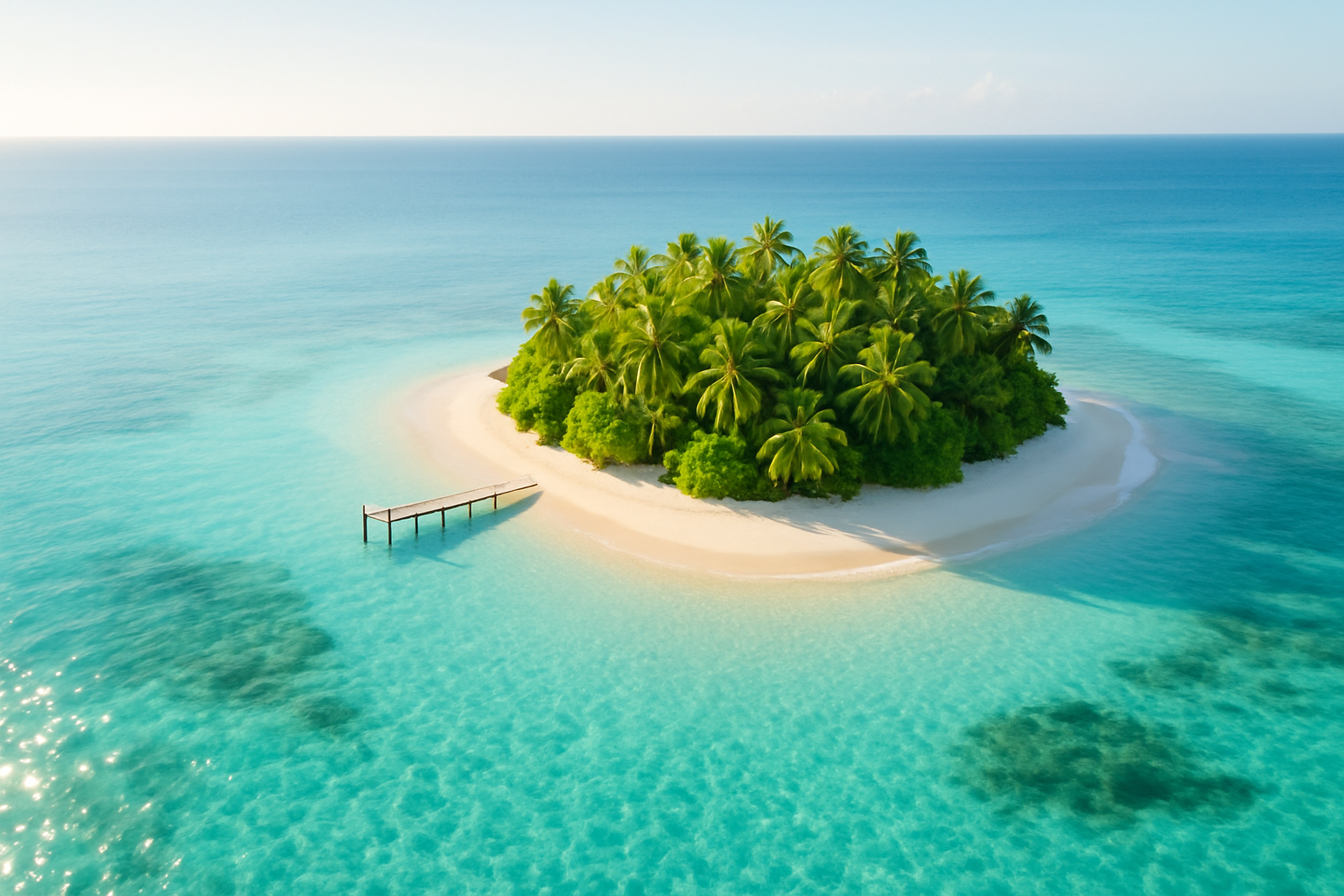
A private island is exactly what it sounds like — a body of land surrounded by water, owned privately rather than by a government or the public. What makes it different from other trophy real estate is that the thing being bought is not a building or a view but separation. When you own the island, you own the only land for a stretch of water in every direction. No neighbors, no through-traffic, no one who can wander up the beach without crossing water to get there. That separation is the entire product. Everything else — the villa, the beaches, the palm trees — is decoration on top of it.
That is why islands occupy a strange category in the wealth world. They are simultaneously the most romantic purchase and the least practical. A penthouse in Manhattan is a scarce asset that also happens to be convenient; an island is a scarce asset that is deliberately inconvenient, and the inconvenience is a feature. The distance that makes an island hard to reach is exactly what makes it private. You are buying the friction.
The market is smaller and stranger than most luxury markets. There is no MLS for islands, no Zillow that captures the whole picture. Instead there is a handful of specialist brokers — the German firm Vladi Private Islands, which says it has handled more than 2,400 island sales, and Canada’s Private Islands Inc., whose founder became familiar to television audiences through HGTV’s Island Hunters — and a thin, illiquid trade in which most listings sit for years. The Caribbean, and the Bahamas in particular, dominates: the Bahamas alone accounts for a large share of the world’s private-island listings, thanks to freehold title, no residency requirement, and a short hop from Florida.
Who buys them
The buyers split into tiers that look nothing alike, and the gap between them is the widest in almost any category of luxury.
At the entry level, a private island is surprisingly attainable — more attainable than a nice house in a major city. Undeveloped, remote islands in Canada, Scotland, or parts of Central America can sell for as little as a few hundred thousand dollars, well within reach of an ordinary millionaire or even an ambitious saver. These are not tropical paradises with white sand and a staffed villa. They are rocks and trees, often cold, often hard to reach, with no dock, no power, and no fresh water. The low price is not a bargain; it is a warning about everything the island does not have.
In the middle are the buyers most people picture: the successful entrepreneur, the celebrity, the person with a few tens of millions who wants a genuine tropical hideaway. This is the tier of Leonardo DiCaprio, who bought the roughly 104-acre Blackadore Caye in Belize in 2005 for a reported $1.75 million, and Johnny Depp, who bought the 45-acre Little Hall’s Pond Cay in the Bahamas in 2004 for about $3.6 million after spotting it while filming Pirates of the Caribbean. At this level the island is a personal retreat and a passion project, bought to be used and shaped rather than flipped.
At the top is a different species entirely. When Oracle co-founder Larry Ellison wanted an island, he did not buy a cay in the Bahamas — he bought about 98% of Lanai, the sixth-largest of the Hawaiian islands, in 2012 for a reported $300 million, and has since poured hundreds of millions more into remaking it. That is not a retreat; it is the purchase of a populated place, complete with residents, resorts, and an economy. Between the cold rock and the private Hawaiian island lies the entire range of who buys, and why.
Why they buy them
The obvious motive — “because they can” — is real but shallow. Dig into it and the reasons sort into four.
The first is privacy, and it is the deepest one. For someone whose face is known or whose security is a genuine concern, an island offers something no gated estate can: a natural moat. There are no paparazzi with long lenses across the street, because there is no street. There is no paparazzi in the bushes, because the bushes are yours and the only way to reach them is by water you control. For the very famous, that is worth more than any square footage. It is the same instinct that drives the wealthy toward privacy and invisibility generally, taken to its geographic extreme.
The second is control. On your own island you set the rules for everything — who comes, when, how the place looks, what gets built. There is no homeowners’ association, no zoning board next door, no neighbor’s renovation to endure. For people who have spent careers controlling companies and outcomes, the appeal of a domain where their word is simply final is hard to overstate.
The third is status, and here the island is unmatched. A great many wealthy people own a fine house; far fewer own a whole island. It is a trophy precisely because it is rare and slightly absurd — a purchase that signals not just money but a surplus of it, enough to spend on a piece of the planet with no practical justification. The fourth is legacy and refuge: a self-contained place to gather family across generations, and, for some, a bolt-hole from a chaotic world — the same impulse that drives the wealthiest toward remote, self-sufficient retreats. An island that makes its own water and power is, among other things, a place that keeps working when other places do not.
How it works
Buying an island is not like buying a house, and the first thing a serious buyer learns is that the deal is mostly about what you cannot see in the listing photos.
It starts with a broker, because there is no other efficient way in. The specialist firms maintain the real inventory and, more importantly, know which islands can actually be bought and lived on versus which are legal or logistical traps. Then comes the single most important question, the one that separates a real asset from an expensive mistake: freehold or leasehold? In much of the world you cannot actually own an island as a foreigner at all. Indonesia, Thailand, and the Philippines, among others, restrict foreign buyers to long-term leases or corporate structures rather than outright title. A leaseholder is a long-term renter with a fancier contract — and a leasehold island is reportedly worth only a fraction of a comparable freehold, because the clock is always running down and the improvements you pay for revert to the state at the end.
This is why the Bahamas and Caribbean dominate the desirable end of the market: they offer freehold title with no residency requirement and sit within easy reach of the United States. A buyer there is getting genuine ownership, not a decades-long rental.
Then there is due diligence, which on an island means asking questions no house buyer ever has to. Is there fresh water, or will every drop have to be shipped or manufactured? Is the island in a hurricane corridor? What are the rights of way — can the public land on the beach at low tide? Are there endangered species or protected reefs that will freeze any construction? What permits govern building, and how long do they take on an island a government barely thinks about? The answers determine whether the pretty rock in the photos is a paradise or a permanent, expensive headache.
What it costs
Here is the heart of the matter, and the reason the opening question exists. The purchase price of a private island is, for a developed and usable one, usually the smallest number in the whole equation.
Consider the sticker prices first. They range enormously — from a few hundred thousand dollars for a remote undeveloped island up through the tens of millions for a turnkey tropical estate, with the priciest listings in the Bahamas and Florida reaching into eight figures. That range alone should be a clue: a $500,000 island and a $30 million island are not the same product at different sizes. The cheap one is raw land in the ocean. The expensive one has already had millions spent turning it into a place a human can comfortably live.
Because that is the real cost: development. An undeveloped island typically has no fresh water, no power, no dock, no buildings, and no way to get materials there except by boat or barge. Fresh water means a desalination plant — a residential seawater system runs from the low tens of thousands to several hundred thousand dollars to install, depending on capacity. Power means solar arrays with battery banks or diesel generators, plus the fuel and replacement reserves to keep them going. A dock, a helipad, the villa itself, staff housing — every bit of it has to be barged in and built by crews who must be transported and housed. It is entirely normal for the cost of building an island to exceed the cost of buying it, sometimes by a wide margin. This is precisely why Larry Ellison’s $300 million purchase of Lanai was followed by something like half a billion dollars in development.
And then the meter never stops. Annual running costs for a developed private island typically land somewhere between $84,000 and $310,000 a year, covering property taxes, insurance, maintenance, a resident caretaker, boat transport, and the upkeep of the water and power systems — and that is for a modest one. Salt air corrodes everything; storms damage what the salt spares; equipment on a remote island is expensive to fix because the repairman has to be brought across water. Owning an island is less like owning a house and more like operating a tiny, permanently subsidized utility company that happens to have a beach.
Hidden costs and tradeoffs
Beyond the money, island ownership carries a set of costs that don’t show up on any invoice.
The first is illiquidity. The market that makes islands hard to buy makes them far harder to sell. Buyers are few, the pool is global and thin, and a specialized property in a remote location can sit on the market for years. If you need your money back quickly, an island is close to the worst place it could be. This is the opposite of a Manhattan condo, which can be sold in weeks; an island is an asset you should assume you cannot easily exit.
The second is isolation, which is the same feature that made the island appealing, now experienced as a cost. The distance that keeps the paparazzi away also keeps away doctors, restaurants, schools, and friends. A medical emergency on a remote island is a genuinely serious situation. The romance of total separation tends to wear thinner the longer one actually lives with it, which is one reason so many privately owned islands end up used only a few weeks a year — and why many owners quietly rent them out to defray the staggering running costs, as David Copperfield does with Musha Cay at rates starting around $37,500 a night.
The third is the operational burden. You cannot own a working island passively. Someone has to manage the staff, the boats, the generators, the water plant, the permits, the storm preparations. Either the owner takes that on — turning a retreat into a second job — or they hire an estate manager to run it like the small business it is, which is another salary layered on top of everything else. And the regulatory exposure is constant: environmental rules, building permits, and coastal-access laws can halt projects and generate disputes for years, particularly where a foreign owner’s plans collide with local interests, as Ellison has repeatedly discovered on Lanai.
What people get wrong
The single biggest misconception is the one baked into the opening question: that the purchase price is the cost. It almost never is. For any island you would actually want to live on, the price of the land is the down payment on a much larger, open-ended obligation to build and then run a piece of infrastructure in a hostile environment forever. The people who get into trouble are the ones who see a cheap listing, picture a paradise, and never do the arithmetic on the water plant, the barge, the caretaker, and the twenty years of salt-air maintenance.
The second misconception is that buying means owning. In much of the world’s most beautiful island geography, a foreigner cannot get freehold title at all, and a leasehold is a wasting asset dressed up as a purchase — you are paying for improvements that will one day revert to someone else, on land you never truly held. A buyer who doesn’t understand the difference can spend millions and end up, in effect, a tenant.
The third is that remote equals safe and simple. It is easy to imagine an island as an escape from complexity. In practice it is a machine for generating complexity — legal, logistical, mechanical, meteorological. The very isolation that provides the privacy is what makes every ordinary problem harder and more expensive to solve. The island does not shed the difficulties of ordinary property; it concentrates them and surrounds them with water.
Bottom line
The answer to the Million Dollar Question is C: the buyer is underestimating everything that comes after the purchase. The $2 million listing is not the cost of owning a private island; it is the entry fee for the right to spend far more building it and running it, likely for the rest of one’s life. The purchase price is the smallest, simplest, and most visible number in a picture dominated by the ones nobody puts in the listing.
That gap is the real subject here. A private island is the ultimate trophy because it delivers, in its purest form, the two things wealth most wants to buy and can least often get: absolute privacy and absolute control. For the buyers who understand what they are actually purchasing — an operation, not just a place — it can be worth every unglamorous dollar. For the ones who see only the beach in the brochure, it is the most beautiful way there is to discover that in luxury, as everywhere else, the sticker price is where the spending begins, not where it ends.