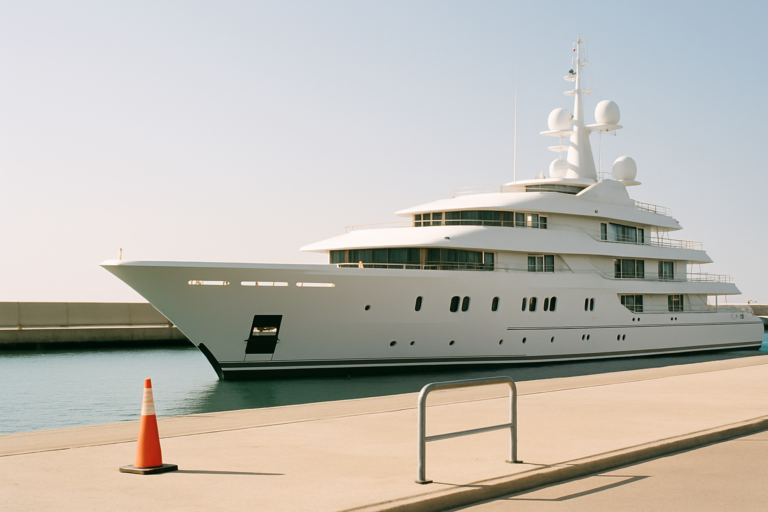
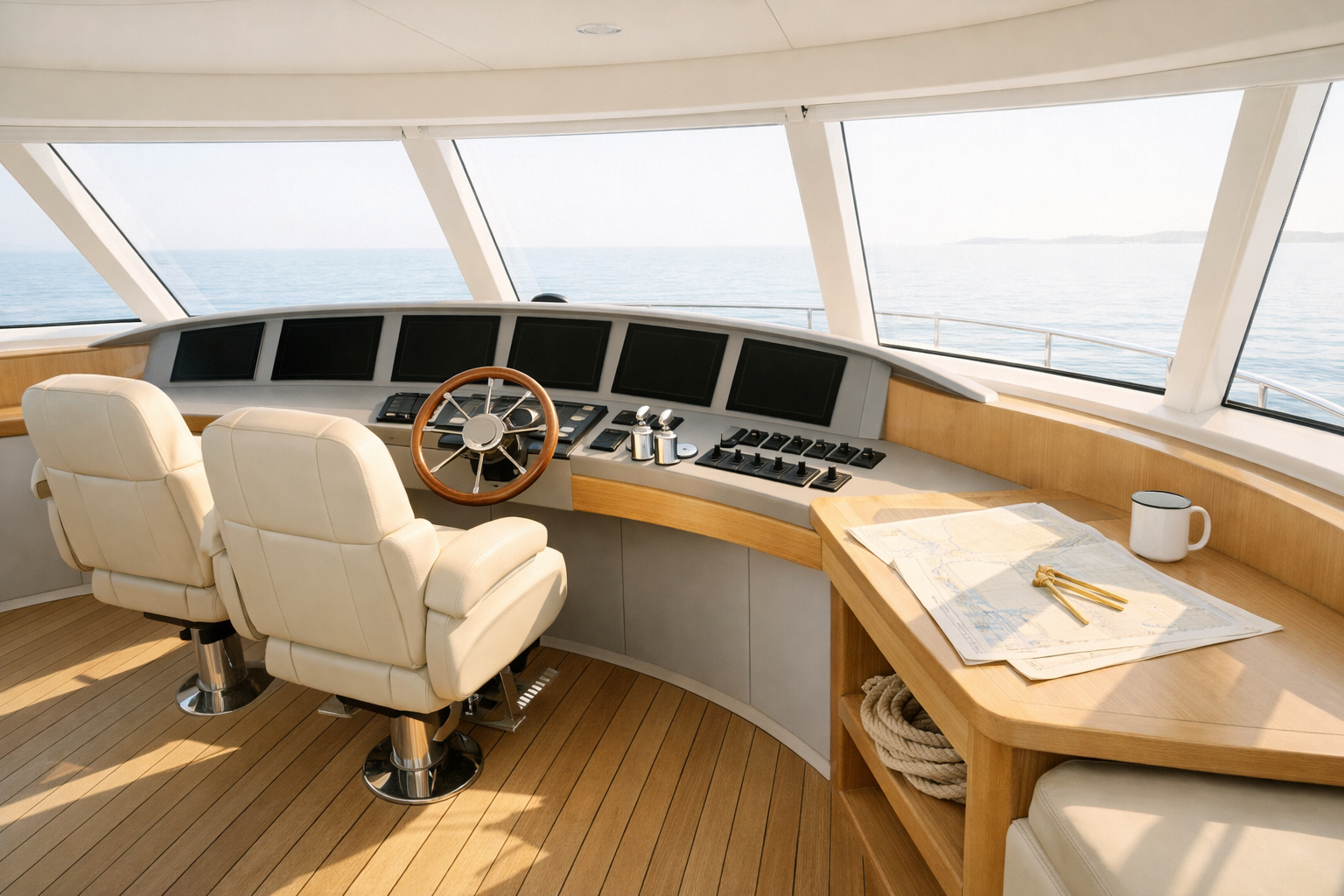
The Job That Sees It: The Yacht Captain
The Million Dollar Question: A recruitment firm surveyed 367 superyacht captains on vessels from 20 to 120-plus metres and asked, among other things, how their time was structured. What share of them were on a time-for-time rotation — equal time aboard and equal time off, so that the job occupies roughly half the year?
A) 13% B) 33% C) 63% D) 83%Read on for the answer.
The housekeeper had five published salaries that agreed with each other and described a population that mostly worked in hotels. The yacht captain has both of that job’s problems at once, plus one of his own.
Start with the number a reader wants. On the industry’s own figures, a captain on a 50-metre motor yacht is paid somewhere between €10,000 and €16,000 a month — the band YPI Crew published in March 2026 for that length. At the bottom of the range the average is around €6,000 for boats of 20 to 24 metres; past 100 metres it is over €25,000, both from Quay Crew’s 2025/26 survey of 367 captains. An owner-facing guide puts the same job in annual dollars: $235,000 to $393,000 at 60 metres, says Yachtbuyer.
Now the US federal government’s answer. It prices Captains, Mates, and Pilots of Water Vessels at a $103,720 annual mean across 36,850 people, and the best-paid large group among them are towing barges up a river.
Both are real measurements. Neither is of the other’s job. And the monthly figures above are not annual earnings divided by twelve, because most of the people earning them are not aboard for twelve months. Three distinct problems, and the rest of this is an attempt to keep them apart.
Yacht captain salary: the numbers, and how many of them are the same number
| Source | Figure | What it is | As of |
|---|---|---|---|
| YPI Crew | €5,000–€23,000/mo | Agency benchmark bands, below 30m to 100m | Mar 2026 |
| Quarterdeck | €5,000–€23,000/mo | “Indicative gross monthly base,” same bands | Sep 2026 |
| Northrop & Johnson | $9,800–$32,800 | Brokerage guide, same bands, period unstated | 2026 |
| Quay Crew | ~€6,000 to >€25,000/mo | Measured averages, 367 captains, 20m–120m+ | Nov 2025 |
| Dockwalk | $8,002–$20,541/mo | Measured averages, 336 captains, 60ft–280ft+ | 2021 survey, pub. Feb 2022 |
| Salary.com | $110,967/yr | US national average for “Yacht Captain” | 1 Nov 2026 |
| PayScale | $84,988/yr | US average base, 14 salary profiles | 1 Sep 2026 |
| BLS OEWS (53-5021) | $103,720/yr | Annual mean, 36,850 workers surveyed | May 2025 |
The first three rows are variants of one row. YPI Crew’s seven captain bands — below 30m €5,000–€6,000 rising to 80–100m €16,000–€23,000, with 100m+ “discretionary” — are reproduced number for number by Lighthouse Careers, which cites only an unnamed “published 2026 guide.” Quarterdeck prints the same six numeric bands exactly, stopping short of the 100m+ row because, it says, “figures at the very top end (90m+ superyachts) are excluded”; it describes its own data as “sourced from industry salary guides” and names YPI only in connection with junior deckhands. Northrop & Johnson uses the identical band cuts and, in its non-captain rows, role labels down to “Specialised Deckhand” and “Laundry Master” that Lighthouse reproduces as well — in several of them N&J’s dollar figures appear unchanged as Lighthouse’s euro ones — and it too treats 100m+ as discretionary, printing it, in an English-language document, as Discrecional.
But N&J’s captain figures are not a conversion of YPI’s. At 80–100m, YPI says €16,000–€23,000 and N&J says $26,200–$32,800; across the twelve band endpoints the implied ratio runs from 1.40 to 2.04, which no single exchange rate produces. So either it is a separate dataset wearing the same clothes, or it is an inconsistent conversion — and N&J never states whether its figures are monthly or annual, or that “<30M” means metres.
Strip out the restatements and roughly three primary datasets exist. Quay Crew surveys captains directly — 186 in 2021, about 300 in 2023, 367 in 2025/26. Dockwalk, the trade paper, which says its 2026 round is “now in its 28th year,” drew 476 captains in 2021, of whom 336 gave salary figures. Oyster Yachts, a builder, surveyed 141 crew on its own sailing boats at a 71% response rate. Everything else restates one of those, or publishes bands with no sample size, method or date. And the measured numbers come in lower than the advertised ones: Quay Crew’s 2023 round, reported by SuperyachtNews, found an all-captain average of €16,243 a month, against agency bands running to €23,000 and a brokerage guide to $32,800.
The US aggregators are measuring something else entirely. Salary.com’s “Yacht Captain” page gives $110,967 with a 90th percentile of $128,276 — a tighter distribution than any industry source, for a job the industry prices across a fivefold range. On the same site, on the same date, “Boat Captain” is $53,941, on a title difference. PayScale’s figure rests on fourteen people.
The federal survey counts 36,850 captains, and the money is in towing
Unlike the butler, the captain is in the federal classification, and precisely. Captains, Mates, and Pilots of Water Vessels, SOC 53-5021 covers 36,850 people in the May 2025 estimates, at a $103,720 annual mean, a $92,460 median and a $170,640 90th percentile, with industry splits and standard errors published too. It is better data than anything the yachting industry has. Then read the occupation’s own definition: “Command or supervise operations of ships and water vessels, such as tugboats and ferryboats. Required to hold license issued by U.S. Coast Guard.”
| Industry | Employment in 53-5021 | Share | Annual mean |
|---|---|---|---|
| Inland Water Transportation | 9,970 | 27.1% | $115,630 |
| Support Activities for Water Transportation | 8,720 | 23.7% | $111,970 |
| Deep Sea, Coastal and Great Lakes | 4,640 | 12.6% | $104,610 |
| Scenic and Sightseeing Transportation, Water | 4,240 | 11.5% | $70,960 |
| Other Amusement and Recreation Industries | 930 | 2.5% | $79,440 |
| Private Households (NAICS 814) † | — | — | — |
† is not a BLS row; it marks an absence explained below. The shares are this piece’s arithmetic; the ordering is the finding. The two best-paid large industries here are inland towing and port services, while the two that could plausibly contain a yacht — sightseeing water transport and the catch-all recreation bucket — pay $70,960 and $79,440, both below the occupational mean. Nothing in the published federal data points to commanding a boat for pleasure as where the money is, though the survey excludes private households by construction, so its silence here is structural rather than evidential.
And the last row is again the point. Private households are not a small share of this occupation in the federal numbers; they are absent, and so is anyone self-employed. The OEWS technical notes say it in two flat sentences: the survey “does not include the self-employed, owners and partners in unincorporated firms, household workers, or unpaid family workers,” and “Private households (NAICS 814) are also excluded.” A captain on a private owner’s payroll, or invoicing through his own company, is outside the survey by construction.
You can see roughly how many people that is. The Occupational Outlook Handbook puts 2025 employment for the same occupation at 41,300, because it comes from the Employment Projections programme, which counts the self-employed. The gap of about 4,450 is not all yacht captains, but it is the only federal measure of the population the wage survey cannot see.
Two more cautions, both from the technical notes. The annual figures are a convention — an hourly rate multiplied by a 2,080-hour notional year, which is an odd thing to apply to a job worked in 28-day hitches, and mariners are not among the occupations BLS says report annual rates directly. And “May 2025” is not May 2025: the estimates “are based on responses from six semiannual panels collected over a 3-year period,” reaching back to November 2022.
The answer is C: paid twelve times for about half a year aboard
The answer is C — 63%. In Quay Crew’s 2025/26 report, 63% of the 367 captains surveyed had a time-for-time rotation — equal periods on board and off. YPI Crew describes equal rotation as standard from 50 metres up; in Quay Crew’s 2021 round uptake rose with size, from 23% at 40–49 metres to 83% above 100 metres, and no yacht under 39 metres offered it at all.
This is the fact that makes every monthly figure above hard to annualise, and it is where the two best surveys appear to contradict each other.
Dockwalk asked rotational captains how they were paid. Of the 476 who responded, 20.59% were on rotation — about 98 people — on schedules from 1:1 to 4:4, and of those, 70 were paid monthly regardless of rotation while 12 were paid only for the months they worked. Eighty-two answered that question, so the proportion is not firm; but of those who did, the large majority draw twelve monthly payments for about six months aboard.
Quay Crew, measuring the same arrangement from the other end, found that full-time positions on yachts over 60 metres averaged “over 2k a month more” than rotational ones. Quarterdeck, writing a guide rather than a survey, warns that only “some yachts pay the quoted monthly salary throughout the year.”
Read together — this reading is this piece’s, not any source’s — those findings are not in conflict. The rotational captain accepts a monthly rate roughly €2,000 below what a full-timer on the same boat would get, then receives it twelve times for half a year’s presence: on the 2021 figures, giving up about €24,000 a year to buy back about six months of his life. Nobody publishes that as a finding, and it is the first thing to establish before treating any of these monthly numbers as a salary.
It also quietly reprices the whole table. Quay Crew’s 2023 average of €16,243 a month annualises to €194,916, and in the same firm’s 2025/26 round 63% of captains were aboard for half the year. Those are different rounds with different samples, so that is not a statement about the people inside the 2023 average; it is the reason nobody should annualise either number without first asking about rotation.
How much do yacht crew make, and the floor underneath them
A captain does not come alone, and the sources do not agree on how many come with him. At 50 metres Yachtbuyer gives 8 to 12 for its 40–50m row and publishes no 50–60m row at all, while Ocean Independence gives 15 to 22 for 50–70m, plus a rule of thumb of roughly one crew member per three to four metres of length. Dockwalk adds the variable none of the others isolate: “a 40-meter (131-foot) private yacht might operate with five crew, while a similarly sized commercial charter yacht might require eight to ten crew.”
Monthly bands for the rest of the boat, from Quarterdeck’s gross-euro guide: junior deckhand €2,800–€3,200, bosun €3,500–€6,000, junior steward or stewardess €2,500–€3,500, chief steward or stewardess €4,000–€8,500+, sole or head chef €4,500–€10,000+, chief or sole engineer €5,000–€15,000+. The engineer tops out near the captain, and in the federal data Ship Engineers (53-5031) out-earn captains on average, $111,790 against $103,720 on 8,400 people, while Sailors and Marine Oilers average $56,830.
Then there are tips, a material part of the package on charter boats and the only part nobody contracts for. The published percentages do not agree — Burgess and Northrop & Johnson both say 10–15% of the charter fee, Worth Avenue Yachts says 10–20% and Oyster 5–15% — and the one measured series is Dockwalk’s, from charter yachts only, as monthly averages: $1,374 at 60–99 feet, $2,988 at 140–179 feet, $5,600 at 280 feet and over.
Underneath all of it sits a floor almost nobody in yachting will ever touch. Under MLC 2006’s Guideline B2.2.4, basic monthly pay for an able seafarer “should be no less than the amount periodically set by the Joint Maritime Commission.” That amount is US$690 a month, effective 1 January 2026, agreed in Geneva in April 2025 by what the ILO calls the only statutory international wage-fixing mechanism of its kind in any industry. And Guideline B2.2.4 sits in Part B of the Code, which is recommendatory, not binding. A junior deckhand at €2,800 a month is paid more than four times a floor that is itself only advice.
What the owner pays, which is not what the captain gets
Flip to the buyer’s side and the numbers get larger and less certain at once. Every broker quotes the same rule of thumb and none will own it. Fraser: “Industry benchmarks put annual running costs at between 10 and 15 percent of a yacht’s purchase value.” Moran: “typically add 10% of the yacht’s value per year” in one place and “8-20% of purchase price” in another, on the same page. IYC: 10% to 25%. That is an 8%-to-25% spread on one benchmark, and each firm attributes it to the industry rather than to its own books. Maintenance alone, on Fraser’s figures and Boat International’s alike, accounts for five to ten per cent of purchase value a year — so most of what is left in the benchmark is crew.
Within that budget, crew is the biggest line. Will Christie of Christie Yachts, writing in SuperyachtNews: “Crew salaries and associated employment costs make up the largest single part of the operating budget.” Moran puts a number on it — “Salaries typically account for 30 to 40% of total annual operating costs regardless of vessel size.” Its own 50-metre example, on a $30m hull with 10 to 12 crew, runs crew at $1.2m–$1.8m inside a $2.7m–$5.4m total, which works out at 33% comparing the tops of the two ranges and 44% comparing the bottoms — overlapping its stated band rather than confirming it. Yachtbuyer totals the payroll directly: about $390,000 for a 30-metre boat with five crew, $942,000 for a 50-metre with nine, and $2,252,000 for an 80-metre with twenty-five — the last excluding relief crew, so the real bill “could be considerably higher.”
Whether the law is aboard depends on what the owner calls the boat
Here the job departs from every other one in this series. The housekeeper, the nanny and the butler are all inside the Fair Labor Standards Act, named in the regulations. A captain’s position depends on a classification the owner largely controls.
The Maritime Labour Convention is the seafarer’s charter: a written employment agreement with eleven mandatory particulars, minimum rest of ten hours in any 24 and 77 in any seven days (or, at the flag state’s election, maximum work of 14 and 72), a notice period that “shall not be shorter than seven days,” repatriation at no cost, and since the 2014 amendments a financial security covering up to four months’ unpaid wages, though the duty to carry proof of that security aboard reaches only ships of broadly 500 gross tons and over on international voyages. Its scope is Article II, paragraph 4: the Convention “applies to all ships, whether publicly or privately owned, ordinarily engaged in commercial activities.”
The Convention never defines that phrase. The ILO’s own FAQ says so outright — it “would be a matter for good faith determination by the country concerned” — and on yachts answers that “in principle, yachts ordinarily engaged in commercial activities fall within the scope.” The Cayman Islands Shipping Registry, which flags much of the fleet, states the converse in one line in Guidance Note 02/2013: “any pleasure yacht that is not engaged in trade is not required to comply with the MLC.” And the Red Ensign Group Yacht Code hands the decisive term straight back: “‘Pleasure vessel’ shall have the meaning assigned to the term as defined in the national legislation of the REG Member State.”
So: the same 60-metre boat, the same captain, the same hours. Offered for charter, he has a statutory contract, rest limits, repatriation and abandonment cover. Kept purely private, he has whatever the owner agreed to. Cayman’s answer is to make compliance a condition of the certificate rather than of the law — a private yacht that declines it gets a Statement of Compliance instead of a Certificate — which is, on this piece’s reading, a commercial lever rather than a legal one. Which is why Oyster’s finding that 97% of its crew had a written seafarer employment agreement is worth noticing: on that fleet the document is near-universal whether the Convention compels it or not.
The abandonment numbers show what the floor looks like when it gives way. The IMO/ILO joint database, reported to the IMO’s legal committee in December 2024, held 1,145 incidents since 2004 covering 16,569 seafarers — 142 new cases in 2023 and 310 between 1 January and 20 December 2024, of which 144 involved no obligatory financial guarantee at all. That is merchant shipping, overwhelmingly. But yachts appear. Crew of the 81-metre Alfa Nero, left in Antigua from early 2022, won unpaid wages in the High Court of Antigua and Barbuda; Nautilus International reported £890,000 released to its members in January 2025, after the boat itself sold for $40 million. On the 95-metre Indian Empress, arrested in Malta in 2018, the P&I club Skuld paid out more than $615,000 in four months of wages under the MLC financial security provisions, and a Maltese court ordered €234,129 in backdated salaries to fifteen crew.
American law reaches crew less far, not further. 29 U.S.C. § 213(b)(6) exempts “any employee employed as a seaman” from federal overtime, full stop; § 213(a)(12) exempts “any employee employed as a seaman on a vessel other than an American vessel” from the minimum wage as well. A seaman on a US-flagged yacht therefore gets minimum wage and no overtime; on a foreign-flagged one, which is most of the fleet, neither. Whether a given crew member counts as a “seaman” turns on the Labor Department’s test, under which non-seaman work is substantial if it occupies more than 20% of the workweek. The sharper edge is older: in Caruso v. Sterling Yacht, 828 F.2d 14 (11th Cir. 1987), a yacht cook who hurt her foot ashore while the boat she had been hired for was still being completed lost both her Jones Act claim and her maintenance and cure, because a vessel not yet licensed, not yet sea-trialled and not yet delivered was not “in navigation.”
Licensing bends the same way. In Britain the certificates are explicit — the MCA’s MSN 1858 (M+F) Amendment 2, published in May 2026, runs Master (Yachts) under 500 GT, under 3000 GT and a newer Yachts Unlimited rung, and 68% of the captains in Quay Crew’s 2021 survey held Master 3000gt. In the United States a private yacht is a “recreational vessel” under 46 U.S.C. § 2101(36) — “operated primarily for pleasure” — and is not inspected, so no certificate of inspection sets its crew. Below 200 gross register tons no federal credential is required to command one.
Above that line the governing condition turns out to be geography, not pleasure. 46 CFR § 15.701 applies to “each vessel documented under the laws of the United States navigating seaward of the Boundary Lines,” excepting only public vessels, wooden vessels of primitive build, barges and vessels of less than 200 gross tons, and then provides that “the Master, Mates and engineers on any vessel to which this section applies must hold an MMC officer endorsement.” Section 15.805(a)(1) says the same of “every self-propelled, seagoing documented vessel of 200 GRT and over.” Neither contains a recreational exception, and § 15.805(c) shows the drafters knew how to write one — they put it in the citizenship requirement instead. So inside the Boundary Lines these provisions ask nothing of a private yacht; outside them, on their face, they require a credentialed master whatever the boat is for. What this piece could not establish is enforcement: no Coast Guard policy letter or circular on the point was found, and most large private yachts are not American-documented in any case.
One rule runs the other way, and it is the career on-ramp: 46 CFR § 11.422(c) lets sea time earned “on vessels upon which no personnel need an officer endorsement” count toward an endorsement below 200 GRT, where the Coast Guard “must be satisfied that the nature of this required service … is a reasonable equivalent” to service on vessels that do need one. It is a discretionary test rather than an entitlement. But time on a boat where nobody needed a licence can, with permission, buy you one.
Tax is the last asymmetry, and it runs in opposite directions by passport. A UK-resident captain who satisfies the Seafarers’ Earnings Deduction gets, under ITEPA 2003 s.379, a deduction “equal to that amount” — the whole of the qualifying earnings, on a 365-day eligible period counted by whether he was outside the UK at midnight. The statutory definition of the “ship” it all turns on is one clause long: “In this Chapter ‘ship’ does not include an offshore installation.” An American captain gets the reverse. The IRS sets the 2026 foreign earned income exclusion at $132,900 and lists among the things that are not foreign earned income: “Pay for services conducted in international waters or airspace (not a foreign country).” Sea time does not build the 330 days, so a US captain can be away from America a year and still owe tax on most of what he earned.
What people get wrong
That the agency bands are data. They are benchmarks with no sample size, no method and no date for the underlying figures: two apparently separate publishers print all seven of the same rows, a third prints the first six. The datasets with a stated sample — Quay Crew’s, Dockwalk’s, Oyster’s — produce averages below the top of the advertised ranges.
That a monthly figure times twelve is a salary. Sixty-three per cent of the captains in Quay Crew’s 2025/26 survey work a time-for-time rotation, and of the rotational captains Dockwalk surveyed, 70 of the 82 who answered were paid monthly regardless. The annualised figure is real money; it is not a year’s work.
That the BLS number describes this job. It describes 36,850 licensed captains whose best-paid large segment is inland towing at $115,630 and whose sightseeing-water segment averages $70,960, excludes private households and the self-employed by rule, and converts to annual figures at 2,080 notional hours.
That the cost to the owner is the salary. Crew is the largest single line in a yacht’s operating budget, and the payroll for a 50-metre boat with nine crew runs near $942,000 before relief crew, recruitment or insurance.
That maritime law protects yacht crew because they are seafarers. MLC 2006 applies to ships “ordinarily engaged in commercial activities,” the Convention does not define the phrase, and the flag state decides; Cayman’s position is that a pleasure yacht not engaged in trade need not comply at all. US federal overtime reaches no seaman, and the minimum wage does not reach one on a foreign-flagged vessel.
That tax-free pay is the norm. It is a full deduction for a UK or EEA resident who meets a 365-day test. For a US citizen, time in international waters is expressly not foreign earned income, so the exclusion mostly does not apply.
Bottom line
What the job pays, as best the record shows: €5,000 to €23,000 a month across the agency bands for boats from under 30 to 100 metres; around €6,000 to over €25,000 a month as measured averages from 24 to 119 metres in a survey of 367 captains, with €16,243 as the all-captain average in the same firm’s 2023 round; $8,002 to $20,541 a month as measured averages across 336 captains in 2021; $118,000 to $394,000 a year in an owner-facing guide for 25- to 80-metre boats; and $103,720 as the May 2025 federal mean for 36,850 American ship captains, almost none of whom do this.
Those are not six estimates of one number, and the gaps between them are the information. The federal survey measures a licensed occupation whose centre of gravity is a tugboat. The agency bands measure what a recruiter will tell a candidate. The owner guides measure a cost, which is a different quantity from a wage. And the variable that moves the answer most is not length or flag or qualification but time: whether the figure buys twelve months of a person or six.
So the honest version of the query has four clauses rather than two. How large a boat, under which flag, private or chartering — and rotation or not. Each number above answers one or two. None answers all four, and the industry’s own best surveys publish the endpoints of their size bands while keeping the middle in a report you have to ask for.
Methods and sources.
Federal occupational data. Figures for Captains, Mates, and Pilots of Water Vessels (SOC 53-5021), Ship Engineers (53-5031) and Sailors and Marine Oilers (53-5011) are May 2025 Occupational Employment and Wage Statistics estimates, the most recent release — announced in BLS news release USDL-26-0725 on 15 May 2026 — retrieved on 3 November 2026 from the OEWS Profiles tool and the OEWS Query System at data.bls.gov/oes. A note on retrieval, because it affects anyone trying to check this: BLS discontinued its static per-occupation pages with the May 2024 estimates, and the bls.gov/oes/current/oes535021.htm URLs that most articles and aggregators still cite no longer resolve. The figures now live only in the JavaScript applications at data.bls.gov, and the bulk XLSX files and the public API were both unavailable to this piece’s retrieval (403 and an exhausted anonymous daily quota respectively), so the numbers below were read from the live tools rather than from a downloaded file.
For 53-5021: employment 36,850 (relative standard error 2.8%), hourly mean $49.87, annual mean $103,720 (wage RSE 2.2%), hourly median $44.45, annual median $92,460, and annual percentiles of $47,420 (10th), $63,880 (25th), $127,180 (75th) and $170,640 (90th). For 53-5031: employment 8,400, annual mean $111,790, annual median $109,530. For 53-5011: employment 31,670, annual mean $56,830, annual median $51,520. Industry detail for 53-5021 is from the same source: Inland Water Transportation (NAICS 483200) 9,970 at a $115,630 annual mean; Support Activities for Water Transportation (488300) 8,720 at $111,970; Deep Sea, Coastal and Great Lakes Water Transportation (483100) 4,640 at $104,610; Scenic and Sightseeing Transportation, Water (487200) 4,240 at $70,960; Other Amusement and Recreation Industries (713900) 930 at $79,440. The shares — 27.1%, 23.7%, 12.6%, 11.5% and 2.5% — are this piece’s arithmetic on those employment counts against the 36,850 national total, and are not published by BLS, which retired the “percent of occupation” column along with the static pages. The occupation’s highest-paying industries, on the same source, are Merchant Wholesalers, Nondurable Goods (4241, 4247 and 4249 only) at $158,520, Support Activities for Mining at $137,050 and Freight Transportation Arrangement at $136,930; the industry employment and top-paying lists are each capped at fifteen rows by the tool, so neither is exhaustive. OEWS publishes industry detail at the four-digit level, so figures described here as, for example, deep-sea water transportation are the 483100 aggregate rather than a six-digit code.
Private households do not appear in the occupation’s industry breakdown because they are outside the survey: the OEWS technical notes state that the survey measures “wage and salary workers in nonfarm establishments,” that it “does not include the self-employed, owners and partners in unincorporated firms, household workers, or unpaid family workers,” and that “Private households (NAICS 814) are also excluded.” NAICS 814 has no line in the OEWS industry file at all. That exclusion, and not any inference about how a particular employer classifies anyone, is the basis for every statement here that the federal wage survey does not price private-yacht work. Nothing here claims that any individual counted in 53-5021 does or does not command a yacht; the occupation’s own definition — “Command or supervise operations of ships and water vessels, such as tugboats and ferryboats. Required to hold license issued by U.S. Coast Guard” — is the 2018 Standard Occupational Classification wording as the OEWS tool displays it, and also appears, minus the exclusion clause, on O*NET. The 41,300 employment figure for 2025 is from the Occupational Outlook Handbook (last modified 27 August 2026) and comes from the Employment Projections programme, which includes the self-employed; the roughly 4,450 gap against OEWS is this piece’s subtraction of two figures from different programmes with different coverage, and is offered as an upper bound on the excluded population rather than as a count of yacht captains. The Handbook’s 2025 figures for ship engineers (8,800) and sailors and marine oilers (33,000) likewise exceed the OEWS counts of 8,400 and 31,670 for the same reason, and the two series should not be mixed. Two features of OEWS annual wages are stated in the text because they bear on how the figures should be read, and both are quoted from the technical notes: the notes state that “the annual rate for an occupation is calculated by multiplying the hourly wage rate … by a typical work year of 2,080 hours,” which the body renders as “Annual wages have been calculated by multiplying the hourly wages by 2,080 hours” — the wording of the Query System’s own footnote to the same effect — and “The May 2025 estimates are based on responses from six semiannual panels collected over a 3-year period: May 2025, November 2024, May 2024, November 2023, May 2023, and November 2022.” The notes also list teachers, pilots and flight attendants — not mariners — as the occupations for which establishments report annual rather than hourly rates. OEWS wages are “straight-time, gross pay, exclusive of premium pay,” which includes tips but excludes overtime; that matters for a rotational occupation and is why no comparison here treats an OEWS annual figure as annual earnings.
Crew agency and brokerage salary guides, all retrieved 3 November 2026 and quoted with the dates each page gives itself. YPI Crew’s captain guide was published 8 March 2026 and updated 25 March 2026; its bands are monthly euros and it does not state whether they are gross or net, discloses no sample size or collection method, and describes them only as the firm’s “current superyacht Captain salary benchmarks.” The seven bands are below 30m €5,000–€6,000, 30–40m €6,000–€9,000, 40–50m €8,500–€12,500, 50–60m €10,000–€16,000, 60–80m €14,000–€18,000, 80–100m €16,000–€23,000, and 100m+ “discretionary.” Quarterdeck (published 11 September 2026, modified 17 September 2026) prints a six-row captain table whose figures are numerically identical to YPI’s first six bands; it has no 100m+ row, stating that “figures at the very top end (90m+ superyachts) are excluded as they are not the primary audience for this guide,” and it carries no leave column. It describes its figures as “indicative gross monthly base salaries in euros,” says its data is “sourced from industry salary guides” and names YPI Crew only in connection with junior deckhands; its non-captain monthly bands, quoted in the text, are from the same page. Lighthouse Careers carries all seven of YPI’s bands, undated beyond a 2026 copyright, and attributes them only to an unnamed “published 2026 guide” with a second unnamed guide said to be “consistent with it”; several of its euro figures for non-captain roles are numerically identical to Northrop & Johnson’s dollar figures for the same roles and bands, which is why the no-conversion argument below is confined to the captain row. The Northrop & Johnson 2026 guide states its currency as US dollars but nowhere states whether its figures are monthly or annual, and its column headers read “<30M (USD)” through “100M+ (USD)” without saying that “M” means metres; the magnitudes and the band structure both point to monthly figures in metre bands, and the text flags both as ambiguous as printed rather than resolving them. Its captain row reads $9,800–$12,250, $9,800–$16,375, $13,000–$20,500, $16,400–$24,500, $19,600–$32,750, $26,200–$32,800 and “Discrecional.” The observation that these four publications are not four independent datasets rests on the identity of the figures and the band cuts, which is checkable; the inference about which direction the copying ran is not made. The implied YPI-to-N&J ratio range of 1.40 to 2.04 is this piece’s arithmetic across all twelve endpoints of the two captain tables’ six shared bands, and is offered to show that the N&J figures are not a single currency conversion of the YPI ones, not as an exchange-rate claim; at the 80–100m band quoted immediately before it, the ratios are 1.64 and 1.43. No euro figure in this piece has been converted to dollars or vice versa. Three comparisons do cross currencies — the junior deckhand’s €2,800 against the ILO’s US$690 floor, Yachtbuyer’s dollar captain bands against YPI’s euro ones, and Moran’s dollar captain range against the same — and each is stated as a direction rather than a multiple, which is why the deckhand comparison reads “more than four times” rather than giving a figure: at any plausible 2026 rate the true multiple is higher than the bare ratio of the two numbers. Flying Fish’s guide (published 2019, modified 3 February 2026) was reviewed but is not quoted, because its length bands differ, its role headings and its own table disagree, and one passage describes charter gratuities as a percentage of monthly salary while the rest of the page describes them as a percentage of the charter fee.
Primary surveys. Quay Crew’s Superyacht Captain Salary & Leave Report 2025/26, published 17 November 2025, states a sample of 367 captains on vessels from 20m to 120m+, gives monthly euro averages of “around €6,000 on 20–24m yachts to over €25,000 on 100–119m vessels,” reports a 7% rise for the 70–79m band against 2023, and states that 63% of captains have a time-for-time rotation. It publishes no figures for the intermediate size bands, no gross-or-net basis and no survey period or collection method; it does publish the rotation figure used here, along with pay-review and travel results. The firm’s 2021 survey page (published 4 May 2021, modified 29 January 2024 — and referred to here as the 2021 round by its publication date, though the firm’s later write-ups number its surveys 2020 and 2022, so the fieldwork year is not certain) states a sample of 186, gives separate full-rotation and full-time monthly averages by band, reports that 68% of respondents held Master 3000gt, and is the source for the rotation-uptake figures of 23% at 40–49m and 83% above 100m and for the statement that no yacht under 39m offered rotation. Readers should note that the 2021 page also reports a 63% average rotation rate for yachts above 50 metres (92 of 147 captains), which is numerically the same as the 2025/26 all-sizes figure quoted in the text; the two are from different rounds with different samples and denominators, and this piece attributes 63% only to the 2025/26 report. The 2021 page’s “over 100m” full-time average of about €14,500 is lower than its 90–99m figure of about €25,000, which the page does not explain and which this piece does not use. The statement that full-time positions above 60 metres average “over 2k a month more” than rotational ones is quoted from that page. Quay Crew’s 2023 round is quoted at second hand from SuperyachtNews, which reports a sample of about 300 captains and an all-captain monthly average of €16,243, with private captains at €17,105 and charter captains at €15,518; that article carries no publication date on the page, and the underlying 21-page report was not obtained. The €194,916 annualisation of €16,243 is this piece’s arithmetic and is presented in the text precisely in order to say that it should not be read as annual earnings.
Dockwalk’s captain figures are from its 2021 salary survey, published 1 February 2022 by Lauren Beck: 476 captains responded and 336 gave salary information, so the salary averages rest on 336 and the rotation question on a subset of the 98 rotational respondents, bands are in feet, figures are monthly US dollars with euro responses converted by the publication, and salary figures exclude benefits, tips and other extras. Averages: $8,002.01 (60–99ft), $10,108.18 (100–139ft), $14,166.31 (140–179ft), $16,147.26 (180–239ft), $15,473.58 (240–279ft) and $20,540.91 (280ft and above) — a series that is not monotonic at 240–279ft, which the article does not explain and which is most likely a small-sample artefact; no per-band sample sizes are published. The tip figures quoted are from the same table, apply only to yachts available for charter, and are monthly averages. On rotation, the article states that 20.59% of the 476 respondents were on rotation, on schedules from 1:1 to 4:4, and that of those, 70 were paid monthly regardless of rotation and 12 were paid only for months worked. Note that 20.59% of 476 is about 98 captains while 70 and 12 sum to 82, so roughly sixteen rotational respondents are unaccounted for on that question; the text therefore describes the split as “70 of 82” rather than as a share of all rotational captains, and the phrase “roughly five in six” refers to the 82 who answered. The reading of Quay Crew’s and Dockwalk’s rotation findings as compatible rather than contradictory is this piece’s synthesis and is labelled as such in the text; no source states it. The €24,000 figure is twelve times the “over 2k a month” differential, this piece’s arithmetic, and is illustrative on two counts: the differential is an average across a size band rather than a figure for any individual post, and it comes from the 2021 page, so applying it to 2026 pay assumes a stability nobody has measured.
Oyster Yachts’ Crew Salary Survey, published December 2025, surveyed 141 crew on Oyster sailing yachts of 50 to 90 feet carrying one to four professional crew, at a 71% response rate, for the 2025 season; it is the source for the 97% written-employment-agreement figure and the 5–15% charter gratuity range. Its own documentation is inconsistent about whether it is the 2025 or 2026 edition. It covers small sailing yachts with tiny crews and is not a superyacht dataset; it is cited here for its method and its contract findings, not for captain pay.
Commercial aggregators, retrieved 3 November 2026. Salary.com’s Yacht Captain page, last updated 1 November 2026: average and median $110,967, with percentiles of $92,281, $101,186, $120,027 and $128,276, and a stated monthly average of $9,247; the page describes its estimates as built from employer job postings and third-party sources and states no sample size. Its Boat Captain page, same date: $53,941 average. PayScale, last updated 1 September 2026: average base $84,988 on a range of $32,000 to $160,000, resting on fourteen salary profiles — a sample quoted in the text only to show how thin the aggregator data is. ZipRecruiter, Indeed and Glassdoor pages for this job title could not be retrieved and no figure from them is used.
Crew numbers and owner-side costs. Yachtbuyer (updated 27 October 2026) publishes annual US-dollar base salaries explicitly “annualised from monthly US-dollar rates” — captain $118,000–$147,000 at 25m, $118,000–$197,000 at 30m, $156,000–$246,000 at 40m, $235,000–$393,000 at 60m and $314,000–$394,000 at 80m — together with crew complements of 8–12 at 40–50m and total crew salary bills of about $390,000 (30m, five crew), $942,000 (50m, nine crew) and $2,252,000 (80m, twenty-five crew), the last stated to exclude relief crew. It publishes no 50–60m complement row. Ocean Independence (published 15 June 2026, metadata updated 21 August 2026) gives 8–14 crew for 30–50m and 15–22 for 50–70m and the one-crew-per-three-to-four-metres rule of thumb; its own key-takeaways figure for the largest yachts differs from its table, which is why only the mid-range figures are used. This piece cites Ocean Independence only for crew numbers; no running-cost percentage is attributed to it. The private-versus-charter crewing comparison is quoted from Dockwalk, 30 June 2024. Running-cost percentages are quoted from each firm’s own page: Fraser (no visible date; metadata last modified 23 April 2026), Moran (published 1 April 2026, updated 5 August 2026, and carrying both a 10% figure and an 8–20% figure on the same page) and IYC (10 July 2024), giving a range of 8% to 25% of purchase price or value. The five-to-ten-per-cent figure is a maintenance figure, not a running-cost one, and is quoted as such: Boat International (2 June 2025) puts annual maintenance at “around five to 10 per cent of the yacht’s original purchase price” and Fraser’s own page says “yacht maintenance alone typically accounts for 5 to 10 percent of purchase value annually,” so on that line the two agree. No source cited here rejects the running-cost benchmark; Moran qualifies it by widening the range, which is not the same thing. The inference that most of the remaining benchmark is crew follows from the 30–40% crew share and the five-to-ten-per-cent maintenance share and is this piece’s, not any firm’s. Moran is also the source for the 30–40% crew share and for the 50-metre worked example; Will Christie’s quotation is from his SuperyachtNews article, which carries no publication date and which the author explicitly frames as professional experience rather than data. Several of these broker pages are marketing copy on the firms’ own domains rather than survey output, and are attributed to the firms on that basis. Northrop & Johnson’s gratuity figure is from its charter guide: “it is customary to leave a tip of 10 to 15% of the base charter fee.” Gratuity percentages are each firm’s own characterisation of customary practice; the MYBA charter agreement itself is members-only and was not obtained, so no statement here is attributed to MYBA. The observation that the owner-facing annual bands exceed the crew-facing monthly ones, and the suggested explanation, are this piece’s reading and are labelled as such; the comparison crosses two currencies and two reporting bases and is directional rather than arithmetic.
Convention, statute and regulation. MLC 2006 is quoted from the text of the Convention as published by the ILO and mirrored by national maritime administrations. Article II, paragraph 4 — “Except as expressly provided otherwise, this Convention applies to all ships, whether publicly or privately owned, ordinarily engaged in commercial activities, other than ships engaged in fishing or in similar pursuits and ships of traditional build such as dhows and junks” — is the scope provision, and its opening words are what allow individual Standards to vary their own reach, and the determination in cases of doubt rests with the flag state under Article II, paragraphs 5 and 7. The hours figures are Standard A2.3, paragraph 5, under which a Member adopts either a maximum-work limit of 14 hours in any 24 and 72 in any seven days or a minimum-rest limit of ten hours in any 24 and 77 in any seven; the two are alternatives rather than cumulative, and they are not arithmetically equivalent on a weekly view. The seven-day notice floor is Standard A2.1, paragraph 5; the eleven mandatory particulars of a seafarers’ employment agreement are Standard A2.1, paragraph 4; repatriation is Regulation 2.5 and Standard A2.5.1; and the four-month wage cover is Standard A2.5.2, paragraph 9(a), added by the 2014 amendments adopted on 11 April 2014 and in force 18 January 2017, which also define abandonment to include a failure to pay contractual wages for at least two months. Note that A2.5.2 is not in the 2006 base text, so it cannot be checked against a copy of the original Convention; and that while paragraph 3 obliges every Member to have a financial security system in place “for ships flying its flag” without any tonnage or voyage threshold, paragraph 6 limits the duty to carry documentary evidence of it on board to ships caught by Regulation 5.1.3, paragraphs 1 or 2 — broadly 500 gross tons and over on international voyages. That distinction is the basis for the clause in the text about a chartering 45-metre and a chartering 60-metre. Guideline B2.2.4 and the able-seafarer figure are quoted as a Guideline — Part B of the Code, which is recommendatory and not binding — and the US$690 figure effective 1 January 2026, with $704 and $715 following in 2027 and 2028, is from the ILO’s announcement of the Joint Maritime Commission subcommittee’s April 2025 agreement; the characterisation of that body as the only statutory international wage-fixing mechanism of its kind is the ILO’s. The ILO’s statements that the Convention does not define “ordinarily engaged in commercial activities” and that it is “a matter for good faith determination by the country concerned,” and its answer on yachts, are from the ILO’s own MLC FAQ, entries B5 and B13. The Cayman sentence is paragraph 2.1 of Cayman Islands Shipping Registry Guidance Note 02/2013, and the Certificate-versus-Statement-of-Compliance consequence is from paragraphs 3.1 to 3.4 of the same note; Cayman’s position on chartering yachts, including that there is no private-yacht limited charter scheme, is from its Guidance Note 04/2023 Rev 01. The “Pleasure vessel” definition is from the definitions section of the REG Yacht Code, July 2024 Edition, Part A; note that the Code does not contain a defined term “commercial yacht” — the twelve-passenger formulation sits in its scope and application provisions — so nothing here is attributed to such a definition.
Abandonment figures are from IMO document LEG 112/4(a) of 20 December 2024, the joint ILO/IMO Secretariats’ report on the abandonment database: 1,145 incidents since the database was established in 2004, concerning 16,569 seafarers; 142 new cases in 2023, of which 62 involved no obligatory financial guarantee; and 310 cases between 1 January and 20 December 2024, of which 144 involved no obligatory financial guarantee. The database covers merchant shipping overwhelmingly and the report does not break out yachts, which the text states. The Alfa Nero figures are from SuperyachtNews (9 January 2025) and Marine Industry News (16 January 2024): claims brought in the High Court of Antigua and Barbuda in September 2023 for wages from March 2022, a December 2023 judgment setting rates, a further court decision on 11 December 2024 releasing funds, £890,000 reported as reaching Nautilus members in January 2025, and the vessel’s sale for $40 million in July 2024. Different figures appear at different stages of that proceeding and in two currencies — unionised crew sought about €2.2 million and non-unionised crew €439,494.40 — and are not combined here; the judgment itself was not obtained, the registered owner is not named, and the vessel had been seized and sold by the Antiguan government, which is part of the procedural background and not characterised here. The Indian Empress figures are from SuperyachtNews (7 March 2018) and The Malta Independent (30 May 2018): the Skuld payment of more than $615,000 covering four months of wages under the MLC financial security provisions, and a judgment by Mr Justice Toni Abela ordering €234,129 in backdated salaries to fifteen crew. The reporting attributes the vessel’s ownership only on an alleged basis and no owner is named here; the Maltese court is not identified in the source and is not named here either.
The FLSA exemptions are quoted verbatim from 29 U.S.C. § 213: subsection (b)(6), “any employee employed as a seaman,” exempting seamen from the overtime requirement of § 207, and subsection (a)(12), “any employee employed as a seaman on a vessel other than an American vessel,” additionally exempting them from the minimum wage of § 206. The 20% threshold for substantial non-seaman work is the Department of Labor’s interpretation at 29 CFR §§ 783.31 and 783.37, as quoted and applied in Selby v. Yacht Starship, Inc., 624 F. Supp. 2d 1367 (M.D. Fla. 2008); the regulation text was not separately retrieved for this piece and the threshold is described in the text as the Labor Department’s test rather than quoted. Caruso v. Sterling Yacht and Shipbuilders, Inc., 828 F.2d 14 (11th Cir. 1987), decided 22 September 1987, affirmed summary judgment against a yacht cook on the ground that the vessel was not in navigation — it was unlicensed, had not completed sea trials and was not delivered until 6 May 1986 — which defeated both her Jones Act claim and her claim for maintenance and cure. US manning provisions are quoted from the eCFR and the US Code as in force on 3 November 2026: 46 CFR § 15.805(a)(1), “Every self-propelled, seagoing documented vessel of 200 GRT and over”; 46 U.S.C. § 8304, whose subsection (b) exempts only public vessels, wooden vessels of primitive build, barges and vessels of less than 200 gross tons; the definition of “recreational vessel” at 46 U.S.C. § 2101(36); and 46 CFR § 11.422(c) on crediting service from vessels where no officer endorsement is needed. Note that § 15.805(c) contains an express exception for “a vessel with only a recreational endorsement” but applies it to the citizenship requirement rather than to the credential requirement in (a)(1). The scope limitation matters and is stated in the text: § 8304 reaches only “a documented vessel operating on the high seas,” and § 8304(a) defines high seas as “waters seaward of the Boundary Line,” so nothing in these provisions bears on a yacht inside the Boundary Lines. 46 CFR § 15.701, which implements the same Convention, carries the same four exceptions and the same geographic trigger, and § 15.103(a) states that Part 15 applies to vessels subject to the navigation and shipping laws “including uninspected vessels.” What this piece does not resolve is enforcement: no Coast Guard policy letter, Navigation and Vessel Inspection Circular or National Maritime Center statement was found addressing the application of these provisions to a purely recreational vessel, and the “understandings appended” to the 1938 US ratification that § 8304(b) incorporates by reference were not obtained. The $100 civil penalty at § 8304(d) is not quoted in the text because the more consequential sanction is detention and denial of clearance under § 8304(f). Readers should also note that the US provisions are expressed in gross register tons under 46 U.S.C. § 14502 while the MLC and the yacht codes use gross tonnage under the 1969 International Tonnage Convention; the two are not interchangeable, and the difference matters most near the 200-ton line. The MCA certificate structure is from MSN 1858 (M+F) Amendment 2, published 18 May 2026 and replacing Amendment 1; the earlier MSN 1858 (M+F) page was withdrawn on 10 January 2023 and is not the current notice, and MSN 1802, still live on gov.uk and still cited by training providers, refers to the superseded LY2 code. Neither is used here.
Tax. The UK deduction is quoted from the statute: ITEPA 2003 s.379 provides that the deduction “is allowed from the amount of the earnings from the employment attributable to the eligible period” and “is equal to that amount,” which is the basis for describing it as covering the whole of qualifying earnings rather than as “100% relief,” a phrase the statute does not use. Section 385 reads in full: “In this Chapter ‘ship’ does not include an offshore installation.” The 365-day eligible period and the midnight rule are from s.378 and from HMRC’s guidance and helpsheet HS205; the eligibility conditions also include residence in the UK or an EEA state, and no single return visit exceeding 183 consecutive days, which are not set out in the text. The foreign earned income exclusion of $132,900 for tax year 2026, against $130,000 for 2025, is from the IRS announcement of the year’s inflation adjustments; the quoted line “Pay for services conducted in international waters or airspace (not a foreign country)” appears under the heading “Not foreign earned income” on the IRS’s Foreign earned income exclusion page, last reviewed 12 June 2026. The 330-day figure is the physical presence test from the same page. Nothing here is a statement about any individual’s liability, and the bona fide residence route is not addressed.
Not established. No source anywhere publishes what share of yacht crew pay income tax, and the claim that yacht pay is generally tax-free circulates without one; the text therefore says what the two statutory regimes do rather than what crew generally do. No primary or authoritative flag-by-flag breakdown of the large-yacht fleet was obtainable, so no figure is given for how much of the fleet flies which flag; the statement that most large private yachts are not US-documented rests on the absence of US flags from the brokerage fleet material reviewed and on the registries’ own marketing rather than on a count, and should be read as an unquantified characterisation. The intermediate size bands of Quay Crew’s 367-captain dataset, the full Dockwalk 2024 and 2025 tables, and Dockwalk’s 2026 survey — announced on 23 June 2026 for publication later in the year, and described by the publication as “now in its 28th year” — were all unobtainable and would each improve this piece. Salary pages for this job title at Wilsonhalligan and Luxury Yacht Group, both widely referenced, were unreachable. One hazard worth recording for anyone checking older citations on this subject: the domain onboardonline.com, long a standard reference for yacht crew pay and crew tax, now serves unrelated commercial content and should not be cited.
Because the sources use different length bands — metres in seven cuts, metres in four, feet in six — any comparison between two of them at a given vessel size is approximate by construction, and the text says so where it matters. Compensation practices, tax treatment, certification requirements and employment obligations vary by flag, jurisdiction, owner and arrangement; nothing here is legal, tax or financial advice, and no figure in this piece describes the pay, employment terms or conduct of any identifiable captain, crew member, owner or vessel beyond the court and regulatory records cited.
Related reading: The Job That Sees It: The Private Jet Pilot · The Job That Sees It: The Private Flight Attendant · The Job That Sees It: The Housekeeper · The Job That Sees It: The Butler · The Job That Sees It: The Estate Manager · The Job That Sees It: The Private Chef · The Job That Sees It: The Sommelier · Yachts: Ownership, Charter, and the Real Cost of Life at Sea · Flying Private: How the Wealthy Travel