
Yachts: Ownership, Charter, and the Real Cost of Life at Sea
The Million Dollar Question: Roughly how many weeks per year of personal use does it take for owning a superyacht to actually beat chartering one?
A) 2 B) 4 C) 8 to 16 D) 30+
Read on for the answer.
A working map of how superyachts are actually used by the people who can afford them — fleet size, ownership economics, charter rates, and the operating-cost rule of thumb that explains why most wealthy households charter rather than own.
What it is
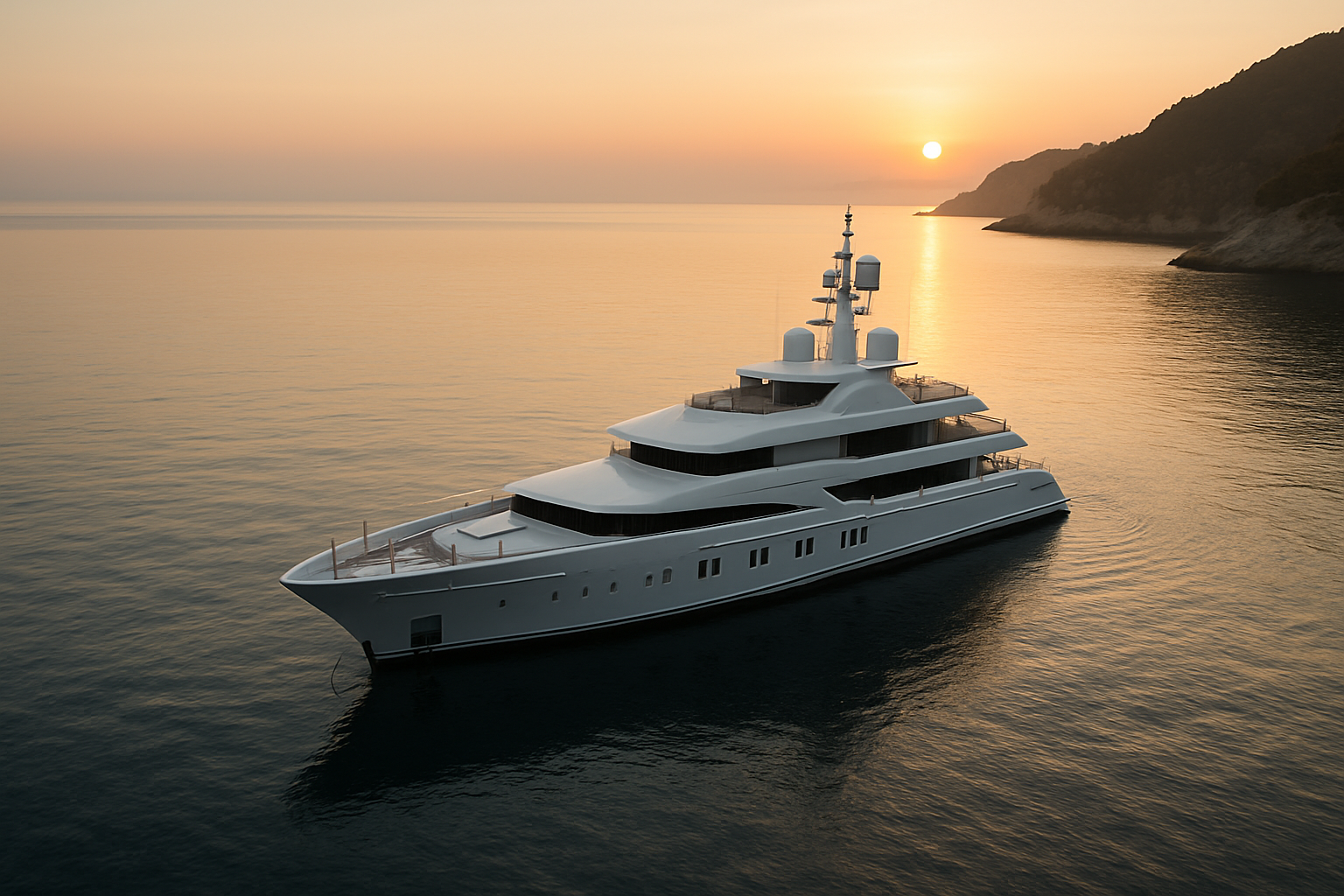
The cultural picture of a yacht is a deck shot — a long white hull at sunset, helipad on the bow, tender garage on the stern, anchored off Porto Cervo or St. Barts. The operational picture is a small marine business that costs roughly 10 to 15% of its purchase price every year just to keep running, requires a permanent crew of eight to fifty, and earns its owner essentially nothing in return. Both pictures are real. They describe different things.
The industry uses superyacht as the umbrella term for any motor or sailing yacht of roughly 24 meters (~78 feet) and above, with 30 meters (~100 feet) as the practical line that most trade reports use. Above ~100 meters, the market calls them gigayachts — a category that has expanded sharply over the past decade and now reaches above $1 billion at the top end (vessels in the rough class of Eclipse, Azzam, and Dilbar, per public reporting).
The fleet is bigger than most readers guess and more concentrated than they assume. Per Lumenautica’s 2026 industry report, the operating fleet comprised roughly 6,174 superyachts over 30m as of mid-2025. Of those, about 2,300 are commercially registered for charter — roughly a third of the global fleet earns at least some revenue rather than sitting idle. That distinction — private versus commercial registration — quietly shapes the entire downstream picture: charter eligibility, VAT treatment, crew rules, and which jurisdictions can seize the boat in a sanctions case.
A historical note worth carrying: the post-2020 yacht market is structurally different from the pre-pandemic one. Pandemic-era buyers entered the market in unusual numbers and largely stayed; the 2022 sanctions cycle pulled a meaningful slice of the older Russian-flagged fleet out of circulation; and the Asia-Pacific operating fleet has grown roughly 20% per year since 2022, going from 372 active yachts over 30m in 2022 to 530 in 2024. The center of gravity is still the Mediterranean and the Caribbean, but the next decade is more Singapore, Sanya, and Phuket than the last decade has been.
Who uses each tier
The four practical tiers map onto the wealth bands defined in Wealth Levels — and the modal user at each tier is rarely the one the cultural picture suggests.
24–35 meter large yachts ($3M–$15M). Households at $10M–$50M, the entry tier of the size class. Often owner-skippered or owner-plus-captain, with a small crew of two to five. In practice, a Mediterranean second residence with a hull rather than a roof — used for family summer trips, weekend coastal cruising, and the occasional long passage. Many owners at this tier graduated from a 12–18 meter motor yacht and trade up rather than starting fresh.
35–60 meter full-service superyachts ($15M–$80M). Households at $100M and above. This is the band that produces the cultural picture — fully crewed, professionally captained, summer in Sardinia, Mallorca, or the French Riviera, winter in St. Barts and the BVIs. The modal “real superyacht” most readers picture without realizing it is a 50-meter boat with a crew of about twelve — closer to a small floating hotel than to Eclipse or Dilbar.
60–100 meter large superyachts ($80M–$300M). Households at $500M and above, plus a handful of corporate-flagged exceptions. Helipads, multiple tenders, full beach club, often a permanent chef and chief stewardess on year-round salaries even when no one is aboard. The boat is a year-round operation; the owner uses it for four to ten weeks in a typical year.
100m+ gigayachts ($300M–$700M+). Billionaire territory only — roughly 100 to 120 vessels worldwide. The owners cluster among UHNW dynasties, energy families, technology founders, and Gulf state royals. Lürssen and Feadship dominate the build side; the 119-meter Feadship Breakthrough, Motor Yacht of the Year at the 2026 World Superyacht Awards, is the current technical benchmark for what a full-custom Dutch build at this scale looks like in practice.
The pattern that does not fit the cultural picture: the great majority of $1M–$100M households who use superyachts charter rather than own. Even a $100M household running a 50-meter boat at full operating cost is paying ~5–7% of total net worth every year just to keep the boat alive — a percentage no rational financial advisor would defend. Ownership is a cultural performance more than an economic one for almost everyone outside the gigayacht tier.
Why they use it
The five recurring themes that run through the canon — time, access, privacy, risk management, and complexity — show up here, but with a particular weighting that is unique to yachts.
Time on the water. A yacht is a moving residence rather than a destination. The product is the days at sea, not the place you arrive at. For households whose most scarce resource is uninterrupted family time, that is a genuine offering — a week of ten-to-fifteen waking hours per day with one’s own household, with no hotel staff turnover and no scheduled commitments.
Access. Anchorages and small island stops that no commercial vessel can reach. The Aeolian Islands at 6 a.m. The west coast of Corsica without the hotel infrastructure. The Exumas without a tender ride from a resort. Yachts unlock geography in roughly the way private aviation unlocks small airports.
Privacy. The most controlled social environment money can buy. No neighbors, no paparazzi within range, total guest control, and — at scale — a complete log of who is aboard at any given moment. The same theme covered in Privacy: Why the Wealthy Value Invisibility, pushed to its logical maximum.
Floating headquarters. A place to host clients, family, and decision-making without a hotel paper trail or a city’s restaurant calendar. For a meaningful share of UHNW owners, this is the actual reason — the boat is where deals get reviewed, partners get convened, and a board meets without flying everyone to a city.
The crew angle. At 50 meters and above, the crew is the product as much as the boat is. A great captain, chef, and chief stewardess compound years of guest preferences — what the family likes for breakfast at sea, which wines move at which port, how children at three different ages get fed and entertained simultaneously. Owners often follow their crew across boats more than they follow their boat.
The “floating jurisdiction” angle deserves a careful sentence. A yacht in international waters is, for many practical purposes, a small piece of its flag state — Cayman Islands, Marshall Islands, Malta, the British Virgin Islands. For owners managing time-in-country exposure for tax residency reasons, this is sometimes a primary motivator. Flag-state shopping does not exempt anyone from anything, but it does change the paperwork and the available tax structures meaningfully.
How it works
Three structures cover essentially the entire market, with one growing-but-still-small fourth.
Charter (by the week). The dominant access mode for everyone below the gigayacht tier. You select a vessel through a charter broker — Burgess, Fraser, Camper & Nicholsons, IYC, Edmiston — pay a base weekly rate, and add a 35% to 55% APA (Advance Provisioning Allowance) on top to cover fuel, food, drink, port fees, and crew gratuities. The boat is yours for the week. Mediterranean summer rates run 20–40% higher than Caribbean winter rates for the same yacht, and the build year of the boat matters more than its length — a brand-new 90-foot yacht from 2024 often charters for more than a 120-foot yacht built in 2010.
Fractional and shared ownership. A small but growing structure (Yotha, AvYachts, SeaNet) where multiple households share a managed yacht — same logic as NetJets fractional. Practical for the 35–50 meter segment, rare above. Trades guaranteed availability, lower commitment, and shared operating cost against the loss of full customization. The underlying math closes much faster for fractional than for charter or full ownership; the reason it is still small is cultural rather than economic.
Full ownership. You buy (or build) a hull, register it under a corporate or trust ownership vehicle, hire a captain and crew, and contract a yacht management company (Fraser Yachts, Ocean Independence, Burgess, Camper & Nicholsons) to run technical operations, payroll, accounting, classification compliance, and — if you want — charter management. New builds run 24 to 36 months for a 60-meter-plus vessel from order to delivery; for the marquee builders, the order book is currently three to four years out.
Build versus buy used. In 2025, only 6.8% of superyacht transactions were new builds — 93.2% were resale, per Denison Yacht Sales’ 2025 year-end report. New build is a multi-year process with full custom specification and build-slot scarcity; the resale market is where the great majority of actual ownership transitions happen. Used inventory is also where almost every first-time superyacht owner enters the market.
The five most reputational builders — Lürssen, Feadship, Oceanco, Benetti, and Heesen — dominate the high end. Lürssen and Feadship dominate the gigayacht segment in particular; Benetti and Azimut lead production volume below 60 meters. Builder reputation is the single biggest factor in resale value retention, and the gap between a Feadship and an unbranded competitor at the same length can be 30 to 50 percent at five-year resale.
Million Dollar Question — sidebar: Roughly what share of a superyacht’s purchase price does it cost to operate every year? About 10 to 15%, per Ocean Independence’s 2026 ownership guide. For a $50M yacht, that is $5–7.5M/year before refit cycles. The “10% rule” is the single most useful sticky number in this market.
What it costs
The honest tier-by-tier cost picture, with the 10% rule as the anchor.
Charter rates by size, per Your Boat Holiday’s 2026–2027 charter guide:
- 40–50 m yacht: ~€140K–€220K base/week, plus ~50% APA → roughly €220K–€330K all-in.
- 50–60 m yacht: ~€220K base/week → ~€330K all-in.
- 60–70 m yacht: ~€445K base/week → ~€670K all-in.
- 70–100 m yacht: ~€600K–€1.2M base/week → up to ~€1.8M all-in.
- 100m+ gigayachts: $500K to $3.5M+ base/week. The very top of the market — vessels like the 112-meter Flying Fox — start at €3.5M per week plus expenses.
Ownership — full tier-by-tier annual operating cost (the 10% rule applied):
- 35–50 m yacht. $15M–$50M to buy. ~$1.5M–$5M annually to operate. Crew of 8 to 12. Fuel, in active-use years, $150K–$400K.
- 50–70 m yacht. $50M–$150M to buy. ~$5M–$15M annually. Crew of 12 to 20. Fuel $400K–$1M.
- 70–100 m yacht. $150M–$300M to buy. ~$15M–$30M annually. Crew of 20 to 35. Fuel $1M–$3M.
- 100m+ gigayacht. $300M–$700M+ to buy. ~$30M–$60M+ annually. Crew of 30 to 60+. Fuel $3M–$10M+.
The component shares of operating cost, per Yacht Trading’s running-cost breakdown and Fraser Yachts’ analysis:
- Crew — 30 to 40% of operating cost. A 50-meter yacht with twelve crew runs roughly $1.5M per year in payroll alone. Captains earn $180K–$240K, chief engineers $130K–$180K, head chefs $90K–$140K, chief stewardesses $80K–$110K, with deckhands and stewardesses on $50K–$80K.
- Maintenance — 5 to 10% of vessel value per year, climbing to 15–20% in heavy-use or refit years.
- Insurance — 0.5 to 2% of vessel value, with annual premiums for a 40–50-meter yacht running $70K–$120K.
- Berthing — $8K to $60K per year at typical Mediterranean marinas; gigayachts often pay $200K-plus for marquee slots in Monaco, Antibes, or Palm Beach during peak season.
- Fuel — $5K to $25K per cruising day at full power, though most yachts spend the majority of any given year at anchor or in port.
The breakeven, restated cleanly. A $50M, 50-meter yacht costs roughly $5M per year to operate. The same boat charters for ~€330K all-in per week. The crossover sits around 12 to 15 weeks of personal use per year. The honest question every prospective owner should ask: am I really going to spend three months a year on this boat? If yes, ownership pencils. If no — and for the great majority of buyers the answer is no — chartering four to eight weeks at $300K–$500K per week is roughly a fifth of the all-in cost and avoids the depreciation and refit cycle entirely.
Charter offset. A successfully chartered yacht books about 12 weeks of charter per year, which typically covers 20% to 50% of operating cost. Charter income does not turn a yacht into an investment — almost no superyacht is profit-positive over its life — but it can soften the ownership burn meaningfully and is a reasonable strategy for owners who use their boat fewer than ten weeks themselves.
Hidden costs and tradeoffs
What the brochure does not lead with.
Depreciation. A new yacht typically loses 10 to 20% of its value in year one and 40 to 50% over the first five years, per YATCO’s depreciation analysis. Reputational builders (Lürssen, Feadship, Oceanco) hold value better; production-line builders depreciate fastest. The cleanest mental model is to treat the buy price as a deposit on a six-figure-per-month consumption stream, not as an asset on a balance sheet.
Refit cycles. Every five to ten years, a yacht goes into a multi-month yard refit — paint job, engine work, interior rework, technology and electronics updates. A major refit on a 60-meter-plus vessel runs $5M to $30M and takes the boat out of service for three to six months. The refit calendar is not optional; it is what keeps the boat insurable and seaworthy.
Crew turnover and management overhead. Yacht crew is a transient labor market — turnover at junior positions runs 30 to 50% per year. Replacing a chief stewardess or head chef who knew the family’s preferences for a decade is the kind of soft cost that does not appear on any P&L but matters more than several line items that do.
The carbon and reputational cost. Per Oxfam’s 2024 analysis of billionaire-owned superyachts, the average billionaire yacht emits roughly 5,672 tonnes of CO₂ per year — what an average person would take about 860 years to emit. The SEA Index, run with classification body RINA and the Yacht Club de Monaco, now benchmarks more than 800 vessels on real-world fuel consumption and live AIS tracking. The IMO’s carbon-pricing policy is expected to take effect in 2027, with explicit CO₂-cut targets through 2030. For visible owners, this is no longer a soft issue — it is a real and growing cost driver.
Sanctions and ownership opacity. Post-2022, Western jurisdictions have seized or frozen a meaningful number of yachts owned via opaque structures by sanctioned individuals. The result has been a structural shift toward cleaner ownership chains, away from anonymous shell vehicles, and toward jurisdictions willing to publish beneficial-ownership information. The compliance overhead is now permanent for new buyers and charter clients alike.
The “always working” feel. Owning a yacht means staffing it, scheduling it, refitting it, insuring it, and worrying about it whether or not anyone is aboard in a given week. Many ownership transitions out of the asset class start with the same sentence: I realized I was working harder for the boat than I was enjoying it.
A theme that ran through Wealth Levels carries here: the visible status hierarchy in the yacht industry runs in roughly the opposite direction from the financial logic. Many full owners would be financially better off chartering, and many charter clients would be better off chartering smaller and longer — but the cultural pressure runs upward, not toward sanity.
What people get wrong
Five corrections, in roughly the order they cause confusion.
-
“Yacht ownership” almost never makes financial sense over chartering for personal use. The cultural picture overweights the most visible end. Below 8 to 16 weeks of personal use per year, chartering is cheaper, easier, and lower-risk. Most $50M–$500M households who use yachts charter rather than own.
-
The buy price is the small part. A $50M yacht is also a $5M-per-year ongoing commitment indefinitely. Most prospective buyers underestimate the operating cost by half on the first conversation and by a third even after they have done the research.
-
A yacht is not an investment. Almost every superyacht is sold for less than it cost to buy. The rule of thumb is 40–50% depreciation over the first five years, with a smaller continuing decay after that. Charter income offsets but does not erase operating cost; ownership offsets nothing.
-
The cultural picture skews top-tier. The 100m+ gigayacht class is roughly 100 to 120 vessels in the world. The modal “real” superyacht is a 40–55 meter boat with a crew of ten to twelve — far closer to a small floating hotel than to Eclipse or Dilbar.
-
The market is overwhelmingly Western and shifting east slowly. Mediterranean and Caribbean cruising still defines the global rhythm, but the Asia-Pacific operating fleet has grown roughly 20% per year since 2022. The next decade is more Singapore, Sanya, and Phuket than the last decade has been.
Bottom line
Four size tiers, a clean 10% operating-cost rule, and a charter-versus-ownership crossover that almost no one’s actual calendar justifies.
Returning to the opening question: owning a superyacht beats chartering only above roughly 8 to 16 weeks of personal use per year. Most owners use their boat for four to six weeks. The math does not pencil for them; the cultural picture is mostly people who chartered for the week, were guests of someone who did, or own the boat for reasons that have nothing to d
