
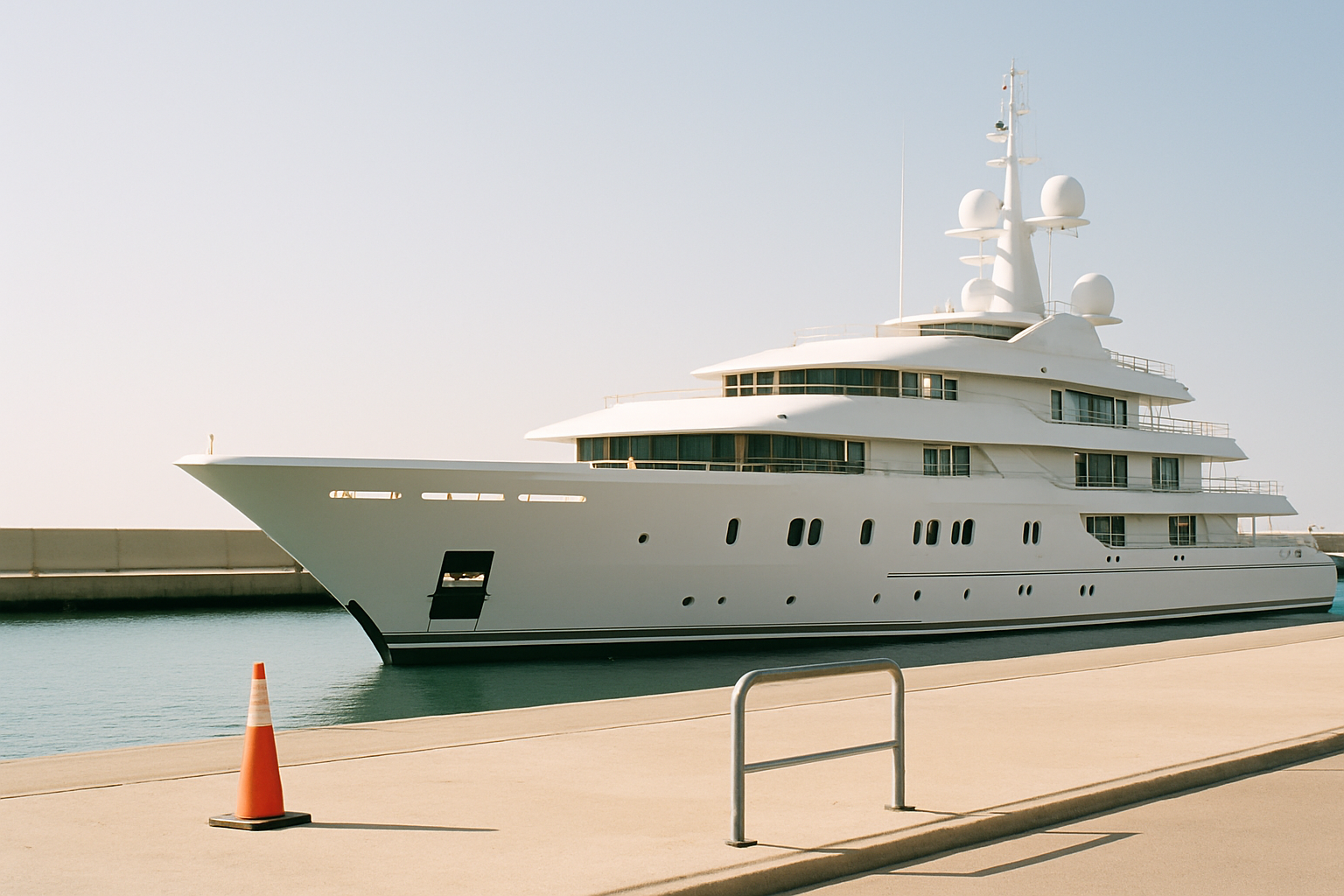
Seized: The Government Resale Market for Oligarch Toys
The Million Dollar Question: To bid on the seized superyacht Amadea at the US government’s 2025 auction, what minimum net worth did a bidder have to document?
A) $50 million B) $100 million C) $500 million D) There was no minimumRead on for the answer.
When a government seizes a superyacht, a jet, or a penthouse from a sanctioned billionaire, the asset does not vanish into a warehouse. It goes onto a balance sheet, accrues bills, and eventually gets sold — often at a steep discount, to a buyer nobody expected. This is how that market works, what the assets actually fetch, and why the seller is almost always in the weaker position.
What it is
Three words get used interchangeably in headlines and mean entirely different things.
Frozen is a sanctions action. The owner keeps title; the asset simply becomes unusable — no sale, no transfer, no servicing by any bank in the sanctioning jurisdiction. Most of the money attributed to sanctioned Russians in 2022 was frozen, not taken.
Seized means a government has physical custody, usually under a criminal or civil warrant. Title has not moved. The state is now a very expensive babysitter.
Forfeited is the endpoint: a court transfers title to the government, which may then sell the thing. In the United States, most high-value cases run as civil forfeiture actions against the property itself — which is why case names read like United States v. 127,271 Bitcoin.
The pipeline is administered by the Justice Department’s Asset Forfeiture Program, with the US Marshals Service acting as primary custodian for seized property — real estate, businesses, vehicles, jewelry, art, vessels, aircraft, and now large quantities of cryptocurrency. Proceeds flow into the Assets Forfeiture Fund, which pays the program’s own costs, compensates victims where a victim pool exists, and shares out to state and local partners.
At the ordinary end, disposal is unglamorous: public online auctions run through Bid4Assets and similar contractors, where anyone can bid on a repossessed pickup truck. At the top end — the nine-figure end — the process looks nothing like that.
It is worth saying plainly that yachts are unrepresentative of the category, and they dominate coverage for the same reason a car chase leads a news bulletin: they are photogenic and they move. The bulk of what governments actually hold is duller and easier — cash and financial instruments, residential and commercial real estate, aircraft, jewellery, art, and increasingly digital assets. A seized apartment sits still, costs a service charge, and can be listed like any other apartment. A seized 100-metre vessel needs a crew of dozens and a fuel budget. The asset classes people find most romantic are the ones that make the worst inventory.
Who uses it
Two populations meet here, and neither is the one people imagine.
On the sell side is a government that did not want the asset, cannot use it, and is bleeding money every month it holds on. On the buy side is a pool of bidders small enough to fit around one table.
The clearest recent example: in September 2025 the United States sold Amadea, a 348-foot Lürssen seized in 2022 on the Justice Department’s allegation that it was beneficially owned by sanctioned Russian billionaire Suleiman Kerimov. (Ownership was contested throughout — former Rosneft executive Eduard Khudainatov claimed the boat, and a US court ruled for the government in March 2025.) SuperyachtNews reported that registered bidders had to document a minimum net worth of $500 million, pass know-your-customer checks, and place a $10 million deposit in escrow before sealed bidding closed at 2 p.m. Eastern on 10 September 2025.
The winner, according to CNBC, was Abbas Sajwani, then 27 — son of Dubai property developer Hussain Sajwani and founder of his own firm, AHS Properties, started in 2021. Forbes has described him as the world’s youngest real-estate billionaire, with a fortune it puts near $1.9 billion.
Sajwani’s first documented change to the boat, widely reported afterwards, was to convert the helipad into a pickleball court — which is either a good joke about generational turnover in extreme wealth or simply the most rational use of a flat deck nobody was landing on.
That profile is typical of the category. Buyers of politically radioactive assets skew toward wealth centred outside the sanctioning coalition — the Gulf, Turkey, Southeast Asia — or toward strategic corporate buyers. Casino operator Genting Malaysia bought Equanimity, the yacht at the heart of the 1MDB scandal. American technology fortunes, by contrast, have mostly stayed away: Eric Schmidt placed the winning $67.6 million bid for the abandoned Alfa Nero in Antigua, then withdrew as the legal position tangled.
Why they use it
The honest answer is price, and only price.
Nothing about a government auction is pleasant. There is no sea trial worth the name, no seller warranty, no negotiated snag list, and a real chance that some third party surfaces later with a claim. What there is, reliably, is a discount — and at this size, the discount is measured in tens of millions.
There is a second, narrower reason: supply. Very few 100-metre-plus hulls exist, almost none are for sale in any given year, and a new one from a top German or Dutch yard implies a multi-year build queue. A forfeiture sale is one of the only ways to acquire that kind of tonnage immediately.
And there is a third reason that rarely gets said out loud, which is that the political discomfort is the discount. A buyer who is genuinely indifferent to owning an asset with a sanctioned Russian’s name in its file is being paid, in dollars, for that indifference. Households in the $1B+ band that care intensely about reputational surface — the ones described in our piece on privacy — self-select out, which is precisely why the clearing price falls.
How it works
A top-tier forfeiture sale is a court process wearing a broker’s clothes.
Custody first. Once seized, the asset needs a keeper. For a large yacht that means a full crew, insurance, fuel, dockage, waste removal, and periodic dry docking — the boat cannot simply be switched off. Amadea sat in San Diego for years, staffed and running.
Then litigation. Civil forfeiture is contested, slow, and layered with competing ownership claims routed through offshore holding structures. Three years from seizure to sale was not unusual; it was roughly par.
Then an interlocutory sale motion. Because custody costs compound, prosecutors frequently ask a court for permission to sell before the case fully resolves, with the proceeds held pending judgment. This is the mechanism that gets the asset off the government’s books, and SuperyachtTimes reported the motion in Amadea’s case leaned squarely on maintenance costs running into the millions each year.
Then the sale itself. For Amadea, Fraser Yachts acted as promotional agent and National Maritime Services of Fort Lauderdale ran a sealed-bid process. Sealed bids matter: a live auction with two motivated bidders can outperform, but a sealed process avoids the spectacle of a public bidding war over a sanctioned asset, and it lets the seller vet who is in the room before anyone bids. The net-worth floor and the escrow deposit are not theatre — they exist because a failed closing on a nine-figure boat restarts a process that costs the government about a million dollars a month.
Then the court signs off, title transfers, and proceeds land in the Assets Forfeiture Fund.
Below the headline lots, the same skeleton runs cheaply and publicly: online auction platforms, short listing windows, as-is terms. The difference at the top is the vetting, not the philosophy.
One structural feature deserves emphasis, because it explains most of the pricing. The government is not selling into a market; it is selling into a list. A sealed-bid process with a documented $500 million net-worth floor, in an asset class where perhaps a few dozen people worldwide are plausible buyers and a meaningful share of those are unwilling for political reasons, produces a bidder pool that might realistically number in the single digits. Auction theory is unkind about what happens to clearing prices when the number of serious bidders falls that low — and the seller, unlike a private owner, cannot credibly threaten to walk away and wait for a better year.
What it costs
Two sets of numbers matter — what the assets sell for, and what the seller spent getting there.
The sales.
- Amadea sold for $187 million in 2025, per CNBC — against the roughly $325 million valuation the government itself had used in public filings and press material. A discount near $138 million, or about 42%.
- Equanimity, the 1MDB yacht, sold to Genting for $126 million — against the roughly $250 million financier Jho Low was alleged to have paid. Malaysia had hoped for at least $130 million and missed its own deadline before accepting the best bid on the table.
- Alfa Nero eventually sold for $40 million after Schmidt’s higher bid collapsed — against a replacement value commonly put north of $120 million.
Three sales, three jurisdictions, one pattern: clearing prices in the range of roughly one-third to two-thirds of the asset’s notional value. That is the working band, not a precise rule, and it will move with condition, litigation risk, and how badly the seller needs out.
The carrying costs. This is where the discount comes from. For Amadea, CNBC reported a monthly bill of roughly $922,000: about $600,000 in running costs (roughly $360,000 crew, $75,000 fuel, $165,000 maintenance, waste removal and provisioning), about $144,000 in insurance, and about $178,000 a month in amortised dry-docking. CNN put the cumulative figure near $20 million as of early 2024; by the time of sale, reported estimates of total upkeep and transport had climbed to around $30 million.
Antigua’s experience with Alfa Nero was the same problem in miniature — a small state burning fuel daily just to keep a derelict yacht’s systems alive while the legal position resolved.
Set that against the whole programme’s revenue. The DOJ’s Assets Forfeiture Fund reported regular revenue of $2.263 billion in FY2024, up from $1.619 billion in FY2023 — across every category of forfeiture, nationwide. The oligarch-yacht file is a rounding error inside a rounding error.
Hidden costs and tradeoffs
For the buyer, the sticker price is the cheapest part.
A vessel that has sat under government custody for three years has been maintained, not operated. Crews turn over. Deferred work accumulates in exactly the systems that are expensive to reach. Refit and recommissioning bills on a boat this size routinely run into eight figures, and the buyer has no seller to bill them to — these sales are as-is, without recourse.
Then there is the financial plumbing. Banks are cautious about lending against an asset with a sanctions history in its file. Insurers price the same history. Flag registries and port states ask more questions. Charter income, which is how many large yachts defray costs, is harder to arrange when the hull’s provenance makes brokers nervous.
And there is the residual legal tail. In contested cases, a losing claimant can keep litigating. A buyer’s title is only as clean as the forfeiture judgment underneath it — which is why the vetting cuts both ways, and why the buyers who show up tend to be the ones with the legal budget to absorb a surprise.
There is also a running-cost reality that has nothing to do with provenance. A boat in this class costs its owner something on the order of 10% of build value a year to operate — crew, dockage, fuel, insurance, class surveys, and a five-year refit cycle. The government’s own $600,000-a-month running figure for Amadea, at a vessel largely sitting still, is a useful floor for what the new owner should expect once it actually moves. A $138 million discount looks less like a windfall and more like two decades of operating cost paid in advance.
For the seller, the tradeoff is starker: hold and bleed, or sell early and take less. Governments almost always end up choosing the second, which is exactly why the discount persists. And because every case is publicly docketed, the next set of buyers can watch the previous seller’s pain in real time — the discount is not a secret, it is a precedent.
What people get wrong
“Seized” does not mean the money went anywhere. Freezing an asset does not transfer it. Seizing it does not transfer it. Only a forfeiture judgment does, and that takes years. The gap between a dramatic seizure headline and any actual dollar reaching any actual beneficiary is measured in election cycles.
The government is not a shrewd seller. It is a distressed one — holding an asset it cannot use, paying to keep it alive, under political pressure to resolve the case. Every structural feature of the sale favours the buyer.
The programme is small, and it is reversible. Task Force KleptoCapture, the unit built specifically to chase sanctioned Russian wealth, was disbanded in February 2025 along with the department’s other anti-kleptocracy initiatives. By the accounting in a Senate oversight letter, the task force had secured forfeiture of or consent to forfeit roughly $170 million in private oligarch assets, with about $450 million more in litigation, as of spring 2024. Enforcement infrastructure at this level is a policy choice, not a permanent feature.
Yachts are the picture, not the money. The largest forfeiture action in Justice Department history is not a boat. It is approximately 127,271 bitcoin, worth roughly $15 billion, sought in a civil complaint tied to Chen Zhi and the Prince Group’s alleged Cambodian fraud operations. Digital assets have no crew, no dockage, and no dry-dock schedule — which makes them, from a custodian’s point of view, a far better thing to seize.
And the discount is not free money. It is the price of legal risk, mechanical risk, reputational risk, and financing friction, all bundled. Buyers who assume they simply outsmarted the government tend to discover the bill later.
Bottom line
The answer is C: $500 million. To bid on Amadea, a buyer had to document a nine-figure net worth an order of magnitude above the asset’s price, clear KYC, and post $10 million in escrow — a government auction with an entry bar higher than most private clubs, run precisely because the seller could not afford a bidder who failed to close.
That bar tells the story. Sanctions enforcement at the luxury tier has produced something nobody legislated: a thin, slow, discount-priced resale market in which the state is a reluctant seller with a meter running, and a handful of buyers with the right passports and the right appetite take the other side. Amadea went for $187 million against $325 million, after $30 million in upkeep, to a 27-year-old in Dubai. Whether that counts as enforcement working or enforcement being expensive is a genuinely open question — and it is the one worth asking the next time a seizure makes the news.
Related reading: Yachts: Ownership, Charter, and the Real Cost of Life at Sea · Offshore: Tax Havens, Shell Companies, and the Panama Papers · Outside the Rankings: The Wealth the Lists Never Count · Asian and Gulf Wealth: The Geography of New Money · Asset Protection: How the Wealthy Reduce Exposure to Risk